
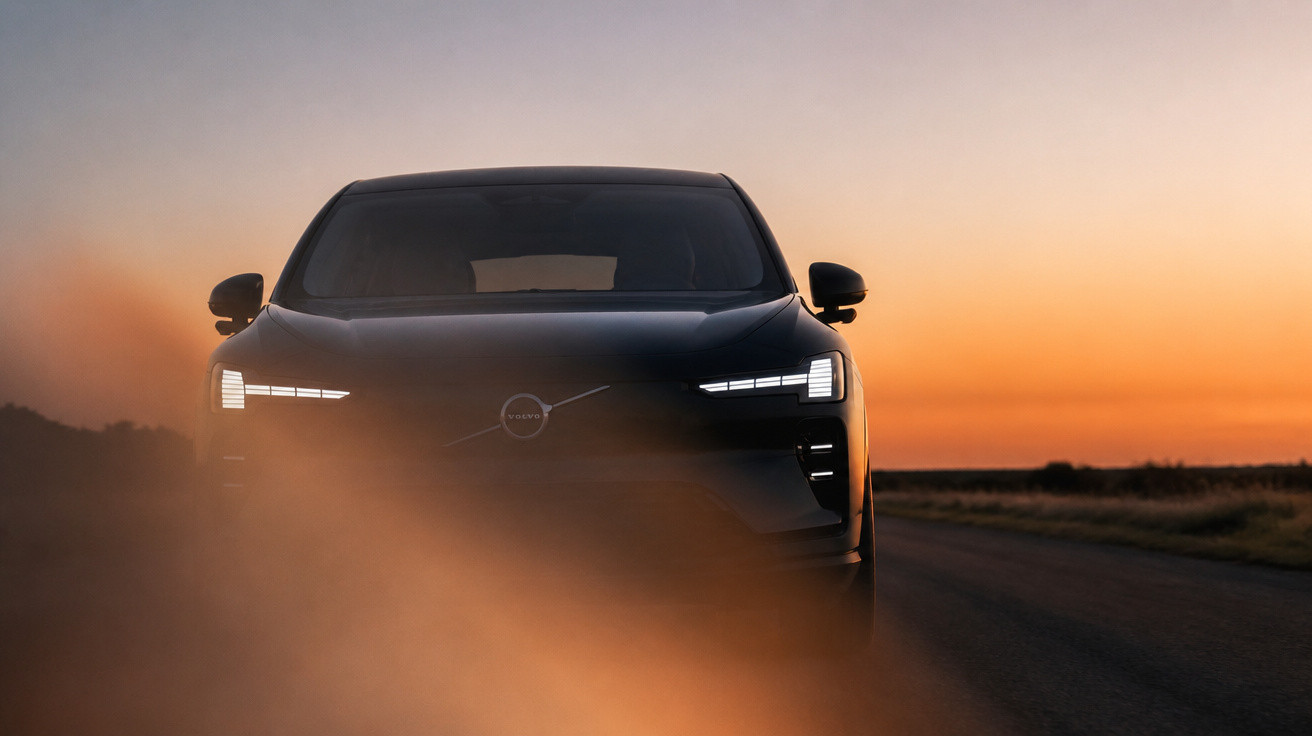
Volvo will unveil its new electric crossover, the EX60, to the world in late January. In terms of size, it sits between the EX40 and EX90 - hardly an unexpected positioning. What is already clear, though, is that its range and charging performance are set to eclipse those of both models, as well as those of almost every competitor.
TopGear.com has spoken to Akhil Krishnan, Volvo’s head of programme management for the vehicle. The company remains tight-lipped about the EX60’s styling, although the sole image released so far reveals a face that is clearly either a larger interpretation of the EX30’s design or a smaller take on the EX90’s.
Volvo EX60 range and rapid charging
The available figures are striking. Even in four-wheel-drive form, the EX60 is expected to offer 813 km of WLTP range. Its 800V electrical architecture can add 338 km of range during the first 10 minutes at a charging stop, as long as it arrives at a 400kW charger with the battery at its optimum roughly 10–20 per cent state of charge. Those figures put it in very similar territory to the new BMW iX3.
Krishnan says the EX60 being a dedicated EV, with no petrol equivalent, is fundamental. The combustion-engined XC60 has, however, recently received a facelift and will continue alongside it for several years.
While he stresses that software is crucial to achieving the claimed efficiency and range, Krishnan also points to substantial hardware advances. Volvo calls the new chassis, suspension and underbody architecture ‘SPA3’, placing it a generation beyond the EX90’s ‘SPA2’ platform.
New battery structure and EX60 body engineering
One major development is hidden from view: the “cell to body” battery design. Instead of placing cells in modules, fitting those modules into a battery pack and then attaching that pack to the vehicle structure, Volvo stacks the cells directly into the body. The conventional approach adds bulk and weight. With this arrangement, the exterior casing reinforces both the car’s body and the compartment containing the cells. It saves weight, and despite plenty of discussion around the technology, very few rivals have yet adopted it.
The body also incorporates “megacasting” around the inner wheel arches and the floor section spanning the car’s width. These huge, thin and complex aluminium castings take the place of dozens of small, welded pressed-steel parts, creating a structure that is both lighter and stiffer. Tesla and XPeng use the same principle in their electric crossovers.
Volvo’s engineers have additionally concentrated on reducing rolling resistance and aerodynamic drag. Krishnan insists that “the aero works in a smart way”, ensuring the EX60 retains the elevated, spacious and square-set proportions expected of a Volvo crossover. It is not a teardrop-shaped car. Minimising drag will be essential if it is to deliver, as claimed, a strong share of its WLTP range at motorway speeds.
Motors, software and battery longevity
Efficiency is also aided by the motors. Volvo has developed separate in-house designs for the front and rear units, allowing a motor that is not required for traction to avoid creating drag. This is broadly standard industry practice, so its effectiveness will need to be assessed on the road.
Volvo holds a stake in Breathe Battery Technologies, a British business that develops software to control the temperature and voltage of every cell, ensuring they all charge and discharge at the most effective rate. This is central to the overall charging speed, as well as durability: the battery carries a guarantee of 10 years and 241,000 km, retaining 70 per cent health.
According to Krishnan, Volvo has created a very large share of the vehicle’s software stack, along with its motors, battery and electronics. Yet, based on what is known so far, the underlying technologies are largely familiar. There are no in-wheel motors, solid-state batteries or cell anodes that do not use graphite. Instead, the focus is on highly optimised, proven technology that Volvo says will put the EX60 at the front of the class.

Comments
No comments yet. Be the first to comment!
Leave a Comment