
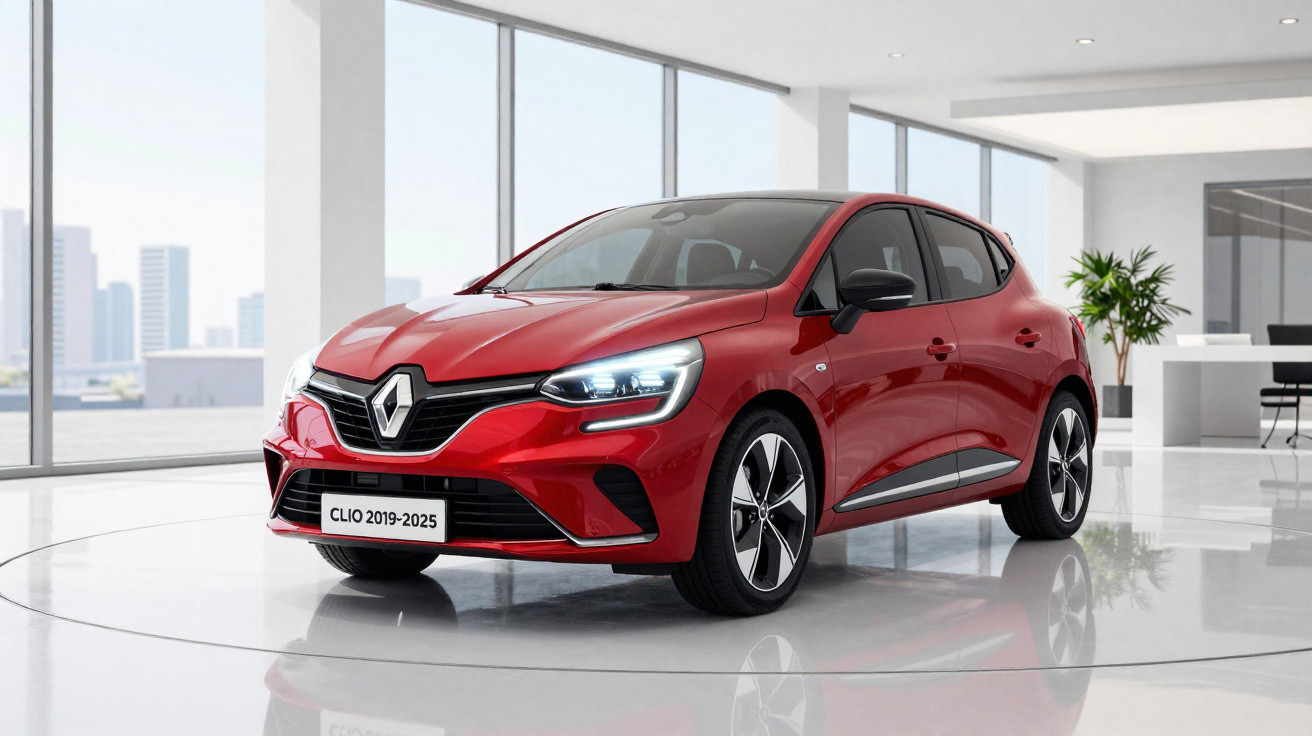
More than half a million Renault Clios have already been sold in Portugal, which also says a great deal about the French supermini’s strengths.
The Renault Clio is an institution in Portugal. Since 1991, it has accumulated more than half a million sales and has regularly featured among the country’s best-selling models. The story is much the same across Europe. Although the fifth generation is about to be replaced, its sales rose in 2025, making it the second best-selling model on the continent.
Its success is not simply down to price. The Renault Clio has plenty of qualities that carry over into the used market: it is comfortable, reasonably spacious, safe, with a five-star Euro NCAP rating, equipped with the essentials for modern life and, generally speaking, not punishingly expensive to own.
This buying guide focuses on the fifth generation. It arrived in 2019 and is nearly at the end of its run, with the sixth generation due in early 2026. This article and video cover the model’s development, the points to watch for and the engines that make the most sense, helping you choose from the roughly 1,400 examples advertised in Portugal on Pisca Pisca:
Evolution first, boldness later
When the fifth-generation Renault Clio was launched, its exterior design attracted plenty of criticism for looking too similar to the model it replaced. It appeared to be little more than an update. After the huge success of the fourth generation, Renault followed the principle that “you do not change a winning team”.
Its arch-rival, the Peugeot 208, received an all-new generation in the same year and looked more expressive and distinctive, inside as well as out. Yet there was no reason for concern: the Clio continued doing what it had always done, selling like hot cakes… or perhaps hot baguettes?
That said, it did not stand still. A 2023 facelift gave it a fresh, more expressive and bolder face. The bumpers, headlights, grille and light signature were revised, while it also adopted the diamond brand’s new logo. These changes aligned it with the design language introduced by Renault’s new design chief, Gilles Vidal - coincidentally, the same man responsible for designing the 208.
You can follow that evolution in the gallery below:
On the car we drove in the video above - the Clio 1.0 TCe - this bolder character is toned down somewhat because it is an entry-level Evolution trim model.
For the full visual effect, choose the sportier R.S. Line versions or, following the facelift, the Esprit Alpine models. They are more appealing, partly because of their larger wheels - 17 inches rather than 16 inches - although the extra style comes with a slight reduction in comfort.
A Renault Clio supermini with family-car ambitions
While the exterior may have looked like a cautious evolution, the cabin was a revolution. The Clio made a major push towards digitalisation, from its 7-inch or 10-inch instrument display to the 7-inch or 9.3-inch central infotainment touchscreen, with the larger unit mounted vertically.
Unfortunately, this generation never received the Google-based OpenR Link system found in current Renault models. Nevertheless, the Easy Link system fitted to this generation of Clio was suitably easy to use and already supported Apple CarPlay and Android Auto.
Physical controls were not neglected either. The climate controls stand out in particular, with three generously sized rotary dials incorporating small displays - a solution that remains as straightforward and functional today as it was when introduced.
As a supermini, it naturally uses materials that are far from the softest available, but the Clio feels solidly built. The car tested in the video had covered more than 30,000 kilometres and showed no unwanted rattles.
Another point in the Clio’s favour is its 360-litre boot, one of the largest in the segment and not far behind offerings from the class above. Rear-seat space is adequate - only taller passengers may find it a little tight - and, combined with Isofix mounting points, it allows the Clio to meet family duties without much difficulty.
Engines for every requirement
One of the fifth-generation Renault Clio’s greatest strengths is its broad choice of powertrains: petrol, diesel, LPG and hybrid. An electric version may seem to be missing, but that role was first fulfilled by the Zoe and is now taken by the nostalgic Renault 5.
Another appeal of the fifth-generation Renault Clio is that it seems to offer the right engine for virtually every need: petrol, diesel, LPG and hybrid. Only a fully electric variant is absent, a gap initially covered by the Zoe and now by the nostalgic 5.
The car shown in the video above used the entry-level engine available in Portugal: the 90 hp 1.0 TCe, paired with a six-speed manual gearbox. It may not sound like much - especially in an era of very powerful electric cars - but it is enough. The Clio’s moderate weight provides adequate everyday performance, including on the motorway.
This 1.0-litre three-cylinder engine is also considerably more pleasant to use than the earlier 0.9 TCe, while fuel consumption is very reasonable: Spritmonitor records an average of around 6.1 l/100 km.
If reducing fuel bills is the priority, the Clio offers the Eco-G version, in other words a bi-fuel petrol/LPG model. It uses the same 1.0 TCe engine but gains 10 hp, for a total of 100 hp. It is probably the range’s most sensible choice.
For high-mileage drivers, there is the familiar 1.5 dCi with 100 hp. Indeed, this generation of Clio will be remembered as the last to offer a diesel option. The Renault Clio E-Tech hybrid, which does not need plugging in, was an entirely new addition for this generation. It promises stronger performance, with 140 hp, alongside lower consumption, averaging 5.0 l/100 km in Spritmonitor records. It could be the ideal companion for drivers who rarely leave the city.
Behind the wheel
Finding a good driving position in the Clio is easy. On the move, it achieves the typical feat of the best French cars by combining a good level of comfort with assured handling. It is not the class benchmark in either respect, but it is not found wanting at all.
A Ford Fiesta is more entertaining, a Volkswagen Polo feels more refined and a Citroën C3 is more comfortable, but the Renault Clio delivers a strong balance across all of these attributes.
Renault Clio price trends
As mentioned in this Used Car of the Week feature, Piscapisca.pt lists around 1,400 Clios from every generation for sale. Limiting the search to the fifth generation leaves nearly 390 cars, priced from €11,000 to just over €25,000 - you can view all Renault Clio listings by following this link.
Figures from consultancy MotorCV, which compiles actual transaction values in the used-car market, show the price development and depreciation of the fifth-generation Renault Clio over the years:
Bear in mind that these figures are indicative only. Trim level, mileage and engine choice can significantly alter the specific value of each Clio.
Overall, among superminis, the French model remains competitively priced against its rivals and is one of the segment’s most well-rounded options.
Running costs
Despite being a relatively recent model, the fifth-generation Renault Clio generally has a good reputation in the market. This report supplied by MotorCV gives access to the main recall campaigns for this generation of Renault Clio:
To increase confidence when choosing a car, ask for its maintenance history whenever possible. On Piscapisca.pt, you will find hundreds of examples with a full history and warranty, as well as certified models.
Any recurring problems? None are known. The 1.0 TCe engine is generally reliable, although the maintenance schedule should be observed. The most common issue may be noise from the turbo wastegate, which is normally not serious and has a moderate repair cost.
Early Clios from this generation were also known to suffer a few electronic issues, including starting difficulties and juddering, but these have since been resolved through software updates. Nothing that compromises the model’s reliability.
The Clio E-Tech hybrid has the most complex powertrain and deserves greater attention if you decide to choose it. There are reports of gearbox issues, particularly oil leaks, as well as error messages appearing. A complete vehicle history is crucial to establish whether it has already received any work. The “trick” here is to choose more recent examples.
Replacement and wear-and-tear parts are competitively priced too, as shown in the table below:
Our Renault Clio choice
Many strengths apply across the Renault Clio range: from its variety of capable powertrains and equipment levels - even lower trims include everything needed in a modern car - to its versatility as a supermini that works well as a family car.
Which Clio should you choose? Preferably one from 2023 onwards, meaning the facelifted Clio. As well as cosmetic revisions, it gained more equipment, including safety and connectivity features, and the hybrid version was updated.
As for engines, we must admit that the Clio 1.0 TCe impressed us. It proved economical and well suited to its intended role. Better still is the LPG version, which can substantially reduce fuel costs.
Renault Clio alternatives
There is no shortage of alternatives to the Renault Clio, starting with the already mentioned Peugeot 208. Its French compatriot has a more sophisticated image, inside and out, but not everyone gets on with the i-Cockpit and the 1.2 PureTech engine remains an unknown quantity.
The Volkswagen Polo is the more conservative choice. Equipment levels are usually lower, but its build quality is among the best in the class. Staying within the Volkswagen Group, the SEAT Ibiza is more interesting to drive but less comfortable, making up for this with one of the segment’s roomiest cabins.
For those seeking more driving enjoyment, it is impossible not to mention the Ford Fiesta, the class’s dynamic benchmark. However, it falls short on space and its 1.0 EcoBoost engine is not always restrained in its fuel appetite.


Comments
No comments yet. Be the first to comment!
Leave a Comment