
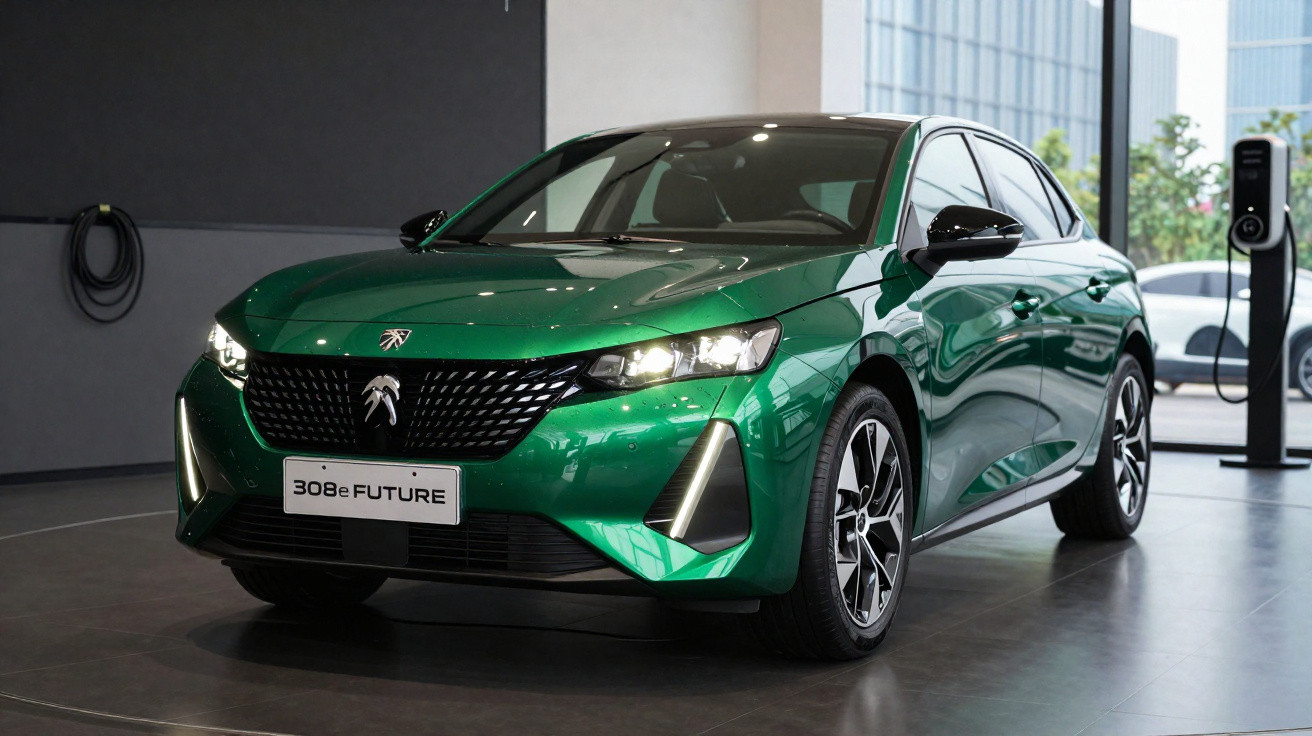
Sharp styling and an exemplary chassis, yet technical shortcomings that are hard to ignore. With unpredictable charging and a price tag exceeding €46,000, can the new electric Peugeot 308 hold its own against more affordable rivals?
60, 61, 62… and that is as far as it goes. 62 is the maximum power in kilowatts supplied by this Ionity charger at the Réserve service area. Connected at the other end of the cable is the new electric Peugeot 308. In theory, the Sochaux-built hatchback can accept 100 kW of direct-current charging. Unfortunately, that leaves us 40 kW short of the brand’s claim. The battery was clearly ready for rapid charging, having arrived at 32% charge.
The unkind mid-January weather might have been to blame: rain and 5°C temperatures. Perhaps the charger was simply having an awkward start to the year, too… But no. A gust of wind soon brings matters into focus. 100 kW is already inadequate, while the lack of battery preconditioning-unthinkable in 2026-undoubtedly makes the situation worse.
Between claims and reality: the Peugeot 308 electric’s 100 kW mystery
Peugeot officially states that charging from 20 to 80% takes 32 minutes. You will need patience, particularly as this figure genuinely covers 20 to 80%, rather than the 10 to 80% interval used by many manufacturers. There is little doubt that the wait would be longer in the latter scenario. Thankfully, you will not be stuck at around 60 kW throughout, because that would be genuinely embarrassing.
With the battery warmed up, another Ionity session instead reached… 109 kW, exceeding the 308’s theoretical maximum acceptance rate. Better an error in that direction than the other. Even so, it shows that the car’s behaviour at rapid chargers can be rather unpredictable, which is hardly reassuring. Moreover, power drops off fairly quickly, falling below 60 kW at 40% charge.
A bold facelift: the Lion reveals its new claws
Fortunately, Peugeot has not stumbled at the drawing board with this updated 308. The mid-cycle redesign is genuinely daring, thoroughly reshaping the front end. The fang-like lights are gone: the compact hatchback now arranges its face across two levels, with an upper section for garland-style daytime running lights and a lower zone containing the main headlamps. For the first time, the brand badge is backlit.
The colour palette gains fresh shades, including the particularly appealing Lagoa Blue worn by our test car. Every wheel design is also new, with diameters ranging from 16 to 18 inches. Changes at the rear are more restrained, with slanted LED lights now fitted across the range and a revised “308” badge. Job done.
250 km of motorway driving in the Peugeot 308: the battery’s real test
The mechanical package has changed as well, which is welcome, as the Sochaux model has never excelled in this area. Usable capacity in the lithium-ion battery rises from 51 to 55.4 kWh, improving the claimed range from 412 km previously to 450 km. It will certainly help in some circumstances, though regrettably not all of them.
While energy consumption remains reasonable-20 kWh/100 km at 130 km/h in cold weather-motorway stops will still be frequent, with a charging break required every 250 km, or even sooner if you stay within the 10–80% range. In short, the 308’s new battery makes longer trips less stressful, but it cannot eliminate charging stops. Nor should you trust the displayed range, as it is greatly overstated at higher speeds.
i-Cockpit: a premium cabin undermined by dated software
One consolation is that the Peugeot 308’s dashboard remains as distinctive as it is well made. Its contemporary design still hits the mark, and the materials remain pleasing, just as they were at launch. These welcome memories are paired with acceptable ergonomics, despite an excessive reliance on touch controls. Using the 10-inch screen remains unavoidable in this respect.
Making matters worse, it appears to have become less responsive. The PowerPoint-style transition animations between menus hesitate and lack smoothness, especially when the car is starting up. That is a pity, because the graphics still look current. The definition of the 360° cameras deserves particular praise.
The queen of the road: driving enjoyment remains intact
On the road, however, it is impossible to catch the 308 out. Its comfort/handling balance is once again excellent, delivering the right measure of suppleness and firmness. Body roll through bends is well contained, while the front axle grips the tarmac like a cat clutching its ball of wool. You even end up wishing there were more than 156 hp beneath your right foot to play with.
The small steering wheel also gives a pleasing sense of agility, although the steering itself is not the sharpest. Meanwhile, the dampers do their job well, even if their responses are a little harsh at low speeds. Sound insulation makes up for this, thanks to laminated front windows from GT trim upwards. The car is easy to manoeuvre in town, but there is no One Pedal mode.
Interior space: why you will avoid the rear seats
Rear accommodation in the 308 has not changed at all and remains below the class average. Elbow room is restricted, while legroom is genuinely tiny. The rear bench is not set high enough, limiting thigh support. Average-sized adults need not apply; basketball players should stay away altogether.
The unfortunate passenger assigned the middle seat must contend with a tunnel taking up foot space, as well as a fairly upright backrest. USB ports and decent headroom offer some consolation. The boot remains generous for the segment, however, swallowing up to 361 litres in this electric version (412 litres in the hybrid and 312 litres in the plug-in hybrid).
€46,350, or Tesla money: is the electric Peugeot 308 too expensive?
For €42,600, you could buy yourself some lovely presents… or an electric 308. But would it really be a good gift? Let us remove any suspense: the entry-level model already sets the bar far too high for what it offers. Every direct rival-the Volkswagen ID.3, Cupra Born, Renault Mégane and MG4-is cheaper and offers greater versatility.
Our GT test car takes matters further at €46,350. At this level, it is easy to find models from a class above, such as the Tesla Model 3 at €44,900, with… 750 km of range and a properly developed route planner. Yes, the French car does not even provide a route planner built into its sat-nav. In short, unless you adore the Lion brand and are a committed supporter of French-made products, choosing the electric 308 is difficult to justify. Choose the hybrid instead.
Our verdict on the new electric Peugeot 308
The electric Peugeot 308 needlessly complicates long journeys, and time lost at chargers inevitably raises the question: how relevant is this version, when it is the most expensive in the range? Its smooth electric drive might win you over, but there is not much else to tempt you.
Performance is nothing special, rear seating is cramped, and the interface suffers from the same sluggishness as the charging system. Looking on the bright side, its handling, comfort and build quality are genuine strengths… but they are equally present in the less expensive hybrid variants. You now know which version to favour before signing on the dotted line.
Peugeot e-308 GT
€46,350
Verdict
6.5/10
What we like
- The comfort/handling balance
- The solid build quality
- The restrained energy consumption
What we like less
- Rapid charging that is not up to scratch
- Infotainment that needs refining
- Limited rear-seat space
- Underwhelming performance
- The excessively high price


Comments
No comments yet. Be the first to comment!
Leave a Comment