
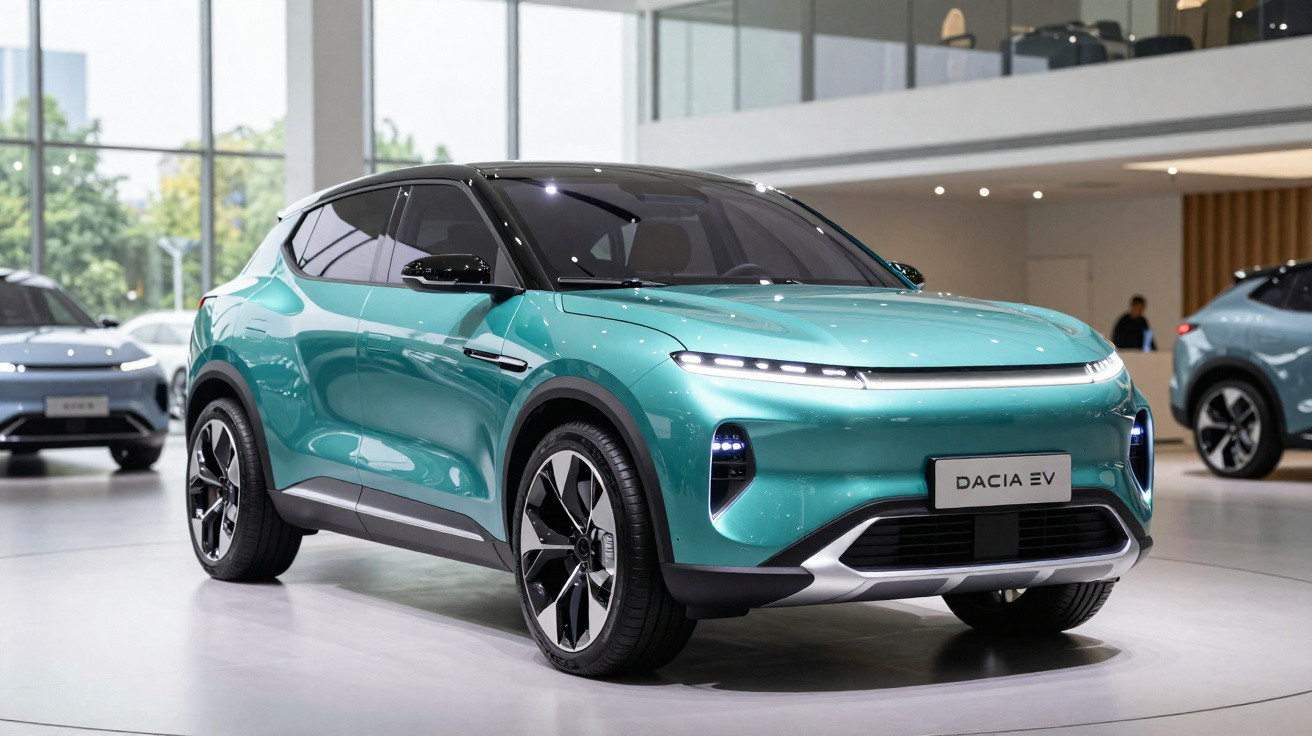
Dacia is stepping up. As part of Renault’s new “futuREady” plan, the brand has announced four fully electric models and set a new pricing benchmark. Its first new EV is due to arrive as a city car based on the next-generation Twingo, carrying a starting price below €18,000 and built in Europe. This puts Dacia squarely into the affordable electric mobility debate, an issue many manufacturers have so far addressed largely on paper.
Dacia accelerates its electric strategy to 2030
Until now, Dacia’s range has included just one electric car: the Spring supermini. The brand is now raising its ambitions substantially. By 2030, it intends to offer four all-electric models, with electric power expected to account for two thirds of sales by then. For a marque known for straightforward engineering and low prices, that represents a major change.
By 2030, Dacia aims to make around 66 per cent of its sales with electric powertrains – without giving up its reputation for low prices.
The board’s objective is clear: electric mobility should remain affordable rather than being reserved for high-earning city dwellers. Choices in the entry-level segment remain limited, while many models quickly rise well above €30,000. This is exactly where Dacia plans to compete, transferring its established formula of simple technology and pared-back equipment, in exchange for a low price, to the electric market.
New Dacia electric supermini below €18,000
The key announcement concerns the first new EV: a small urban car using the forthcoming Twingo generation as its basis, but positioned unmistakably as a Dacia. Officially, the only confirmed details are European production and a starting price of less than €18,000. In France, local manufacturing could even make support available, potentially bringing the price towards €15,000 there.
The manufacturer has not yet revealed much about the technical specification. Even so, several aspects appear likely:
- a compact battery to reduce both weight and cost
- a driving range intended more for towns, cities and nearby areas than long journeys
- probably modest equipment levels with few unnecessary extras
- straightforward infotainment, potentially centred heavily on a smartphone
That approach suits a range of everyday uses: commuters travelling 30 to 60 kilometres a day, families wanting a second car for urban trips, or trades businesses needing an affordable EV for short journeys. Anyone routinely covering more than 400 kilometres in one go will not find the right car here, but that has never been this model’s purpose.
Spring, Sandero and more: how Dacia is arranging its electric portfolio
Dacia already sells the small Spring, which is built in China and therefore does not qualify for national EV incentives in some countries. Despite that drawback, it has established itself as one of Europe’s least expensive electric cars, demonstrating that price is the priority for many buyers.
However, the new European-built EV is intended to take that proposition further: local production, stronger prospects for incentives and a platform with a more modern feel. An electric version of the popular Sandero range may also be in the pipeline. Industry sources expect robust LFP batteries (lithium iron phosphate), which offer good durability and lower costs, although they provide slightly lower energy density.
For the Duster, the brand’s best-selling SUV, no fully electric version has been announced for the time being. Hybrid or full-hybrid powertrains are likely to take priority here, keeping prices manageable while also helping to meet fleet CO₂ targets.
How the planned models fit into the range
| Model / plan | Status | Planned starting price | Production location | Key features |
|---|---|---|---|---|
| New electric supermini (Twingo-based) | Announced | Below €18,000 | Europe | Potentially eligible for incentives, focused on urban driving |
| Dacia Spring | Already on sale | Not newly stated | China | Still one of Europe’s most affordable EVs |
| Sandero electric variant | Planned, not officially confirmed | Still open | Still open | LFP battery very likely |
Price strategy remains central to the brand
Anyone anticipating an entirely new brand promise from Dacia is likely to be disappointed, and that is very much intentional. The company stresses that its fundamental direction is unchanged: as much everyday usability as possible for as little money as possible, without a lifestyle premium or costly experiments.
Dacia will continue to rely on simplicity, robust technology and low costs – just with a plug.
In practice, that means no high-end infotainment systems with 3D graphics, no excessive performance figures, no expensive air suspension and no elaborate driver-assistance packages that few people need. Instead, the focus will be on simple controls, familiar Renault technology and clearly defined trim levels. Many customers are willing to accept a somewhat plainer interior if the purchase price is several thousand euros below that of competing models.
What this means for German-speaking customers
For the German-speaking market, Dacia could become a key player in a segment that has been neglected for a long time: genuinely entry-level electric cars priced below €20,000. So far, some models only reach this territory with the help of incentives, or come with so little equipment that many buyers return to combustion-engined cars instead.
This could be particularly relevant for households on limited budgets. People who currently use a second-hand petrol or diesel supermini for city driving may eventually have a new-car alternative from Dacia. Car-sharing providers and fleet operators have also been watching the brand for some time, as low purchase prices can significantly improve the overall cost calculation.
Electric car terms explained briefly
LFP battery is a term that frequently appears in connection with the planned models. It describes a cell chemistry based on lithium, iron and phosphate. This technology is regarded as comparatively robust, less sensitive to high temperatures and dependent on readily available raw materials. Its disadvantage is that it needs slightly more space to provide the same range.
For affordable electric cars, however, the concept is a good fit. Ranges of 250 to 350 kilometres in urban and local-area use are sufficient for many drivers. The maximum distance is often less important than the price and whether the car can be used for many years without concern over an expensive battery replacement.
Risks and opportunities in Dacia’s strategy
Naturally, Dacia is also taking a risk with its electric offensive. Rising raw-material prices, stricter safety requirements or tougher charging standards could disrupt its cost calculations. The brand must therefore keep a particularly close eye on costs and will probably draw more often on proven Renault Group technology rather than pursuing independent developments.
On the other hand, Dacia could fill precisely the gap overlooked by many established manufacturers: straightforward, honest electric cars without lifestyle aspirations. If a starting price below €18,000 is genuinely achieved and the cars work well in everyday life, pressure on rivals is likely to rise significantly, increasing the choice for buyers unwilling to spend half a year’s salary on an electric city car.
Comments
No comments yet. Be the first to comment!
Leave a Comment