
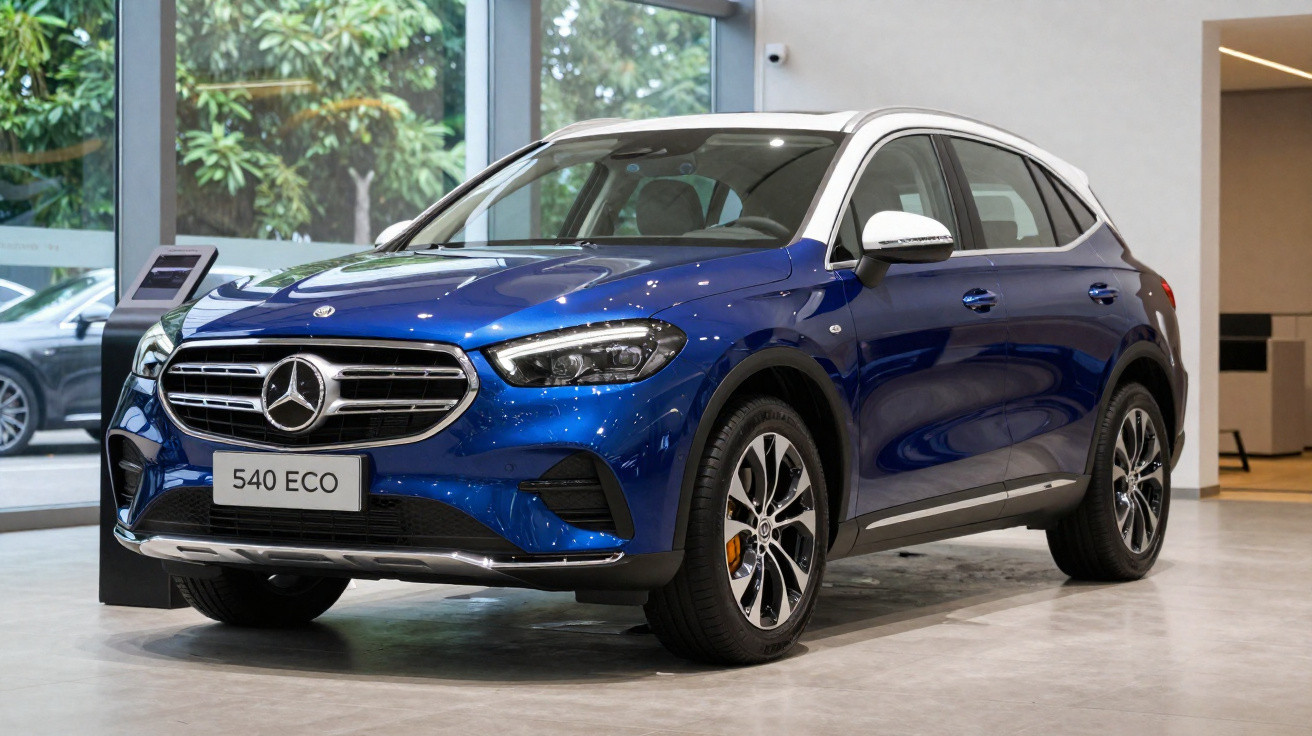
Ebro is the brand, S400 is its latest model, and its on-paper formula of punchy hybrid performance, an automatic gearbox and aggressive pricing could unsettle several established rivals.
A newcomer taking on the Yaris Cross and Captur
Ebro is virtually unknown among car buyers in France, the UK and the US, but it is preparing to enter one of Europe’s most competitive markets: compact hybrid crossovers. The Toyota Yaris Cross, Renault Captur E-Tech and Kia Niro dominate this territory, attracting customers with their practical nature, economical running costs and environmentally friendly credentials.
The Ebro approach is to offer precisely what many fed-up urban motorists want: ample power, a self-charging hybrid system, an automatic transmission and, in Spain when bought on finance, a price beginning with a “1”.
The Ebro S400 launches in Spain from €19,990 with finance, offering 211 hp and an automatic gearbox for less than many petrol superminis.
That attention-grabbing price will not be available in every country, and tax systems differ significantly across Europe. Even so, Ebro’s intention is unmistakable: it aims to undercut mainstream brands while equalling or surpassing their performance.
A powerful but practical hybrid system
Beneath the bonnet, the S400 has a self-charging hybrid powertrain centred on a naturally aspirated 1.5-litre petrol engine producing 95 hp. This works alongside a 204 hp electric motor, delivering a total of 211 hp to the front wheels via a CVT automatic gearbox.
For a compact SUV aimed at families and city motorists, this is a substantial power output. Ebro claims a 0–100 km/h time of approximately 8.8 seconds and a maximum speed of 150 km/h. Neither figure is likely to excite sports-car enthusiasts, but both should provide confident motorway overtaking and prompt acceleration from junctions.
Refinement and day-to-day costs are evidently the priority. Its claimed combined fuel consumption is 5.3 l/100 km, placing it directly alongside today’s hybrid competitors. The electric motor is expected to cover much of the low-speed urban driving, with the petrol engine doing more work on suburban roads and motorways.
For emissions, the S400 is eligible for France’s Crit’Air 1 sticker and Spain’s “ECO” classification. These designations are important for entering low-emission zones - ZFE areas in France and comparable schemes in numerous European cities - where older diesel vehicles and certain petrol cars face restrictions or bans.
With Crit’Air 1 classification, the S400 stays welcome in most current and planned low-emission zones in major European cities.
Pricing that could disrupt the segment
In Spain, Ebro prices the S400 from €19,990 with finance and at roughly €23,457 paid in cash, including taxes. Prices for France and other countries have yet to be confirmed, but the model remains far cheaper than familiar alternatives even once homologation expenses and local taxation are taken into account.
| Model | Power | Base price (approx.) | Label |
|---|---|---|---|
| Ebro S400 | 211 hp | €23,500 | Crit’Air 1 |
| Toyota Yaris Cross Hybrid | 116 hp | €27,900 | Crit’Air 1 |
| Renault Captur E-Tech 145 | 145 hp | €29,000 | Crit’Air 1 |
| Kia Niro Hybrid | 141 hp | €31,490 | Crit’Air 1 |
This gives the S400 an exceptionally strong price-to-power proposition. At about the cost of a small petrol hatchback, customers receive a 211 hp hybrid SUV with an automatic gearbox. For families seeking manageable monthly repayments while moving away from diesel, that proposition alone warrants closer consideration.
However, Ebro must demonstrate that it can support its vehicles over the long term. The scope of its warranty, availability of spare parts, and the scale of its sales and servicing network will all be decisive. First buyers of a new marque are often enthusiasts or deal-seekers, whereas mainstream families generally prefer to see how a manufacturer responds to reliability problems and recalls.
Modern equipment without a bargain-basement feel
Ebro presents the S400 as good value, while avoiding the “budget” positioning. In “Premium” specification, the SUV comes with equipment that many motorists now consider essential:
- 17-inch alloy wheels
- LED headlights and rear lights
- A digital instrument cluster ahead of the driver
- Dual-zone automatic climate control
- A range of driver-assistance features, including automatic emergency braking, lane-keeping assist, traffic-sign recognition and more
Inside, a digital driver display is paired with a centrally positioned touchscreen, following current design trends. Rear accommodation is said to be average for this class, normally indicating comfortable room for two adults with reasonable legroom, while a third passenger should be suitable for shorter trips.
The boot has a versatile arrangement thanks to its 60/40 split-folding rear seat, enabling owners to balance passengers and luggage. Ebro has not promoted a class-leading load capacity, but for families who mainly drive in towns and cities, straightforward loading and a level floor can matter more than headline litres.
Why the Ebro S400 matters to European buyers
The S400 arrives as electrified vehicles become noticeably more costly. Battery costs, tougher safety requirements and substantial technology investment are all raising list prices. Many households now feel unable to afford fully electric cars, or even hybrids from established manufacturers.
By providing hybrid technology at a price nearer to that of conventional petrol vehicles, Ebro is targeting a sizeable group of customers who want lower fuel costs and low-emission-zone access but cannot, or simply do not want to, move to a plug-in hybrid or a fully electric car.
The S400 targets buyers who want hybrid efficiency and urban access rights, without paying premium-brand money or installing a charger at home.
There is a political dimension too. The vehicle is manufactured in Europe at a point when EU bodies are examining low-cost Asian imports and weighing up additional tariffs. A competitively priced SUV built in Spain avoids some of the trade tensions surrounding Chinese and other non-EU models.
Availability and the question of importing
At present, the S400 is officially available only in Spain. Ebro has not yet established a formal dealer network in France, while its presence elsewhere in Europe remains at an early stage. Interested French customers therefore currently have two principal choices: wait for an official launch or pursue a personal import or broker arrangement.
How a French buyer could import one
Buying a car from another EU country is not uncommon, although it requires administrative work. A French resident purchasing an S400 in Spain would normally require:
- A European certificate of conformity (COC) from Ebro or its representative
- A visit to the regional DREAL office where the COC is incomplete or special approval is needed
- Evidence that VAT has been paid for a used car, or payment of VAT in France for a new vehicle
- A French registration document (carte grise), obtained after receiving a tax clearance certificate (quitus fiscal)
Import brokers specialising in Iberian vehicles are already looking at the S400 because of its compelling value proposition. Should demand become sufficiently strong, French customers may find the procedure close to turnkey, with brokers managing transport, paperwork and registration in return for a fee.
What a “self-charging hybrid” means in everyday driving
The marketing term “self-charging hybrid” can seem somewhat magical. In reality, the S400 works like other non-plug-in hybrid cars: its battery is relatively small and receives charge from the petrol engine as well as energy recuperated during braking and coasting.
As a result, there is no cable to plug in and no need to consider home sockets or public charging points. For brief urban journeys, the vehicle can pull away and travel short distances in electric mode, reducing both fuel consumption and noise. During longer motorway runs, the petrol engine handles more of the workload, while the electric motor assists under acceleration and on inclines.
Motorists who spend most of their time in urban congestion are likely to achieve the greatest fuel savings compared with a petrol-only car. Those who mainly commute on motorways will still gain from hybrid assistance, though the fuel benefit will be smaller; for them, the choice is more likely to centre on low-emission-zone access and the comfort of an automatic gearbox.
Who this SUV may suit - and who should hesitate
The S400 appears especially well suited to several buyer types:
- Urban families wanting a compact SUV with space for two adults, two children and weekend luggage
- Commuters who enter low-emission zones, travel long distances and cannot conveniently charge a plug-in hybrid or full EV
- Cost-conscious customers who appreciate power and equipment but are prepared to try an unfamiliar brand
Conversely, buyers focused on proven resale values, or those living a long way from a future Ebro servicing location, may have reservations. A warranty claim is more difficult when the closest qualified workshop is hours away or parts must be transported across national borders.
It is sensible to assess total cost of ownership rather than the list price alone. That involves balancing the S400’s low purchase cost against the potential uncertainties surrounding depreciation and maintenance. Local support and the risk of downtime should rank highly for company-car drivers and high-mileage motorists.
For other buyers, a 211 hp hybrid SUV made in Europe and priced below €20,000 with finance in its domestic market points to a wider shift: increasing pressure on major brands to reduce prices, plus new competition in a segment that had begun to appear comfortably predictable.
Comments
No comments yet. Be the first to comment!
Leave a Comment