
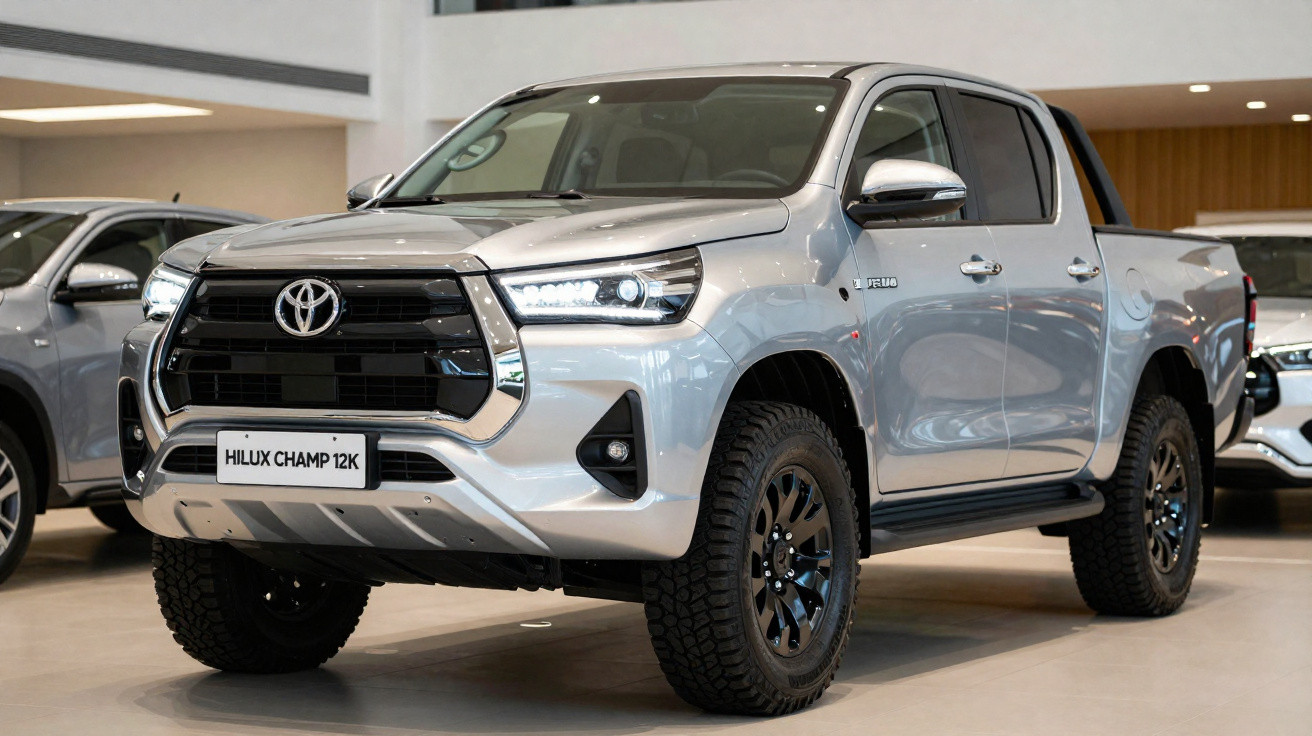
Picture this: a modern pick-up with the essentials required of a commercial vehicle, extensive scope for customisation, proven solutions and an affordable price. It sounds appealing, doesn’t it?
Japanese engineers thought so too. Working from a brief along those lines, they created the Toyota Hilux Champ, effectively a “low-cost” take on the well-known Toyota Hilux.
Before reaching for your chequebook, however, be aware that this pick-up will not be sold in Portugal - we will explain why shortly. Even so, the Hilux Champ is an engineering exercise worth examining.
Cost-cutting is the rule
The Toyota Hilux Champ was conceived with a calculator in one hand and an Excel spreadsheet in the other. That is no exaggeration: cost control has shaped the project from the outset.
Toyota management issued a straightforward instruction: create an inexpensive product that, at the same time - and this is where matters become more complicated… - meets every requirement expected of a vehicle in this category.
It is based on the IMV (Innovative International Multi-purpose Vehicle) platform, which is also used by the Toyota Hilux. As a result, it shares the same suspension set-up as that pick-up and, according to version, is offered with either rear-wheel drive or four-wheel drive.
Its bodywork takes inspiration from the lessons of the historic Toyota Land Cruiser 70 Series range, whose production also has Portuguese involvement. Accordingly, it relies heavily on straight lines, which are easy to form and, naturally, inexpensive to manufacture.
Savings extend further still. The front, rear and side windows, for instance, are completely flat, with no curvature whatsoever, lowering both manufacturing and replacement costs if they are damaged.
Inside, every component is made from hard plastic or rubber. Luxury features? There are very few, if any.
The load bed is not included either; as we will see later, it is not the only item that does not come as standard with this pick-up. On the one hand, this makes adaptation easier; on the other, it keeps the price below €12,000 - although the original objective was to remain under the psychological €10,000 threshold.
Toyota Hilux Champ combustion engines, naturally
The Toyota Hilux Champ will be available exclusively with combustion engines. For now, there are three powertrains: two petrol units and one diesel, all borrowed from other Toyota models that share its platform.
The decision to use these non-electrified four-cylinder engines is easy to understand: they are straightforward to maintain, cheap to produce and already proven in the marketplace.
Portugal and Europe are out of the equation
It is precisely this pick-up’s simplicity and frugality that ultimately undermine any prospect of it being sold in Europe. In other words, its strengths in Asian markets - especially South-East Asia - are regarded as weaknesses in Europe.
First, the combustion engines offered for this pick-up do not comply with European emissions standards.
Not long ago, those same regulations caused another departure from our market: the Mitsubishi L200 had to leave Europe because it failed to meet the required minimum standards. In Portugal, that announcement triggered a frantic rush for the final units still available in the country.
Then there is safety: this pick-up also falls short of European requirements in that respect. Both the anti-lock braking system (ABS) and airbags appear only on the options list.
These two limitations will not affect this pick-up’s commercial prospects in countries such as Thailand, Indonesia or India in the slightest.
Back in Europe, at a time when average car prices continue to rise, it is nevertheless refreshing to see a product launched with such a straightforward yet noble purpose: helping thousands of people get their businesses moving.
Comments
No comments yet. Be the first to comment!
Leave a Comment