
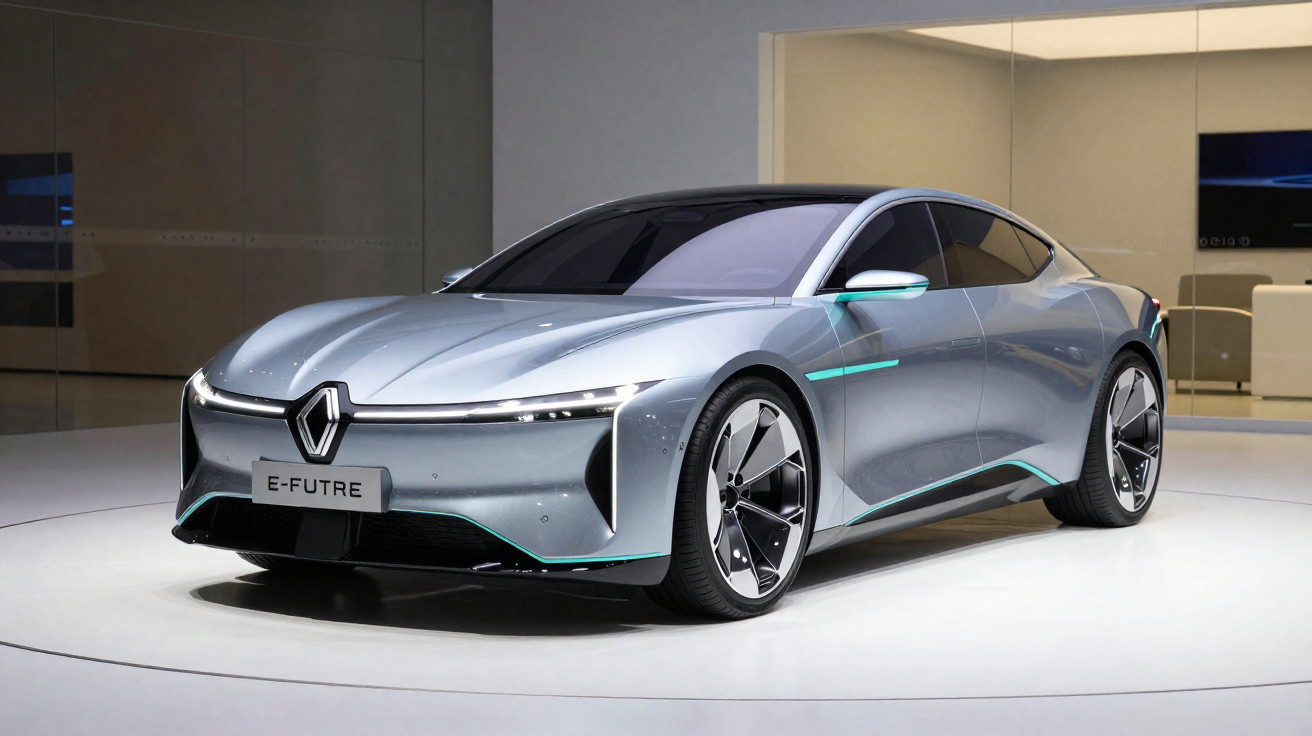
The long-established French manufacturer is easing back slightly on fully electric cars while stepping up its technology programme substantially. By 2030, Renault aims to offer an even split between EVs and hybrids, while batteries capable of charging in just ten minutes and delivering up to 1,400 kilometres of range are coming into view. At the same time, its plants are being transformed into highly automated Industry 4.0 factories, with humanoid robots working on production lines.
Renault revises its electric-car push
Renault had previously said that it would sell only fully electric vehicles in Europe by 2030. The group is now moving away from that target. Its new strategy for 2026 to 2030 instead calls for a 50:50 balance between EVs and hybrid vehicles across Europe.
The reasoning is straightforward: demand for fully electric cars is rising more slowly than anticipated, while many buyers remain hesitant because of prices, charging infrastructure and residual values. At the same time, European CO₂ and fleet regulations are being made somewhat less stringent than initially planned. Renault is responding without abandoning the shift towards electric mobility altogether.
“By 2030, all Renault models in Europe are to be electrified – either fully electric or hybrid.”
In markets outside Europe, the group is targeting electrified vehicles for half of all sales. Conventional combustion-engine cars will therefore gradually fade away, though not at the full pace that seemed certain a few years ago.
1,400 km range and ten-minute charging: Renault’s plans
To remain competitive in an increasingly demanding market, Renault is focusing on major advances in battery and drivetrain technology. The strategy identifies three principal targets:
- Batteries that can receive a significant charge in around 10 minutes
- Ranges of up to 1,400 kilometres through range extenders
- Fleet emissions of only 25 grams of CO₂ per kilometre
The short charging time directly addresses what remains the biggest day-to-day concern for many EV drivers: lengthy stops at charging points. It does not refer to a complete 0-to-100% charge, but to a practical “boost” that can restore several hundred kilometres of range during one stop. Achieving this will require new cell chemistries, high charging capacity and sophisticated thermal management.
For its 1,400-kilometre range target, Renault is not relying solely on ever-larger battery packs, but also on so-called range extenders. These may take several different forms:
- a compact, efficient combustion engine acting as a generator
- fuel-cell modules for commercial applications
- additional battery modules that can be used temporarily for long journeys
This type of solution could particularly reduce the usual range anxiety for fleet customers, tradespeople and frequent travellers, without requiring them to carry an oversized, costly battery at all times.
Software Defined Vehicle: the car becomes a mobile platform
Another key priority is the so-called “Software Defined Vehicle” – a vehicle in which software takes precedence over hardware. The architecture is intended to use central control units and a standardised operating system, enabling new functions to be introduced continuously.
Renault intends to launch an electric Trafic van this year that receives over-the-air updates in the same way as a smartphone. New features, security updates and efficiency improvements could then be sent wirelessly to the vehicle, removing the need for a workshop visit.
“The car becomes a digital platform that continues to evolve over years – much like a smartphone with regular updates.”
For drivers and fleet operators, this offers clear benefits:
- fewer workshop visits through remote maintenance and software patches
- predictive maintenance based on continuous data analysis
- additional functions activated when needed, potentially for a fee
- longer service life because software keeps the hardware up to date
It also shortens the development cycle for new models. Renault wants to move closer to the agility of Chinese manufacturers and reduce the time from the first concept idea to a production model to less than two years. That would be difficult to achieve without a unified software and electronics platform.
Industry 4.0: 350 humanoid “Calvin” robots for Renault plants
On the manufacturing side, the group is planning a far-reaching move towards automation. Over the next 18 months, 350 humanoid robots named “Calvin” are due to be deployed in its factories. They were developed by the French start-up Wandercraft.
The robots are not intended to replace every worker, but to assist with physically demanding or ergonomically difficult tasks. Lifting and carrying work, repetitive assembly stages and hazardous areas can therefore be organised differently.
“Renault aims to increase production in France by around 20 percent with humanoid robots while also reducing costs.”
The group has drawn inspiration from manufacturing approaches used by companies such as BMW and Hyundai, which already rely heavily on robot-assisted processes at some plants. Every minute saved on the line matters particularly for compact electric cars, where expensive batteries put pressure on margins.
What humanoid robots can really deliver in factories
Unlike conventional industrial robots, which are fixed in place and designed for a single task, humanoid systems can operate with greater flexibility. They can move through the same space as people, handle tools and take on different jobs, provided they have been programmed accordingly.
For Renault, this creates a dual benefit: productivity increases, while production lines can be adapted for new models more quickly because the robots can be “retrained” rather than requiring a complete mechanical rebuild.
36 new models in four years: a broad Renault offensive rather than a niche strategy
To bring its strategic shift to life, Renault is promising more than technological advances: it is also preparing a comprehensive model launch programme. Over the next four years, 36 new vehicles are scheduled to reach the market, including 16 fully electric models.
The range is likely to extend from compact city cars and SUVs to light commercial vehicles. For the group, the priority is to reach every customer segment with an electrified option without entirely moving away from hybrids. Buyers who are not yet ready to rely completely on battery power are meant to have a gradual route into electrification.
| Target by 2030 | Planned figure |
|---|---|
| Share of fully electric cars in Europe | 50% |
| Share of hybrids in Europe | 50% |
| New models by 2030 | 36 in total, including 16 EV models |
| Range target | up to 1,400 km with range extender |
| Rapid charging | around 10 minutes for a range boost |
| Robot deployment | 350 humanoid “Calvin” units |
| Production increase in France | around 20% |
What does this mean for drivers in German-speaking countries?
Although the strategy officially applies to the group as a whole, many of its effects will be felt directly in Germany, Austria and Switzerland. These markets are heavily regulated, affluent and technologically demanding, making them well suited to modern hybrids and software-defined vehicles.
For buyers, this is likely to mean:
- a wider choice of hybrid models as a bridge towards fully electric cars
- improved charging performance from future EVs at rapid-charging stations
- vehicles kept in service for longer through software updates
- new digital services, such as in-car subscription functions
Those still reluctant to buy an EV today may find shorter charging times and practical real-world range more convincing. The combination of hybrid power and intelligent software that optimises route planning and energy use can also reduce consumption significantly.
Assessment: opportunities, risks and unanswered questions
Ambitious as these targets are, they depend on several unresolved issues. Batteries able to charge rapidly while offering a long lifespan and acceptable costs remain technically challenging. Heat generation, cell ageing and raw-material prices could slow the plan. Software-defined vehicles also create a new dependency: without reliable IT infrastructure and security patches, the risk of failures and cyber-attacks increases.
Greater automation in the plants is also prompting mixed reactions. Employees face questions about which tasks will be handed over to humanoid robots and which skills will be needed in future. Lower costs and greater flexibility are attractive to the group, but for sites and workers this represents a structural change that must be actively managed.
For the market as a whole, the plan makes one thing very clear: the contest over range, charging time and software capability is entering a new phase. Those leading in digital vehicle architecture and efficient production will set the rules in the years ahead – not only on Europe’s roads, but worldwide.

Comments
No comments yet. Be the first to comment!
Leave a Comment