
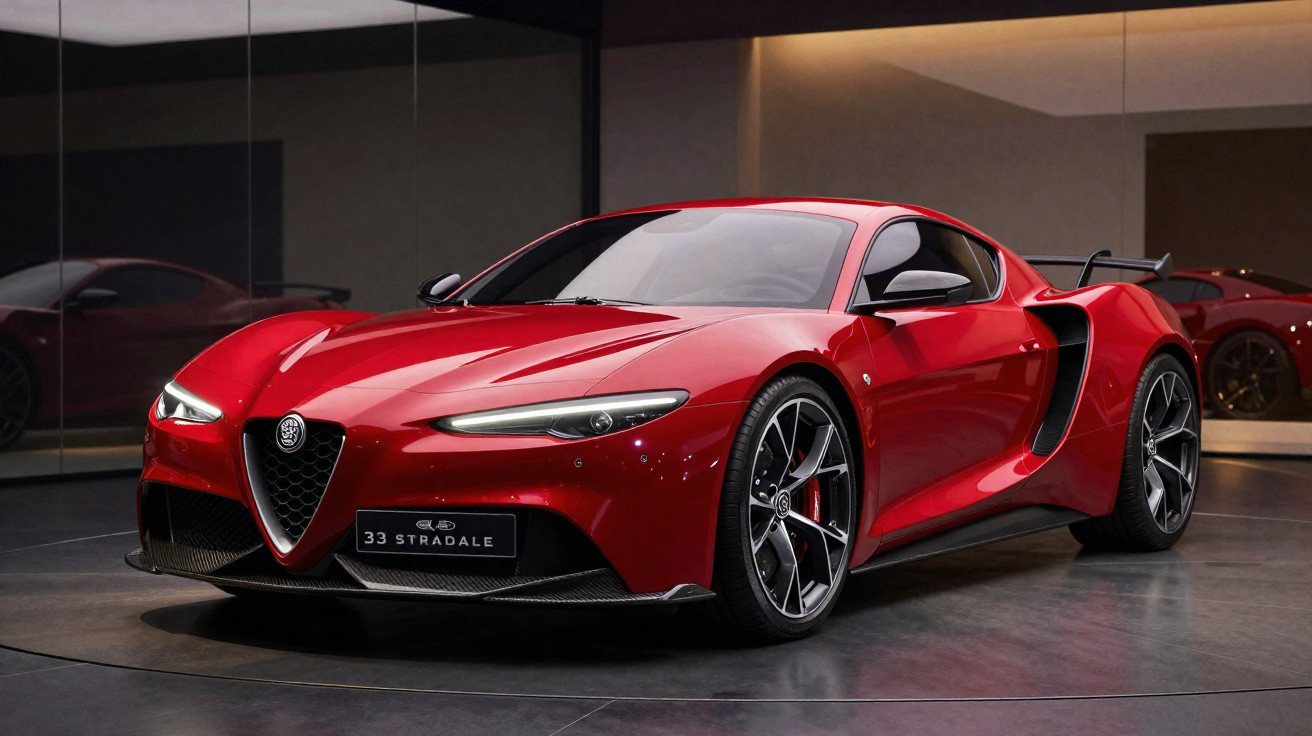
Some cars seem to have been created to last forever. The Alfa Romeo 33 Stradale is one of those exceptional cases - so exceptional that just 18 exist. Every one is different, but more on that later.
Designed by Franco Scaglione in 1967, the original 33 Stradale is, at first glance, a masterpiece of Italian design. It is a supercar with flawless proportions and an elegance that is both understated and absolute. Yet this car offers more than beauty: it has purpose. Anything created for a purpose has greater staying power.
Racing pedigree, elegant form
The 33 Stradale did not appear from nowhere. It is the direct descendant of the Tipo 33, Alfa Romeo’s racing prototype developed by Autodelta, the brand’s competition division led by Carlo Chiti. Its objective was straightforward: return Alfa Romeo to international winning form.
The Tipo 33’s first tubular chassis was tested at Balocco in 1966. Its two-litre V8 engine - compact, lightweight and featuring aggressive valve angles - was developed for high revs, reaching 11,000 rpm in its most extreme specification. It produced more than 120 hp per litre.
The Stradale version adopted that technical foundation while adding a luxurious finish. It was a racing car civilised for the road - or perhaps the opposite: a road car with a competition-bred soul. Crucially, its weight was kept low. It was 500 kg lighter than the contemporary Lamborghini Miura.
Its vertically opening doors, now known as “butterfly wings”, were the first fitted to a production car. They resulted from the need to provide cabin access in a car with such a low profile. Yet nothing about them feels crude or contrived. Every line has a purpose, with an almost choreographed quality.
It came to find me
I came across it in Arese, at the brand’s museum. Displayed on a circular plinth beneath carefully controlled lighting, it looked like a sculpture. Lorenzo Ardizio, the museum’s curator, showed me around.
He confirmed what I had sensed straight away: this car possesses an uncommon magnetism. It draws every visitor’s attention. Ardizio told me that some people come to the museum solely to see it, as though they were standing before a work by Leonardo or Michelangelo.
I almost felt that the 33 Stradale had come looking for me. That it had called me. I know that cannot have happened because… cars cannot speak and do not have souls!
Or do they? I like to think they might. But I know the credit belongs to the architects of the Alfa Romeo museum, who shaped this space - home to more than 125 years of the brand’s history - to make the 33 Stradale its centrepiece.
A closely guarded secret
Then something happened that I had not expected. Lorenzo invited me into the Sala Storica, an area closed to the public and granted state-secret status by the Italian government. For decades, this was the room in which Alfa Romeo’s most beautiful and significant cars were designed.
It is a place that breathes genius and silence: a temple to Italian creativity. The 33 Stradale’s presence on a central display easel did not seem accidental. Here, it stands as the ultimate symbol of a golden era for the Italian marque.
The room is defined by a vast meeting table and its chairs, though it too is a feat of engineering. Its ceiling was designed to provide identical light, day and night, ensuring that the models taking shape there would become exactly what was intended.
Its sound insulation is equally remarkable. No noise gets in and no secrets get out. These walls do not have ears, but if they could, they would have eyes.
18 examples, every one unique
There are only 18 original Alfa Romeo 33 Stradale body shells, and each differs from the next.
Every example was hand-built, and Alfa Romeo used the interval between each car’s construction to introduce minor improvements: chassis tuning, cooling-system changes, aerodynamic revisions and ergonomic adjustments.
In a sense, it was an evolving production process - a laboratory for engineering and aesthetics. The brand knows where every example is: some are in museums, while others are privately owned, preserved for eternity and passed from one generation to the next.
Nor do they all wear the familiar 33 Stradale shape. Some of these body shells were supplied to Italian design studios and coachbuilders - Pininfarina and Bertone, for instance - to take this supercar’s design even further.
That is why Arese is not only where the new 33 Stradale was born. It is also where the brand’s most distinguished past resides. The Alfa Romeo Museo Storico is one of the most impressive places for any car enthusiast, not simply because of its collection but also because of its atmosphere.
A new chapter in the 33 Stradale story
After the visit, I had the chance to drive the 33 Stradale’s successor. I travelled to the Balocco test track - the very place where the first Tipo 33 cars were developed almost 60 years ago - and the next chapter of that story was waiting for me.
Fortunately, it was all captured on video - and that is a good thing. Some moments deserve to be shared, especially when we know that, by their very nature, they can never be repeated.



Comments
No comments yet. Be the first to comment!
Leave a Comment