
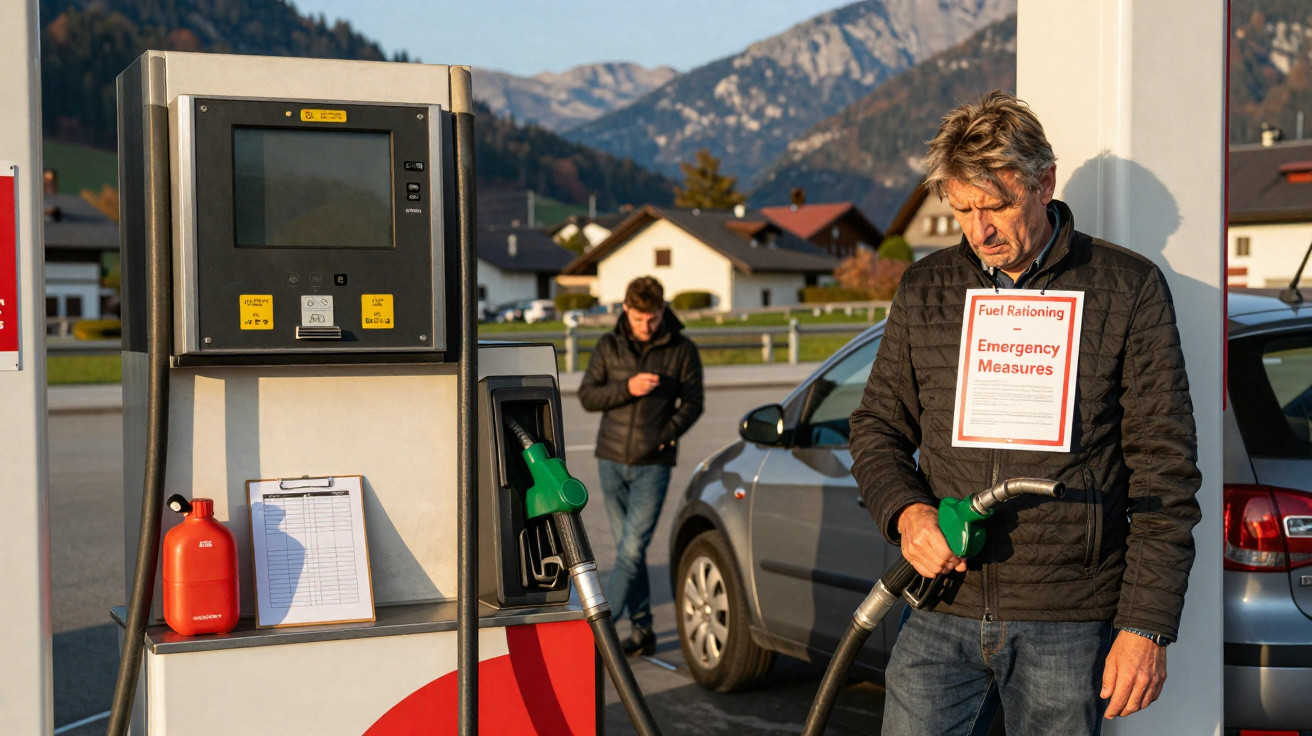
Rising petrol and diesel prices have created uncertainty and packed filling stations in several EU countries. Slovenia’s government is now trying to steady the situation through a nationwide rationing scheme, sending a warning signal across the continent.
Why Slovenia is limiting fuel sales
The current situation has been triggered by the war in Iran and the blockade of the Strait of Hormuz, a sea route of critical importance to the oil trade. Roughly a quarter of global oil trade passes through this narrow strait. As tensions there have intensified, crude oil prices have surged, taking fuel costs up with them.
Concerns about supply shortages are growing in many countries. In Slovenia, this has already prompted a rush on filling stations. To curb panic buying and safeguard the country’s reserves, the government in Ljubljana has introduced a rationing system.
Private individuals in Slovenia may now buy no more than 50 litres of fuel a day, while businesses and farmers are limited to 200 litres.
According to Slovenia’s Prime Minister, this is an “exceptional measure” intended to stop storage facilities from being depleted. At the same time, the government stresses that the country’s tanks are well stocked and that there is currently no genuine shortage. The aim is to make reserves last longer, discourage stockpiling and calm the situation.
First EU country with a nationwide rationing system
With this move, Slovenia is taking the lead. Since the Iran conflict began, no other EU country has imposed such a clearly defined system for restricting individual fuel consumption. For now, many governments are chiefly monitoring price trends and considering support measures, such as tax cuts or subsidies.
Slovenia, by contrast, is primarily relying on volume restrictions. Policymakers want to prevent certain groups, including large-scale buyers or cross-border commuters with large fuel tanks, from buying up supplies and creating an artificial shortage. Filling stations are responsible for implementation and must keep track of every sale.
- Maximum for private customers: 50 litres per day
- Maximum for businesses and agriculture: 200 litres per day
- Monitoring and implementation: directly by filling stations
- Recommendation for additional restrictions on foreign drivers
The rationing applies to all standard fuel types, especially petrol and diesel. Emergency services, police and rescue vehicles generally have special arrangements to ensure they remain operational at all times.
Price caps and “fuel tourism” add to the problem
Slovenia has one particular complication: fuel prices are regulated by the state. Despite turmoil on global markets, the government has capped a litre of Euro-Super 95 petrol at €1.47, while diesel costs €1.53 per litre.
By comparison, according to the latest figures, petrol prices in Austria are approaching €1.80 per litre, while diesel is nearing €2. For many motorists from neighbouring countries, it is therefore worth making a detour to fill up in Slovenia, creating a classic form of “fuel tourism”.
A large number of vehicles cross the border from Austria simply to fill their tanks much more cheaply. For Slovenia, this means significantly higher sales at filling stations, but also a faster drawdown of national reserves. This deepens government concerns that a continued influx of foreign customers could eventually result in a real shortage.
How Slovenia is responding to the influx from abroad
The state has deliberately designed the rationing rules to leave filling stations with some flexibility. They are expected to decide independently how strictly to restrict foreign drivers in particular. Many stations are already checking number plates and tank sizes, setting lower limits for cross-border commuters in order to give priority to local residents.
The government is urging fuel suppliers to apply additional limits to foreign vehicles in order to slow the sell-out.
The policy has sparked heated debate in border areas. Some Slovenians are frustrated by crowded filling stations and see foreign customers as an added burden. Others point to the extra revenue generated for hospitality businesses and retailers. Many “fuel tourists” combine cheaper fuel with a visit to a café or a meal in a restaurant.
Dispute over fairness at the pumps
Residents, filling-station operators and commuters have all voiced their views in local media. Sentiment ranges from scepticism to pragmatism. Although the rush brings higher turnover for operators, it also increases the administrative burden: they have to impose volume limits, explain the rules to drivers and prepare for heated arguments when customers can no longer buy as much fuel as they normally would.
On the other hand, many Slovenians want to avoid being left without fuel. When pumps temporarily close because they are overwhelmed, the impact falls especially on people who depend on their cars for work, such as tradespeople or care services. The rationing is intended to prevent precisely these situations, yet it is also creating uncertainty itself.
| Group | Perspective |
|---|---|
| Residents in border regions | Concerned about availability and frustrated by long queues |
| Fuel tourists | Welcome low prices and are willing to take detours |
| Filling-station operators | Higher turnover, but extensive explanations and organisational pressure |
| Government | Wants to protect reserves and prevent panic without stifling the economy |
What the move means for other EU countries
Slovenia’s initiative raises a broader question: how resilient is the EU’s energy supply when key oil routes in the Middle East are at risk? Many countries hold strategic reserves intended to last several months. However, those stocks offer little protection if panic buying begins at the same time or sharp price increases unsettle the public.
Other countries are watching developments closely. Possible measures could include national limits on fuel purchases, time-based restrictions or targeted support for certain occupational groups. Many governments are still reluctant, as intervention in the market is politically sensitive: it recalls times of crisis and can provoke protests.
What drivers should bear in mind now
Anyone driving through Slovenia or planning to stop for fuel should keep the new rules in mind. It is currently difficult to fill larger reserve tanks or jerry cans sensibly, as the daily limits set clear boundaries.
- Plan ahead rather than waiting until the tank is almost empty before visiting a filling station
- Expect waiting times near the border
- Consider partly filling up in your home country so you are not completely dependent on Slovenian stations
- Read and follow notices at filling stations carefully
For many people, this brings home once again how dependent daily life is on stable energy prices. Commuters, delivery services and farmers all operate within tight cost calculations. Increases of just a few cents per litre can have a noticeable effect on budgets over a number of weeks.
Background: How rationing works in practice
In practical terms, rationing means the state limits the unrestricted purchase of a good. Rather than regulating solely through price, the government establishes a fixed maximum quantity for each person or business. This is intended to prevent wealthier people from stockpiling more while lower-income groups are left with nothing.
Historically, countries have mainly used such methods for fuel during wartime or severe oil crises. Daily or weekly limits at filling stations are typical, sometimes combined with vouchers or digital registration systems. Slovenia is now using a comparatively simple approach: fixed daily litre limits, checked directly on site.
Whether other EU countries follow suit will depend heavily on how the Iran conflict develops, the situation in the Strait of Hormuz and the reaction of global markets. For now, Slovenia demonstrates above all how quickly a foreign-policy conflict can bring distant filling stations into focus.

Comments
No comments yet. Be the first to comment!
Leave a Comment