
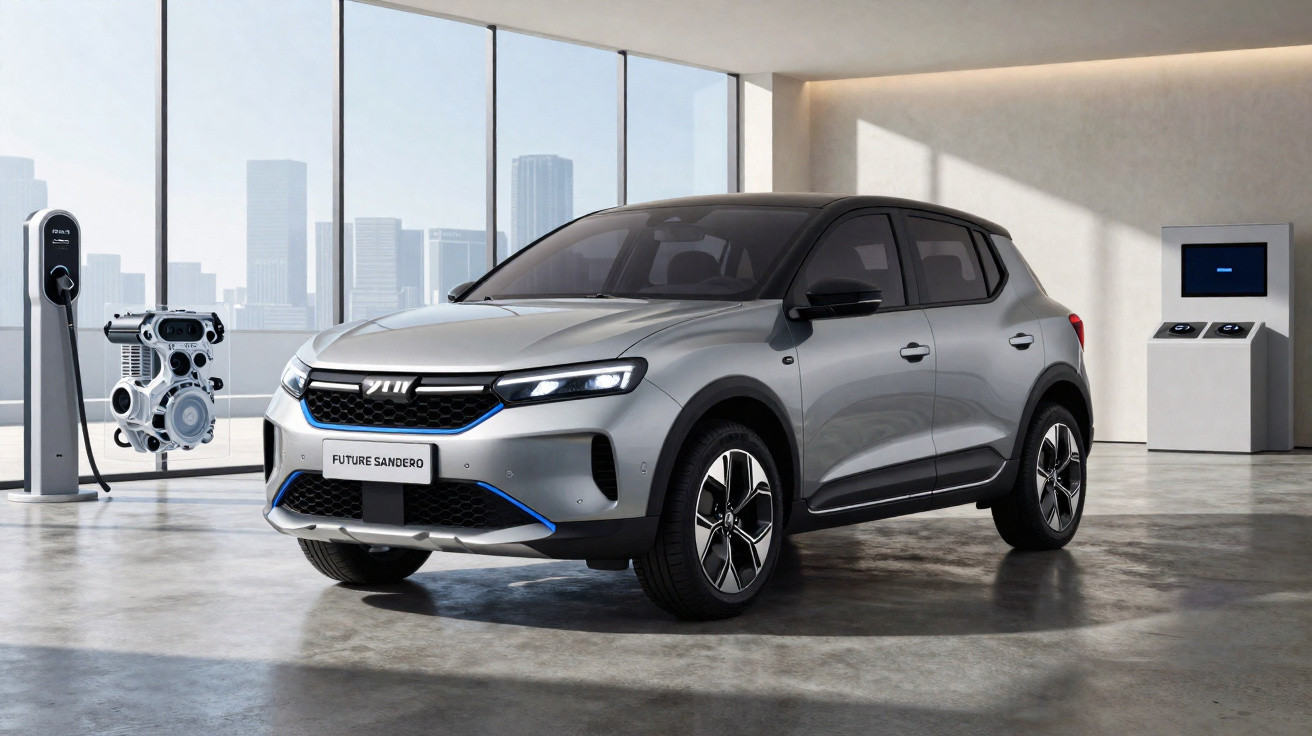
As the Renault Group rolls out its new future strategy, many buyers are asking the same question: does the Dacia Sandero still have a long-term role in a world of hybrids, electric cars and ever-tighter CO₂ rules? The first official signals offer an answer, while the detail between the lines indicates how the successful small high-roof hatchback is likely to evolve over the coming years.
Dacia’s strategic shift: more electric power, but not exclusively
Dacia built its reputation on straightforward engineering, durable engines and uncompromising prices. The brand now intends to combine that formula with modern powertrain technology. The group has said it will progressively increase its range of battery-electric models. By 2030, three further electric cars are due to join the Spring, which is already available as an electric model.
Dacia is not, however, abandoning conventional engines altogether. The marque stresses that affordable combustion-engined cars will remain part of the range, particularly petrol and LPG versions marketed as Eco-G. Full-hybrid and mild-hybrid solutions will also be introduced to meet CO₂ targets without pushing entry prices into the territory of conventional family hatchbacks.
“Dacia wants to strike a balance: greater electrification without giving up its position as the market’s value leader.”
There are already clear examples of this approach. The Jogger, Duster and Bigster are, or will be, offered with several powertrain options. The Striker is another addition: a crossover around 4.62 metres long, planned with both combustion and electrified drivetrains, positioned somewhere between a traditional family hatchback and an SUV.
What will happen to Dacia’s smaller models?
As Dacia reshapes its model range, the lower-priced end of the market is receiving particular attention. It is clear that the current Spring electric city-car solution will not remain in the line-up indefinitely. In the longer term, Dacia is planning a new generation of fully electric city cars in the affordable segment.
That naturally raises the question of where the Sandero fits in. Until now, it has been positioned as an affordable everyday car below the conventional family-car class. Could it eventually be replaced by a dedicated electric equivalent, or will the Sandero itself move further towards electric and hybrid power?
Dacia Sandero will remain - with no end date for now
This is the key message for many prospective buyers: there are currently no plans to discontinue the Sandero. The model will stay in the range and will continue to hold strategic importance.
“The Sandero is Dacia’s best-seller in Europe - replacing it would scarcely make economic sense.”
More than 6,500 examples were newly registered in France during the first two months of the year alone. That put the car ahead of established names such as the Renault Clio and the new R5 E-Tech. For the group, the Sandero is therefore a kind of backbone in the volume market, providing stable sales figures.
The current generation has also only recently received a visual refresh. A redesigned front end, subtle detail revisions and updated equipment have made the car look more up to date again. As a result, there is no immediate need for a complete generation change.
Next-generation Dacia Sandero: multi-energy and electrified
Dacia officially describes a “new chapter” for the Sandero. This points to more than a simple facelift. At the next stage of its development, the small car is set to rely firmly on a broad powertrain range.
According to the group’s communications, a multi-energy strategy is planned. Based on what is known today, this means:
- Petrol engines for conventional buyers with limited charging infrastructure
- Eco-G versions (petrol/LPG) for high-mileage drivers focused on low running costs
- Hybrid solutions to increase the share of electrified sales
Dacia aims for around two thirds of all sales to use electrified powertrains by 2030. Reaching that target would be difficult without an electrified Sandero version. A hybrid Sandero therefore appears highly likely: it would recover braking energy and cover short distances electrically, while retaining a combustion engine as its core power source.
Why a fully electric Sandero may have to wait
A battery-electric car in the Sandero’s format may sound logical to many people, but cost pressure is a limiting factor. Batteries add considerably to a vehicle’s price, and buyers in the Sandero segment are exceptionally sensitive to price increases.
For that reason, Dacia is likely to turn first to hybrid technology, cutting fuel use noticeably without lifting prices to the level of more expensive electric family cars. A fully electric Sandero could become viable only once battery costs decline further and charging provision in rural areas becomes denser.
What role will the new Striker play for the Sandero?
With the Striker, Dacia is placing a model between a traditional family hatchback and an SUV. It is substantially larger than the Sandero, but is still expected to cost less than many rivals in the crossover segment.
| Model | Segment | Planned powertrains |
|---|---|---|
| Sandero | small family car / versatile city car | Petrol, Eco-G, Hybrid (in future) |
| Striker | Crossover, above the Sandero | Multiple energy sources, including electrified options |
| Spring successor | small city car | fully electric |
The Striker is therefore unlikely to take customers away from the Sandero; instead, it expands the range upwards. Buyers wanting more space, a higher seating position and potentially more powerful engines will move to the crossover. Those mainly looking for an inexpensive, uncomplicated car will remain with the Sandero.
What does this mean for buyers in German-speaking countries?
For buyers in Germany, Austria and Switzerland, the picture is becoming clearer. Anyone purchasing a Sandero with a conventional petrol or LPG engine today is not buying a model at the very end of its life cycle. The model line remains a focus for the brand, while minor updates will keep it current.
Those who prioritise the lowest possible emissions and reduced fuel use should follow further developments closely. Once a hybrid version is announced, it could be particularly worthwhile for commuters whose journeys include a large proportion of urban driving. Depending on the driving profile, regenerative braking and electric pull-away can readily save one to two litres of fuel per 100 kilometres, or even more.
Practical considerations: is it worth waiting for the hybrid?
The answer depends largely on individual circumstances:
- Frequent short urban journeys: A hybrid can make sense by reducing both fuel use and wear.
- Long motorway journeys: Eco-G (LPG) or an efficient petrol engine will often remain cheaper overall.
- Uncertain charging infrastructure: A hybrid removes the pressure of always needing to find an available charging point.
Anyone who needs a car urgently gives up little by choosing the recently updated Sandero now. Buyers who are flexible and can wait two to three years may then be able to choose from a wider range of powertrains, including a hybrid option.
Why the Sandero remains important despite electrification
The Sandero meets a simple but essential demand: an affordable car that handles daily life without excessive electronic gimmicks. That customer base cannot simply be moved into more expensive electric or plug-in models.
The small car consequently remains central to the group’s ability to meet fleet targets without allowing entry prices to spiral out of control. Affordable hybrid modules, straightforward infotainment systems and robust combustion-engine technology form the foundation for this approach.
For consumers, that means the Sandero will change rather than disappear. It will remain the entry point to the brand, with an expanding choice of powertrains. Anyone who understands early on how petrol, LPG and hybrid systems differ in cost and day-to-day use can even benefit from this transition, choosing the powertrain concept that genuinely suits their life.
Comments
No comments yet. Be the first to comment!
Leave a Comment