
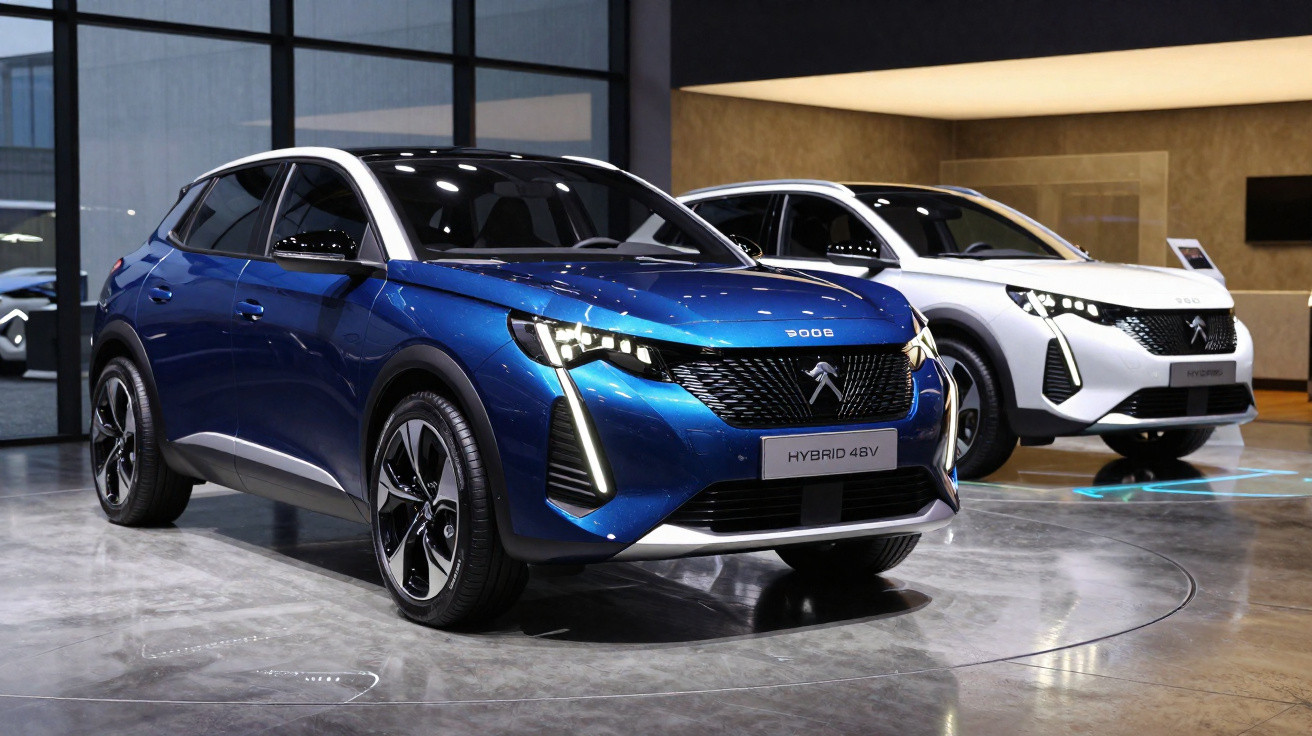
Peugeot’s shift from combustion power to electricity is continuing at pace. However, until the process is complete in 2030, the brand will still offer combined solutions that bring both technologies together, including the new HYBRID 48V system.
The Peugeot 3008 and 5008 will be the first models to receive this new system in the second quarter of 2023. It represents the lightest form of electrification available from the manufacturer and is claimed to cut fuel consumption and emissions by around 15%.
Its introduction will extend to almost the entire Peugeot range, as well as to other brands within the Stellantis group, during the course of this year. Alongside the addition of an electric element to the powertrain, HYBRID 48V also introduces a new automatic gearbox and a new-generation 1.2 PureTech engine.
HYBRID 48V: what is it?
Despite what its name may imply, the system’s 48 V electrical architecture places this technology within the mild-hybrid category rather than among full-hybrid systems, or conventional hybrids, which can operate at up to 200 V.
Nevertheless, Peugeot’s stated capabilities for HYBRID 48V, some of which are close to those of full-hybrid systems, set it apart from other mild-hybrid solutions. It is more closely related to the system used by Jeep, Alfa Romeo and FIAT - also Stellantis brands - although the two systems do differ.
Peugeot’s HYBRID 48V setup consists of a new-generation 1.2 PureTech engine, a new six-speed dual-clutch gearbox, an electric motor integrated into that gearbox and, naturally, a small battery. Each of these components is covered in more detail below.
How does it work?
The electric motor is central to the system, as it can either support the combustion engine or take over from it entirely, according to the driving situation.
In congested stop-start traffic or while carrying out parking manoeuvres, provided the accelerator is used gently, the electric motor can replace the combustion engine. This helps to reduce fuel use and, consequently, CO₂ emissions.
Conversely, when maximum performance is needed and the accelerator is pressed hard, the electric motor can provide extra power and torque to the combustion engine, making an overtaking manoeuvre easier, for instance.
To minimise fuel use even at higher speeds of up to 145 km/h, the system can switch off the combustion engine when the driver lifts off the accelerator, while naturally keeping all the vehicle’s essential systems operational.
At low engine speeds, the electric motor again comes to the rescue by compensating for turbo lag. It “injects” additional torque, reducing interruptions in power delivery and helping to make driving smoother.
This interplay between the electric and combustion engines should go unnoticed by the driver, as the changeover is intended to be imperceptible. It will only be visible on the instrument panel, which can display the energy flows between the engines and the wheels.
As with other electrified systems, the HYBRID 48V’s compact battery is recharged during deceleration - when the combustion engine is also shut down to save further fuel - and under braking, when the electric motor acts as a generator.
Peugeot claims 15% reductions in fuel consumption and emissions for the HYBRID 48V versions of the 3008 and 5008 compared with the current 130 hp 1.2 PureTech paired with the EAT8 automatic gearbox. This brings CO₂ emissions for the 3008 to 126 g/km and those of the 5008 to 128 g/km, compared with 144 g/km and 149 g/km respectively for the current versions.
The greatest benefits are expected in urban driving, where Peugeot states that fuel consumption falls by 2.5 l per 100 km. On open roads, the 3008 and 5008 are expected to use around 0.7 l/100 km less fuel, although no reductions have been announced for motorway driving.
New-generation 1.2 PureTech
To create an optimum partnership between combustion and electric power, Peugeot has developed a new generation of the familiar three-cylinder petrol 1.2 PureTech.
There are numerous changes. The three-cylinder engine now uses a timing chain instead of a belt, its turbocharger has variable geometry, and it operates on the Miller cycle, which enables more efficient combustion than the conventional Otto cycle.
The result is 136 hp (100 kW) at 5500 rpm and maximum torque of 230 Nm at 1750 rpm. These figures are not greatly different from those of the 130 hp 1.2 PureTech currently on sale, but they promise a better balance between performance and fuel consumption. A 100 hp version is also planned.
The new 1.2 PureTech is paired with a new dual-clutch transmission called e-DCS6, developed specifically for the HYBRID 48V system. As already mentioned, it houses the electric motor, but that is not all: the inverter and ECU (electronic control unit) are also incorporated into the gearbox.
The electric motor
The electric motor is a permanent-magnet synchronous unit with peak output of 21 kW (28 hp) and 55 Nm of torque. As well as being able to add power and torque to the combustion engine via a belt when required, it also works as a generator to recharge the battery during deceleration.
A second electric motor acts as the starter motor. It too is belt-driven and enables the combustion engine to restart quickly and smoothly.
The electric motor is supplied by a 48 V lithium-ion battery with a total capacity of 898 Wh, of which 432 Wh is usable. It is covered by an eight-year, 160,000 km warranty.
Because the battery is small, it could be accommodated beneath the left-hand front seat. This means it does not affect boot capacity and reduces the need for cabling to connect it to the powertrain mounted at the front.
Finally, as with other systems of this kind, the addition of HYBRID 48V means there are two electrical networks on board. The 48 V high-voltage network supplies the hybrid system, while the conventional 12 V low-voltage network powers the car’s other systems. Electricity is generated solely by the 48 V electric motor, so these models are fitted with an on-board DC voltage converter to transfer the energy produced to the 12 V network.

Comments
No comments yet. Be the first to comment!
Leave a Comment