
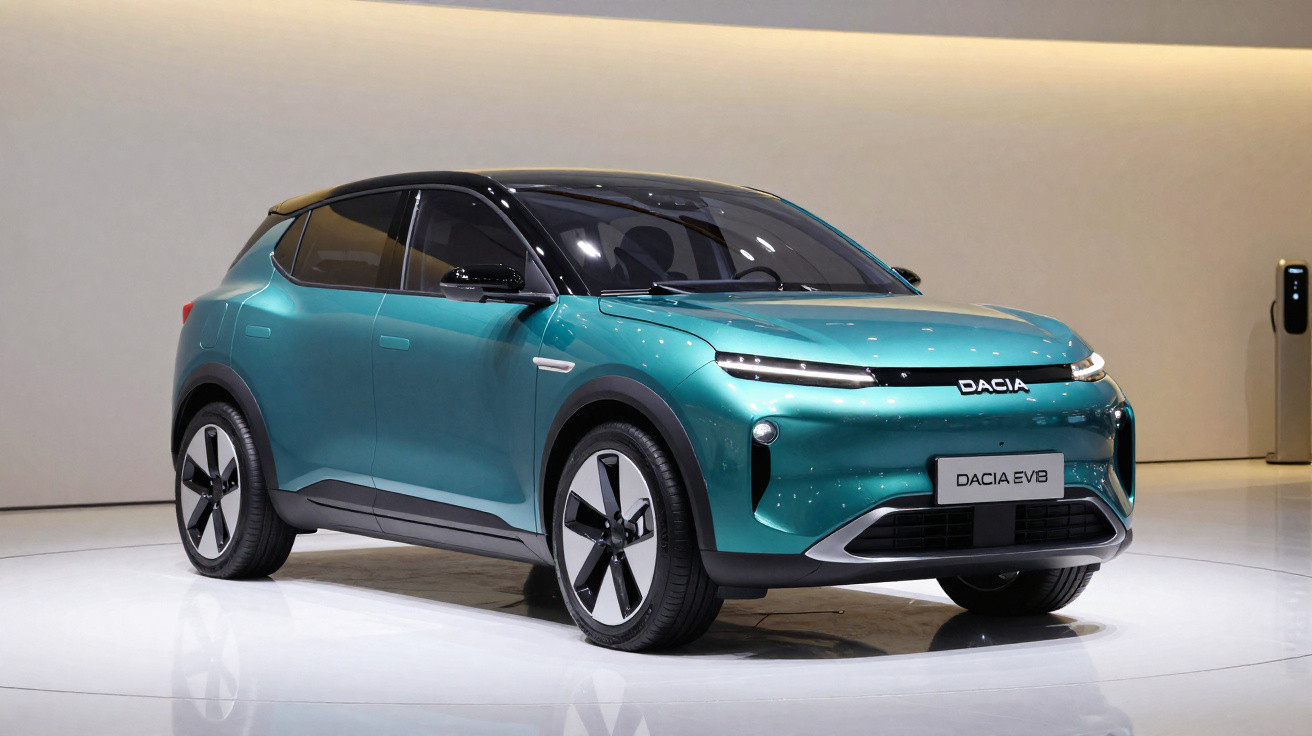
Romania’s budget champion is turning its strategy on its head, while holding firm to one central promise: affordable cars for everyone.
Dacia is using the Renault Group’s new future plan to accelerate its own ambitions. The brand has announced no fewer than four fully electric models, with a new entry price of well under €18,000 on the cards. This puts Dacia directly into the area where most rivals are struggling: genuine electric mobility for smaller budgets.
Dacia steps up: four electric models by 2030
Until now, Dacia’s range contained just one fully electric car: the Spring city car. It performed respectably and was priced within reach of many households, but its technology was relatively basic. Its Chinese production also made it ineligible for certain incentive schemes.
That is now set to change decisively. As part of the group-wide “futuREady” plan, Dacia has officially confirmed that it intends to offer four electric vehicles by 2030. The models will cover a broad spread of the small-car and compact segments, prioritising practical, straightforward vehicles over luxury equipment.
Dacia is aiming for around two thirds of its sales to come from electric powertrains by 2030 – while retaining its characteristically keen prices.
The manufacturer is therefore moving in a similar direction to many competitors, although its approach differs: less spectacle, more usefulness, and a clear battle to bring prices down.
New electric city car for under €18,000
The first element of the programme has already been outlined. Dacia will introduce a compact city-car variant based technically on the upcoming electric Twingo generation. It is intended to carry the familiar Dacia character: tough, uncomplicated, functional and, above all, inexpensive.
The brand is making a clear statement on entry pricing. The new model is expected to start below €18,000, at least in its home market and the most important European countries. Depending on available incentive schemes, it could become considerably cheaper in some local markets.
In markets offering an environmental bonus, the effective price of the new electric Dacia could fall below €15,000.
Another crucial factor is that the car will be built in Europe. This should give it a good chance of qualifying again for government support in several countries, unlike the Spring, which is imported from China and is therefore excluded under some incentive rules.
The future of the Spring, Sandero and Duster
The Spring remains, but faces strong in-house competition
For the time being, the current Spring electric car will remain in the line-up, despite being unable to access certain support schemes. It will continue to be the least expensive entry point, particularly for buyers covering very short distances or looking for a second car.
However, Dacia could offer many prospective customers a more modern and better-equipped proposition with the new European electric city car, while still delivering attractive prices and potential eligibility for incentives.
An electric Sandero is virtually certain
A fully electric version of the Sandero, Dacia’s best-selling model, is highly likely. Although official technical specifications have not yet been released, an LFP battery configuration is regarded as the preferred option behind the scenes. This battery technology is less expensive, durable and designed for everyday usability rather than maximum driving range.
- LFP batteries are considered particularly long-lasting
- They require fewer raw materials than many other cell types
- They are generally less sensitive to heavy use and repeated charging cycles
That makes the technology an ideal fit for Dacia’s philosophy: no record-breaking figures, but dependable engineering without unnecessary frills.
The Duster will initially retain combustion and hybrid power
Dacia is initially drawing a clear line with the popular Duster SUV: it will not arrive immediately as a fully electric vehicle. Instead, it is likely to continue with combustion engines and electrified versions, including hybrid and mild-hybrid powertrains.
This makes strategic sense. Larger, heavier vehicles need bigger batteries, which pushes costs upwards. Dacia is focusing first on smaller electric cars, where its cost-saving approach is technically easier to deliver.
Pricing strategy: electric mobility without a luxury premium
Dacia stresses that its fundamental direction remains unchanged. The brand still intends to offer the cheapest, or one of the cheapest, choices in every segment. This means avoiding unnecessary equipment and keeping costly high-tech extras under control.
The focus is on a simple promise: as much car as possible for as little money as possible – with a battery instead of a fuel tank too.
This approach is already evident in several areas:
- European production to reduce transport costs and improve the CO₂ footprint
- A streamlined model range to simplify development and manufacturing
- Hard-wearing, relatively simple interiors rather than premium styling
- A focus on driving ranges that suit everyday use rather than headline-grabbing figures
How the planned models fit into the range
| Model / plan | Status | Target starting price | Production location | Key features |
|---|---|---|---|---|
| Electric city car based on new Twingo technology | Announced | Under €18,000 | Europe | Good prospects for an environmental bonus |
| Spring | Already on sale | Depends on market | China | No access to certain incentive schemes |
| Fully electric Sandero | In planning | Not yet confirmed | Not yet confirmed | High likelihood of an LFP battery |
What does this mean for customers in German-speaking countries?
For buyers in Germany, Austria and Switzerland, Dacia’s electric offensive is likely to create new choices at the lower end of the market. In particular, people who have held back because of high list prices or uncertain residual values may be attracted by an electric car costing less than €18,000.
For commuters travelling 20 to 50 kilometres each day, smaller batteries will be entirely sufficient in many cases. Those able to charge at home or at work will also benefit from lower electricity costs compared with petrol or diesel.
It will be interesting to see how insurance, service intervals and resale values develop for the new models. Dacia has traditionally been strong in producing simple cars that are easy to repair, but with electric technology, the cost of replacement parts and workshop labour will become even more important.
What prospective buyers should consider now
Anyone considering an affordable electric car over the next one to two years faces a familiar choice: wait for a new model or choose a vehicle that is already available.
Several points can help with the decision:
- The incentive position in your own country: are bonuses likely to change soon?
- Actual space requirements: is a small city car genuinely sufficient?
- Everyday charging infrastructure: a private wallbox or public charging?
- Planned ownership period: around 3–4 years or significantly longer?
Those who are flexible and do not need a vehicle immediately can follow Dacia’s upcoming model announcements and wait for the first test drives. For many buyers, the decisive question will be whether the brand can maintain its reputation as a price disruptor in the electric era as well.
One thing is clear: the announcement of four electric models and a new entry price below €18,000 is bringing noticeable movement to a market segment that has long been dominated by expensive compact and mid-sized electric cars. If Dacia follows through consistently with its concept, it will create fresh pressure on every manufacturer that has so far treated affordable electric mobility as a peripheral issue.
Comments
No comments yet. Be the first to comment!
Leave a Comment