
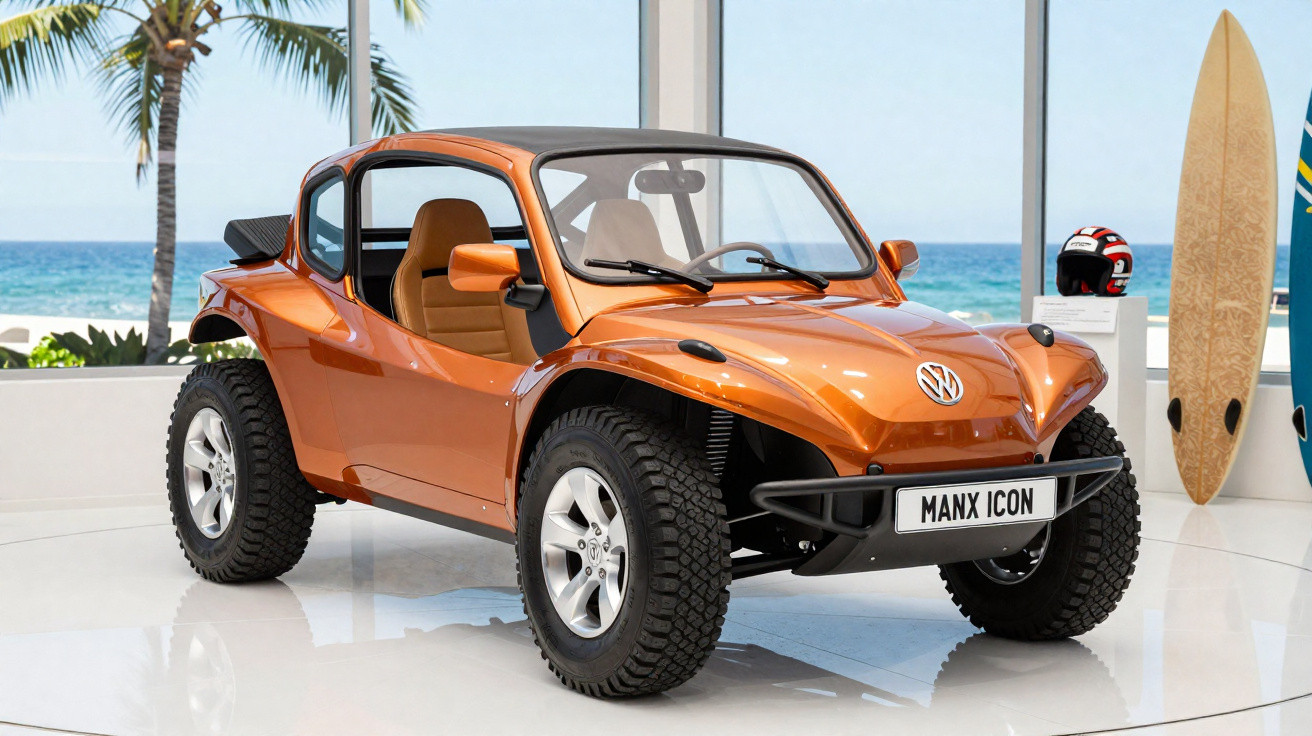
Few cars evoke summer and leisure time quite like the iconic buggy, whose original form was the Meyers Manx (aka the Volkswagen Buggy), created by Bruce Meyers.
This is the story of Meyers and his best-known creation: a fitting tribute to the man behind one of the most feel-good cars ever made.
It is a posthumous tribute. Bruce Meyers died on 19 February at the age of 94, just months after he and his wife sold Meyers Manx to Trousdale Ventures.
Necessity is the mother of invention
Born in Los Angeles in 1926, Bruce Meyers led a life that took him from serving in the Navy during the Second World War to off-road racing and the beaches of California. It was there that the keen surfer realised he needed a vehicle better suited to crossing dunes than his 1932 Ford Hot Rod.
A hot rod? Yes. Long before his most celebrated invention appeared, Meyers already had an extensive automotive background - and was also a competitive racing driver. Naturally, he was drawn to the Hot Rod movement that flourished in post-war America.
His expertise was not limited to cars. He learned to work with fibreglass - the material that would later form his buggy's bodywork - by making surfboards and even small catamarans.
He therefore took the chassis from a Volkswagen Beetle, a mechanically straightforward car, shortened it by 36 cm, removed the body and fashioned a replacement from the fibreglass he knew so well. The design was stripped back to the essentials, giving it a distinctive and… fun character.
The result was the first Volkswagen Buggy: the Meyers Manx, known as “Big Red”. Introduced in 1964, this lightweight, rear-engined, rear-wheel-drive and versatile car laid the foundations for a trend that would spread around the world.
It became more than a trend, too. Meyers and “Big Red” are regarded as key figures in the rise of organised off-road racing. Meyers and his racing partner Tom Mangels set the first four-wheeled record at the inaugural Baja, the Mexican 1000 held in 1967 - the forerunner to today's Baja 1000 - and were even quicker than the motorcycles.
The “price” of success
The Meyers Manx may have been propelled to fame after appearing in the 1968 film “The Thomas Crown Affair” and featuring on the cover of “Car and Driver” magazine in 1969, but it was not all plain sailing.
In 1971, Bruce Meyers left the company he had founded as it entered bankruptcy, despite having already built around 7000 examples of the famous buggy. The reasons? Taxes and competitors that copied his design.
Although he took the imitators to court - at the time, more than 70 companies were building similar models - the ruling did not go in his favour, and Meyers was unable to patent his Volkswagen Buggy. Despite inventing the concept, the business suffered severely.
Nevertheless, Bruce Meyers never lost the urge to build cars. In 2000, roughly 30 years after production of his distinctive buggies had ended, the Californian chose to return to the activity that had made him famous: producing the Meyers Manx.
More recently, Volkswagen paid a deserved tribute to the Beetle's more unconventional side when it unveiled the ID. Buggy in 2019, demonstrating the flexibility offered by its MEB platform, developed specifically for electric vehicles.


Comments
No comments yet. Be the first to comment!
Leave a Comment