
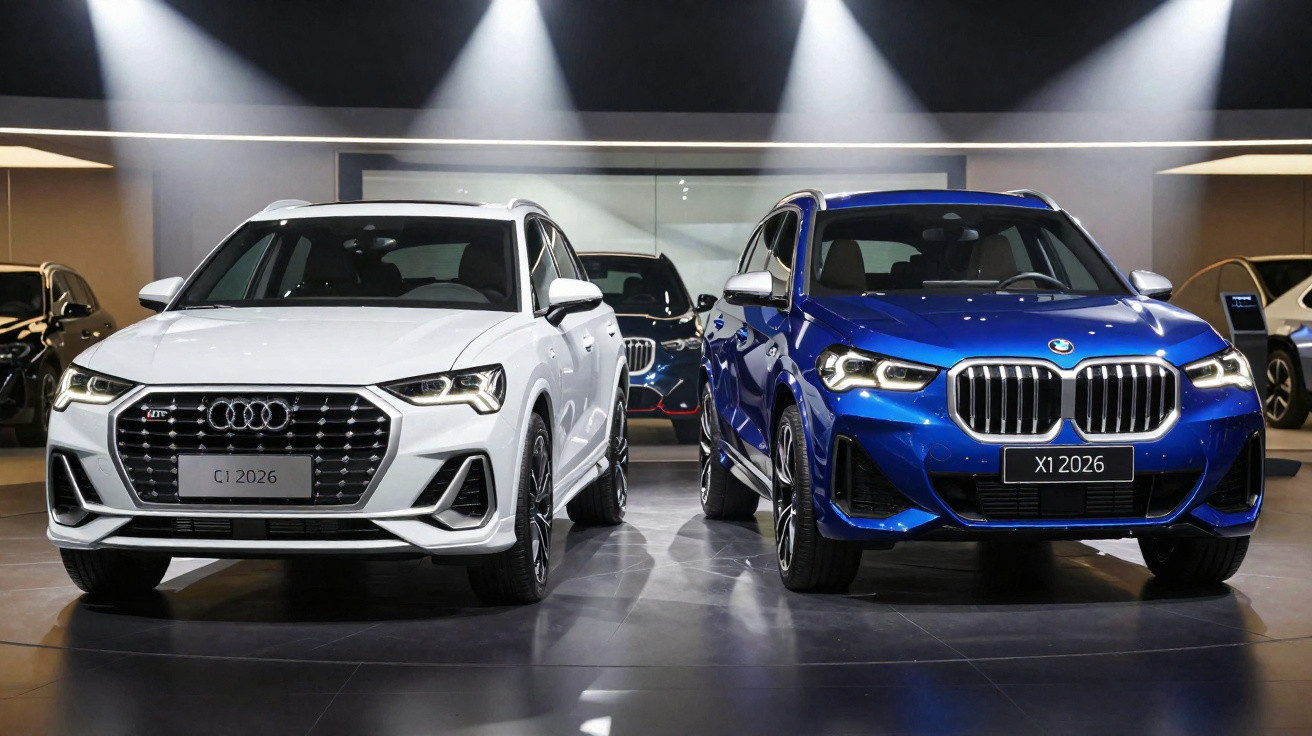
Both compact SUVs are aimed at the same audience: families and commuters seeking an upmarket experience without paying luxury-SUV prices. Their specifications appear closely matched, but 2026 looks set to be a pivotal year in this contest.
Two premium crossovers with distinctly different approaches
This comparison concentrates on the mainstream petrol models rather than the attention-grabbing plug-in hybrids. Audi launches its new third-generation Q3 range with a 150 hp 1.5 TFSI mild-hybrid, whereas BMW offers the X1 sDrive20i, a 170 hp three-cylinder petrol model with mild-hybrid assistance of its own.
The central question for 2026 is simple: at around €50,000 before options, which SUV actually feels worth the money day-to-day?
Both cars tested are in their more sporting specifications: S line for the Audi and M Sport for the BMW. Their starting prices are almost identical in practice. The Q3 TFSI 150 starts at €43,850 in entry-level Design specification, although the tested S line version comes to around €50,000 before options. BMW lists the X1 sDrive20i M Sport at €50,900, again excluding extras.
The real separation comes in the amount buyers must spend on options before either car feels genuinely premium, as well as in their behaviour away from the showroom, whether on a lengthy motorway journey or a wet B-road.
Audi Q3 and BMW X1: cabin design, screens and space
Interior quality: BMW showmanship against Audi restraint
The two models follow very different specification paths. The Q3 S line tested is relatively restrained, carrying about €3,100 of options, largely for paintwork, wheels, a black exterior package and privacy glass. By contrast, the X1 test car has almost €14,750 of extras, placing it firmly in executive company-car territory.
Even allowing for that difference, the BMW cabin creates the stronger initial effect. Blue-stitched Alcantara upholstery is standard with M Sport trim, with the same material extending to the dashboard detailing. Audi responds with fabric trim that appears durable but feels somewhat plain, both on the seats and across the decorative panels.
Visually, the X1 gives the impression of sitting in a car from the segment above, especially once a few key options are ticked.
The BMW test car also included electrically adjusted seats, a heated steering wheel and a panoramic glass roof, reinforcing its scaled-down X3 character. Audi offers most of these features as options too, but at comparable prices the X1 in M Sport form generally feels more generously appointed from the outset.
Infotainment and ergonomics: Audi responds with a better screen
The Q3 regains momentum when attention turns to its central display. Audi’s newest interface is smooth, well structured and responsive. Its menus are easy to understand, while key functions including navigation, audio and driving settings can be reached without difficulty while travelling.
BMW’s large curved screen is visually impressive, but the operation of certain menus is less satisfying. Switching off speed warnings, for example, involves more searching than expected. The driving modes also introduce unnecessary uncertainty: “Personal” sounds as though it should offer extensive individual adjustment, but it is actually Sport mode that allows changes to steering and stability-control settings.
Both interiors are contemporary and heavily digital, yet these ergonomic irritations erode some of the X1’s visual advantage. For motorists who dislike complicated menu structures and multiple sub-menus, Audi’s more straightforward system could prove decisive.
Passenger room, seating and boot capacity
Rear accommodation is closely matched, as each SUV has a sliding rear bench. With the bench moved fully backwards, the BMW provides slightly more legroom and gives rear occupants more space to stretch out. The Q3 still offers reasonable knee room for adults, although taller passengers are likely to prefer the X1.
The situation changes behind the rear seats. With both benches positioned fully rearwards, the Audi Q3 provides around 550 dm³ of boot space, compared with approximately 466 dm³ in the BMW. For parents carrying pushchairs, sports equipment and a weekly food shop, more than 80 extra litres is a meaningful advantage.
- Rear passenger space: X1 slightly ahead
- Boot volume: Q3 clearly more generous
- Cabin design: X1 more plush, Q3 more sober
- Usability of infotainment: Q3 more intuitive
Families who prioritise luggage capacity will lean toward the Q3; those who care about visual flair and rear legroom will favour the X1.
On the road: three cylinders versus four, comfort versus control
Engines and driving character
The specification sheet may initially appear to favour Audi. A four-cylinder Q3 against a three-cylinder X1 would normally suggest an advantage in smoothness, but the reality on the road is more complicated.
BMW’s 1.5-litre three-cylinder engine produces its familiar thrum when started from cold, which is noticeable for several seconds. Once warmed through, however, it settles into an unexpectedly refined note. It is quieter than the Q3 at a steady pace, and the BMW cabin also feels calmer overall.
When driven harder, the BMW engine reveals greater enthusiasm. It revs more willingly, while the mild-hybrid assistance produces crisper responses under acceleration. Performance testing shows the X1 gaining roughly two seconds over the Q3 across a standing kilometre, a gap that is clearly noticeable during everyday overtaking.
Despite its extra cylinder, the Q3’s 150 hp petrol feels more linear and less eager than the X1’s punchier 170 hp unit.
Chassis, ride comfort and wet-weather grip
Both test cars use 19-inch wheels, without sophisticated adaptive dampers, and each has a slightly firmer set-up than its standard-trim equivalent. This firmness is apparent in town, where sharp ridges and potholes are transmitted distinctly through both vehicles.
At higher speeds, the X1 begins to establish a clearer advantage. It is more comfortable on faster roads, smoothing expansion joints and broken surfaces more effectively. BMW manages to retain controlled body movements while reducing harshness, a combination the Audi does not quite achieve.
Tyres contribute to the contrast as well. The X1 tested wore Pirelli P Zero tyres, which delivered excellent wet grip. The Q3 used Bridgestone Turanza tyres and found traction more difficult, spinning its front wheels more readily and surrendering some of its available performance.
Audi delivers a clear response under braking: its brakes bite more strongly and inspire slightly greater confidence from motorway speeds. Overall, though, the X1 is the more complete and involving car to drive, whether the priority is easy long-distance cruising or a more enthusiastic run along a winding road.
Costs: list prices, options and everyday expenditure
Starting price versus the actual purchase price
On paper, the entry-level petrol versions occupy similar financial territory, but their equipment lists soon create a wider gap. Buyers can add more than €20,000 of options to a Q3 if they are not restrained, while X1 extras generally peak closer to €15,000.
Even straightforward conveniences such as keyless entry and keyless start are confined to option packages in both models. That may frustrate customers accustomed to mainstream manufacturers providing these features as standard on much cheaper cars.
| Model | Power | Base price | Test car price (excl. options) | Options fitted | Boot volume | Cylinders |
|---|---|---|---|---|---|---|
| Audi Q3 TFSI 150 S line | 150 hp | €43,850 | €50,000 | €3,100 | 550 dm³ | 4 |
| BMW X1 sDrive20i M Sport | 170 hp | €50,900 | €50,900 | €14,750 | 466 dm³ | 3 |
At the far end of the range, a heavily optioned Q3 used for a “10,000 km” long-term test reached €82,320, an eye-catching sum for a compact SUV. It illustrates how rapidly a carefully selected specification can become a luxury-car invoice if buyers do not keep close control of the options list.
Taxation, fuel consumption and long-distance driving
CO₂-based taxation is marginally less favourable for the Audi because its emissions are slightly higher than the BMW’s. Neither car attracts weight-related penalties, but in markets where it applies, the Audi will usually incur a somewhat higher environmental surcharge.
Fuel consumption follows the same pattern. In comparable use, covering mixed roads, motorways and urban driving, the X1 uses slightly less petrol than the Q3. BMW offsets this advantage with a smaller fuel tank, reducing its overall range despite the improved economy. Around 650 km from a tank is realistic in the X1: sufficient for a substantial road trip, but requiring more stops than the Audi on particularly long journeys.
On running costs, the BMW tends to cost less to fuel and tax, while the Audi goes a bit further between fill-ups thanks to its larger tank.
Strengths and weaknesses at a glance
BMW X1 sDrive20i M Sport
- Strong comfort once above urban speeds
- High-quality cabin feel, especially with M Sport trim
- Good rear-seat space and overall refinement
Eager engine and convincing mild-hybrid assist
Fiddly ergonomics and some confusing menus
Three-cylinder sound at cold start can annoy purists
Digital instrument graphics not to all tastes
Audi Q3 TFSI 150 S line
- Excellent central screen, clear and responsive
- Large boot, genuinely useful for family life
Confident, powerful braking at higher speeds
Less lively performance and more linear character
Narrow instrument cluster feel compared with rivals
Firm low-speed ride that never quite relaxes
Which SUV suits each type of buyer?
For many buyers, the key question is not simply which model is better, but which one better fits their routine. The X1 is particularly well suited to those who regularly cover long motorway distances, value a comfortable interior and enjoy some extra dynamic character at weekends. Its lower fuel use and CO₂ taxation strengthen that argument further.
The Q3 remains compelling for buyers who need the greatest possible boot capacity for child seats, pushchairs and dog crates, while also wanting an uncomplicated infotainment system. It also provides more scope to remain near its starting price, provided buyers avoid being drawn into its extensive options catalogue.
Key terms and purchasing strategies to understand
Two descriptions recur with these vehicles: “mild-hybrid” and “environmental surcharge”. A mild-hybrid system combines a small electric motor and an additional battery to support the engine during acceleration, while recovering energy during braking and when lifting off the accelerator. Unlike a full hybrid, it cannot drive using electricity alone, but it can make stop-start operation smoother and reduce fuel consumption by a few tenths, particularly in urban traffic.
CO₂-based environmental surcharges can add thousands to the purchase price in certain European markets. When comparing vehicles such as the Q3 and X1, buyers should include this initial tax in the real acquisition cost rather than considering only the showroom list price.
One useful approach for 2026 buyers is to create two online configurations: one sensible specification and one dream specification. The dream version can then be reduced to the handful of items that make a genuine difference to daily life, such as adaptive cruise control for commuters in heavy traffic, heated seats in colder regions or an upgraded audio system for those who spend many hours each week behind the wheel. Both Audi and BMW prices can escalate quickly, but a careful choice of options can keep either model within a sensible budget.
It is also worth modelling three years of high-mileage ownership. For someone driving 20,000 miles annually, fuel spending, taxation and tyre wear become more significant than a marginally more attractive dashboard trim. In that situation, the X1’s lower consumption and strong wet-weather traction present a convincing case, even for buyers who had originally preferred the Audi badge.
Comments
No comments yet. Be the first to comment!
Leave a Comment