
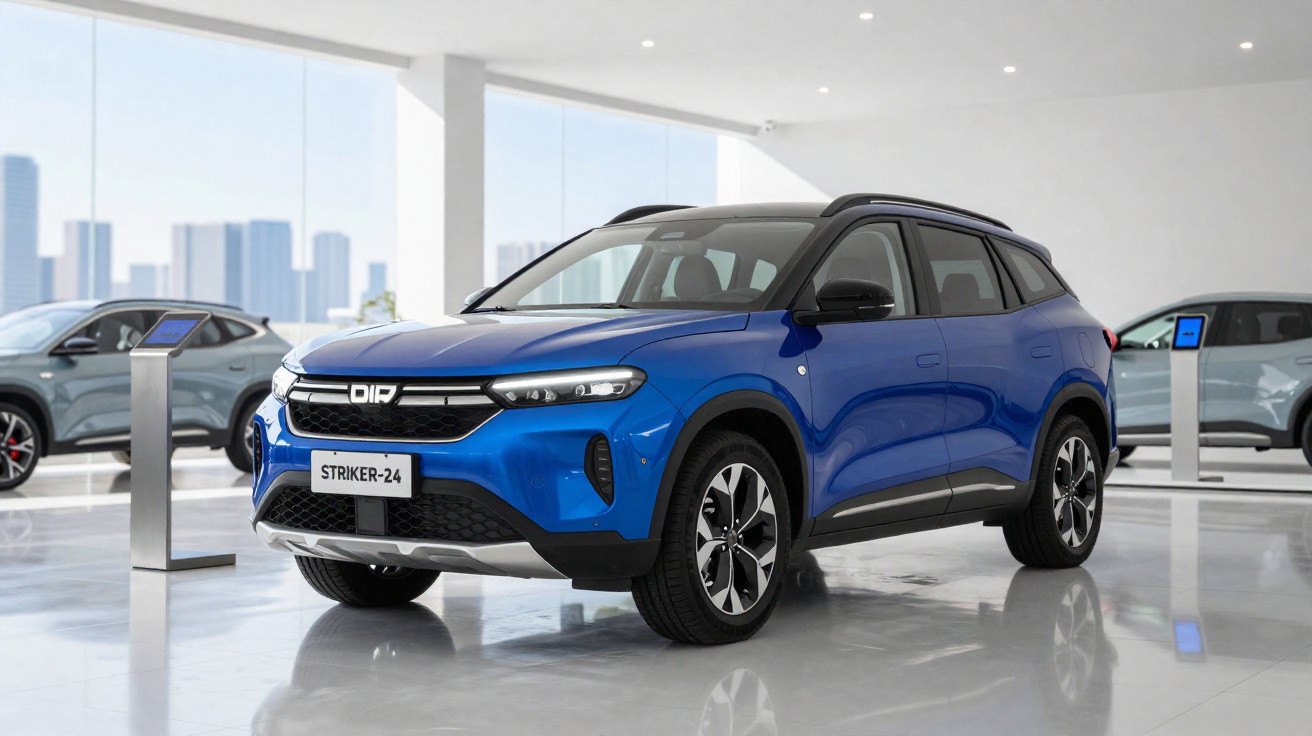
By the end of the decade, Dacia intends to introduce four new electric models, although the current headline act is the new Striker. Unveiled as part of the Renault Group’s FutuREady plan presentation, it strengthens the Romanian brand’s presence in the C-segment and, alongside the Bigster, takes its place at the top of the range.
Dacia Striker design and dimensions
Unlike the Bigster, however, the Striker is not an SUV. Dacia describes it as a crossover, though it looks to us like an estate with its trousers rolled up. It is nevertheless an intriguing move from Dacia, given that estates have been losing ground to the seemingly unstoppable rise of SUVs. That is precisely why the brand sees an ideal opportunity to succeed.
Measuring 4.62 m long, the Striker is 5 cm longer than the Bigster. It combines an estate car’s lower driving position and roominess with SUV-style flexibility, helped by greater ground clearance than is usually found in this kind of vehicle.
In styling terms, it follows Dacia’s latest design language, with its sturdy lines, while introducing new details such as the fresh “T” light signature. For now, no images of the new Dacia Striker’s interior have been released.
Making electrification affordable
Beneath its bodywork, the new Dacia Striker uses the CMF-B platform, which underpins every other model in the range apart from the Spring. The aim is to make electrified mobility more attainable in the compact family car segment.
No powertrain surprises are expected. It will share its entire engine line-up with the Bigster, including the hybrid and LPG choices: the Hybrid 155, the new Hybrid-G 150 4×4 and the ECO-G.
When will the Dacia Striker arrive?
Dacia has not yet confirmed a market launch date for the Striker, although it has said that the model will be fully unveiled in June. Prices have not been finalised for the domestic market, but the brand says they will start below €25,000.
Dacia’s forthcoming electric models
Alongside the Striker, Dacia has announced that the first electric car in its new product offensive is expected to arrive later this year.
It will be a city car based on the Renault Group’s AmpR Small platform, also used by the new Renault Twingo. Developed in under 16 months, it is set to start below €18,000. Its arrival will not mean the end of the Spring.
The next-generation Sandero, due in 2027-2028, is also expected to be among the four electric models Dacia plans to launch. “For the next generation, the Sandero will feature a fully multi-energy powertrain range (…) perfectly aligned with Dacia’s electrification plan,” states the press release.
Comments
No comments yet. Be the first to comment!
Leave a Comment