
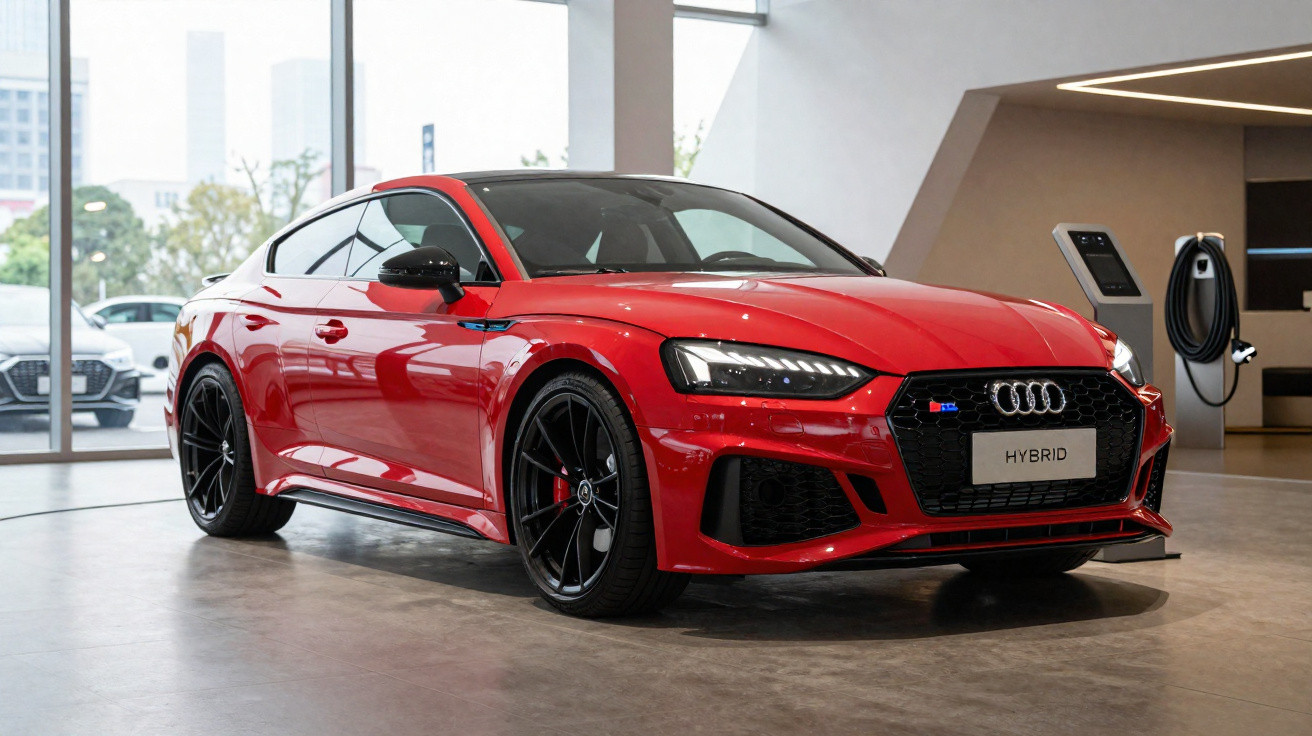
Introduced around two weeks ago, the new Audi RS 5 inevitably prompts discussion of the «elephant» in the room: its engine. Contrary to the fears of many, Audi has not followed AMG’s C 63 route by cutting either the cylinder count or engine capacity.
The Audi RS 5 remains true to the layout that has shaped its identity: a 2.9-litre twin-turbo V6, now paired with a plug-in hybrid system.
Audi RS 5: electrification without downsizing
Yes, it is electrified, but there is no downsizing. Speaking to Edmunds, Audi Sport managing director Rolf Michl said that shrinking the engine was not considered “not even for a single second”. The statement makes it clear that preserving the RS 5’s character was an absolute priority in Ingolstadt.
The real «problem»
Electrification has, however, created a different issue: weight. Depending on the body style - saloon or Avant estate - the German performance car weighs 2355 kg and 2370 kg respectively, an increase of 538 kg and 550 kg (!) over the RS 5 Sportback and RS 4 Avant.
To offset this extra mass, Audi considered offering a conventional hybrid version, without plug-in charging and with a smaller battery. That option was ultimately rejected following the initial tests.
Steffen Bamberger, Audi’s head of research and development, explained that the potential weight saving from a hybrid version would not be sufficient to justify the lack of a plug-in hybrid system. “The conventional hybrid system can weigh up to 150 kg, is quite large and, in my opinion, a range of 10 km is not a realistic offer for the customer,” he said.
With the weight increase unavoidable once an electrified system was adopted, Audi sought to give that compromise a practical benefit. The RS 5 therefore retained its plug-in hybrid system and 25.9 kWh battery, providing up to 87 km of electric range (WLTP). Here are all the figures:
Comments
No comments yet. Be the first to comment!
Leave a Comment