
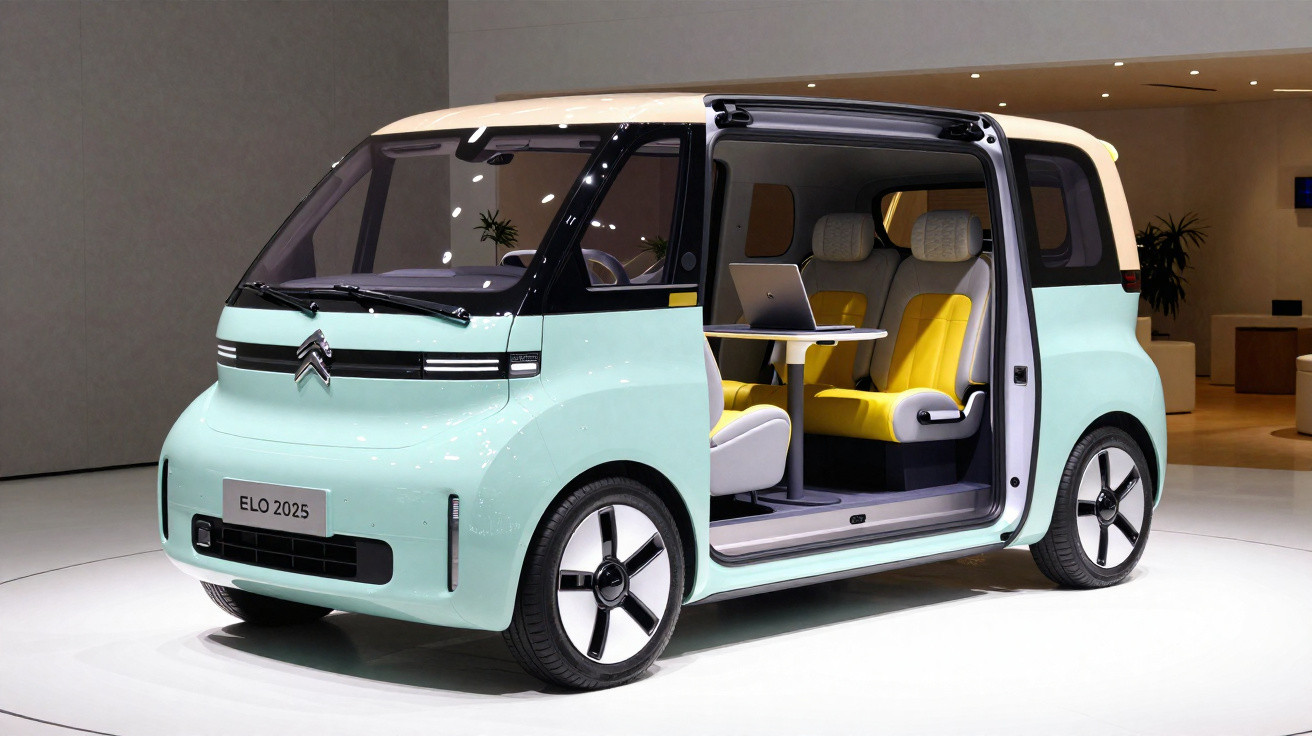
We live in an age when SUVs seem to have swallowed every other type of car, yet ELO, Citroën’s new prototype, pushes back by reviving the “old” compact people carrier, or MPV, concept and reworking it for the 21st century.
At 4.10 metres long - identical to a C3 - it has classic MPV proportions and can accommodate up to six people across two rows. Much like the 1990s FIAT Multipla, it embraces a format that was as ingenious as it was divisive: six seats in under four metres, wrapped in styling that can still provoke a reaction today. It is intriguing that Citroën, within Stellantis, is the brand bringing the idea back.
The key distinction between the ELO and the Multipla is the era in which they were conceived. This is based on a fully electric platform, while its cabin has been designed as a “micro loft” on wheels - closer to a compact home than a conventional car.
Small outside, vast inside
The Citroën ELO is unlikely to reach production, but it acts as an ideas laboratory for the brand’s future models.
Its electric motor sits on the rear axle, freeing up room at the front and enabling a short body with wheels pushed out to the corners and a generous 1.70-metre height. The outcome is an exterior-to-interior ratio that Citroën has no hesitation in describing as “unbeatable” among compact MPVs.
The seating layout is another defining feature. In standard form, the Citroën ELO is a four-seater, but unlike the Multipla, its driver sits centrally, positioned further forward and surrounded by extensive glazing - almost like driving from within a panoramic aquarium.
At the rear, three equally wide seats provide adult-friendly space, while the outer seats conceal two additional fold-out seats. These raise the total to six occupants without reducing boot capacity.
With no central tunnel and a completely flat floor, moving around the cabin is easy, much like in a small mobile studio. All four doors open in opposing directions and, because there is no central pillar, create a huge 1.92-metre side opening. It is anything but conventional - just as the Multipla was in its day.
REST, PLAY, WORK: a car for the whole day
Citroën did not intend the ELO simply to be a people carrier. The French brand wants it to manage the time spent inside it, condensing the concept into three words: REST, PLAY, WORK, which define this prototype’s different “lives”. The name itself is also derived from these words: rEst, pLay, wOrk.
In REST mode, the cabin becomes a compact retreat. Two foldable mattresses, stored in dedicated compartments in the boot, can be inflated using the built-in compressor and fitted inside the cabin to create a bed for two.
The rear interior lights become bedside table lamps, and there are even mounting bases - borrowed from Decathlon paddleboards, as Decathlon was one of the development partners for this prototype - for securing a projector and watching a film on a retractable screen.
In PLAY mode, the Citroën ELO becomes a base for outdoor activities. The three rear seats are removable and can be used as chairs for impromptu picnics; mounting points allow awnings to be fitted on either side; and the V2L system can power an electric barbecue or a speaker. The compressor can also inflate boards, floats or bicycle tyres.
In WORK mode, meanwhile, the driver’s seat rotates through 360° to become an office chair. A table concealed beneath the central seat in the second row slides out to hold a laptop, while the windscreen information projection system switches to displaying diaries, calls and video conferences.
The thinking is straightforward: if a car is parked 95% of the time, it should do more than merely take up space.
Materials built for real life
The Citroën ELO is also being used to trial more sustainable, easier-to-maintain materials. Citroën worked with Decathlon and Goodyear on durable, washable finishes intended for “outdoor” use: from recycled felt from the earlier Oli concept - which we had the opportunity to drive - repurposed into storage boxes, to reinforced plastics and fabrics that can cope with mud, sand and salt water.
Its bumpers and wheel-arch guards are made from expanded polypropylene, the same material used in Decathlon bicycle helmets. It is lightweight, recyclable and well suited to withstanding urban knocks.
The Goodyear-developed tyres are “intelligent”, monitoring pressure and wear in real time, with an LED integrated into the wheel rim to alert the driver if something is wrong.
When will it arrive?
Unlike many show cars, which are little more than production models with added bling, the Citroën ELO is a genuine concept car, bringing the compact MPV idea back to life. As with the Oli, the ELO should therefore be seen as a concentration of ideas that may eventually appear in future models from the French brand.
The ELO will make its public debut at the Brussels Motor Show on 9 January. It is surprising that Citroën is the company revisiting this compact, practical and… very different vehicle concept - and it promises to be as controversial as its Italian predecessor. Still, it is refreshing to see that the future need not consist entirely of SUVs and crossovers.
Comments
No comments yet. Be the first to comment!
Leave a Comment