
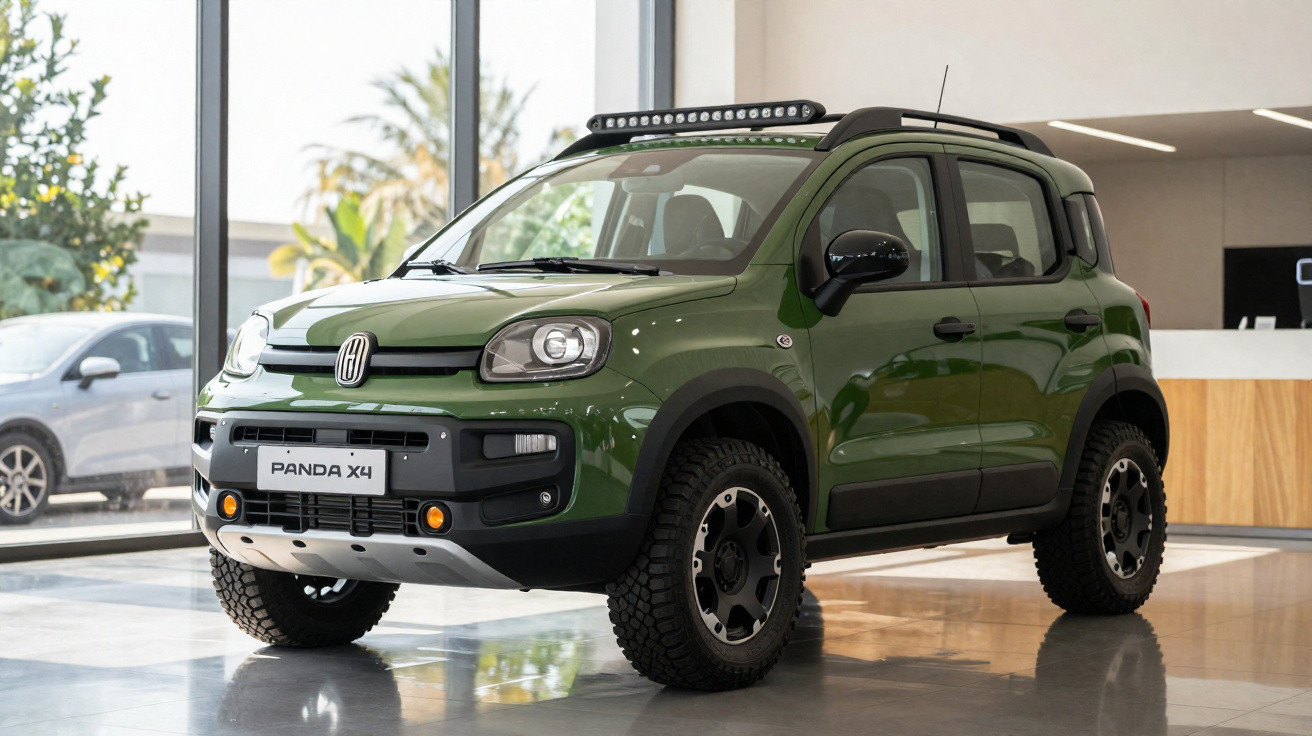
That appears to be a Panda 4X4...
In a sense, yes. The Panda Cross uses the 4X4 as its basis; that model sits beneath it in Fiat’s trio of exceptionally small SUVs.
There are three versions?
There are. The Cross is the strongest performer away from the tarmac, the 4X4 is a little less capable, while the Trekking is essentially an ordinary Panda fitted with more substantial tyres and black plastic-clad bumpers.
Fiat Panda Cross terrain hardware
Right. What has changed?
The Cross introduces Fiat’s Terrain Control system. A rotary controller below the gear lever offers three selectable settings: Auto, Off-Road and Hill Descent Control (HDC).
Auto apportions power between the front and rear axles automatically, requiring no driver intervention. Off-Road, meanwhile, keeps the Panda in four-wheel drive up to 48km/h. It activates the Electronic Locking Diff, switches off traction control for greater purchase on loose surfaces, and employs the ESC to brake the wheel with the least grip, directing power to the others.
Behind the bulging wheel arches and revised bumpers, the Cross gains extra underbody shielding, higher-mounted air intakes and 9mm more ground clearance than the already raised 4X4.
As well as those mechanical alterations, Fiat has added fresh interior and exterior trim details.
Fiat Panda Cross engines and economy
What engines are available?
As with the rest of the Panda range, the Cross can be specified with Fiat’s eager TwinAir two-cylinder turbocharged petrol engine. Its output rises by 5bhp to a formidable 84bhp, allowing it to reach 100km/h in a barely believable 12 seconds. It is paired with a six-speed gearbox. First gear is an ultra-low crawler ratio: useful off road, though less ideal when joining faster traffic.
A diesel option is also offered: the 1.3-litre MultiJet, producing 79bhp. While it delivers considerably more torque (190Nm versus 145Nm), it is noisier, slower and pricier than the TwinAir, so we would avoid it.
Fiat says the petrol version, priced from £15,945, returns 57.6mpg. The diesel costs precisely £1,000 extra and has an official figure of 60.1mpg.
Off-road ability and road manners
That is fine, but can it really drive off road?
Absolutely. Apply a generous dose of throttle and the Panda claws its way up unexpectedly steep inclines. There is a brief pause while the system apportions the power, followed by an almost turbo-style surge as the rear wheels find traction and it bounds over the obstacle you were attempting to conquer. It is genuinely highly impressive for such a small car.
And what is it like on the road?
This is, unfortunately, the Panda’s weak point. Its steering lacks precision and feels indistinct, a trait that is more troublesome at speed than in town. It also hinders off-road driving, since there is little sense of what the front wheels are doing or whether they have any grip. The large tyres give it a reasonably compliant ride, although body roll is abundant.
Is it worth buying?
Likely not. The Cross is an appealing and remarkably capable small car, but it is plainly over-engineered. We suspect that very few owners will ever come close to exploiting what it can truly do. Should you genuinely require the additional traction, the 4X4 makes more sense and saves £1,700; it may not scale slopes as steeply or wade through puddles as deep, but you are unlikely to require either ability. Still, if its tougher appearance is what attracts you, we will not criticise...
Comments
No comments yet. Be the first to comment!
Leave a Comment