
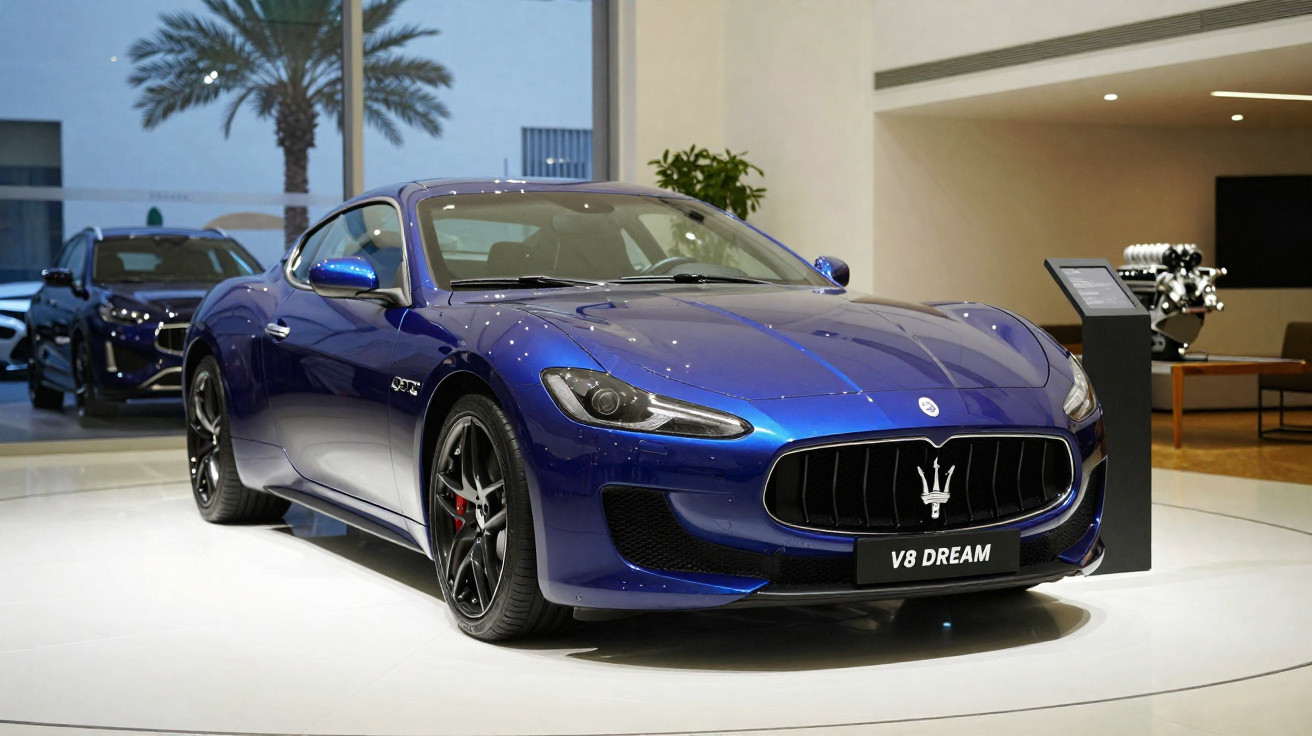
Sports cars that once cost well over €100,000 are currently appearing on the used market at prices comparable with a well-equipped new SUV. One particularly striking case is a Maserati GranTurismo with a traditional naturally aspirated V8, priced close to a new Dacia Duster. It sounds absurd, but it is real – so is it worthwhile for an ordinary buyer, or only for committed petrolheads?
A 2000s dream coupé that has become attainable
The Maserati GranTurismo is widely regarded as one of the most elegant coupés of the 2000s. Its styling was created by the celebrated Pininfarina design house, responsible for the look of many Ferrari models. With its extended bonnet, broad rear shoulders and low beltline, it has the presence of a classic grand tourer: a comfortable long-distance car with sports-car DNA.
The specific car being offered was built in 2009 and is listed at €24,990. That places it in a price bracket where many buyers would usually be considering a new compact SUV or a fully specified Dacia Duster. When the GranTurismo was launched, by contrast, its price sat comfortably beyond €100,000.
“A former super sports car that now costs less than an average family SUV – that suddenly puts the GranTurismo within reach for many people.”
Its appearance has aged remarkably well. The styling still looks current, and many car enthusiasts would not immediately guess that it dates from 2009. This particular Maserati also has a feature appreciated by knowledgeable buyers: according to the description, it remains in original condition, without an aftermarket exhaust or dubious power upgrades. That is increasingly unusual among Italian sports cars.
Maserati GranTurismo: a genuine Ferrari-developed V8
The engine is the GranTurismo's centrepiece. Beneath the long bonnet is a 4.2-litre naturally aspirated V8, developed in collaboration with Ferrari in Maranello. It produces 405 PS and 460 Newton metres of torque. There is no turbocharger and no downsizing – just a traditional high-revving V8 of the type that is now rarely available.
Maserati later introduced a more powerful 4.7-litre version, but the 4.2-litre unit also has a reputation for being very durable. Many cars have covered six-figure mileages without major engine failures. Advertisements include examples with 150,000 or 200,000 kilometres that still run dependably, provided their servicing has been taken seriously.
The more significant weakness of early cars was the transmission. Initial versions used an automated manual gearbox, which was considered jerky in daily use and prone to faults. From around 2009, Maserati moved to a conventional six-speed ZF automatic, which is considerably smoother and generally more durable.
“Anyone looking for a GranTurismo should specifically seek out models with the later ZF automatic – it is considered a clear advantage.”
The vehicle currently advertised fits that description precisely: a 2009 model with a six-speed ZF automatic. It is offered with 99,000 kilometres recorded, and the seller states that both the engine and gearbox work perfectly. It also wears a relatively uncommon colour combination: a dark-red body with a beige cabin and dark-red detailing – considerably more eye-catching than the many grey or black examples.
Low price, important catch: a Dubai import
Why is this GranTurismo so inexpensive compared with the German market? The small print provides the answer: it was originally delivered in Dubai before being imported into Germany. The seller says import duties have been paid, but the car has neither German registration nor a current MOT.
That is exactly what keeps the asking price down. According to the dealer, the advertised figure is around €5,000 to €7,000 below comparable cars with German history and a fresh MOT.
- Imported from Dubai
- No German registration and no current MOT
- A price advantage of several thousand euros
- Four new tyres included in the package
Anyone buying it will therefore need to arrange the technical inspection themselves and deal with the registration authority. This is manageable for capable home mechanics or buyers with a strong relationship with a garage. However, anyone accustomed to simply handing over the keys at a franchised dealer, with little interest in the technical side, should not underestimate this issue.
Running costs of a luxury sports car, not a Dacia
However tempting the purchase price may sound, the ongoing costs remain those of an Italian V8 sports coupé. Insurance alone will normally be substantially more expensive than for a compact SUV. Large brake discs, generously sized tyres and high-quality suspension components can also become costly when replacements are needed.
Although the V8 is regarded as long-lasting, it needs regular and conscientious servicing. Oil changes, spark plugs, belts and fluids should never be treated as areas for savings. Genuine parts and specialist garages cost noticeably more than they would for an everyday car.
“Anyone saving money on the purchase price should not cut corners on servicing – otherwise the dream coupé can quickly become a stationary garage project.”
Fuel consumption is another consideration. A naturally aspirated V8 of this output will readily use 15 litres or more per 100 kilometres in normal driving, and substantially more when driven briskly. For high-mileage drivers with a long commute, it is unlikely to make sense over time.
Who this Maserati proposition genuinely suits
The audience for a GranTurismo at Dacia money is fairly clearly defined. It is aimed at people who:
- want a second or third car for weekends and holiday journeys;
- want the sound and sensation of a classic V8;
- can assess technical risks or have good garage contacts;
- are prepared to meet higher running costs.
Conversely, anyone needing one car for family life, winter use and a daily commute will find a new Dacia or another compact SUV far less stressful. An older sports car only tolerates neglect for a short time before the bills rise sharply.
Value, emotion and alternatives
An interesting question is whether a GranTurismo like this will remain at such a low value level, or could even appreciate slightly over the longer term. Many observers see current prices for classic V8 coupés as relatively attractive, since modern new cars with similar emotional appeal are rarely affordable. At the same time, large-capacity naturally aspirated engines are becoming increasingly scarce due to CO₂ requirements.
Even so, a Maserati GranTurismo is not a guaranteed investment. Its condition, service history, import status and market demand have a major influence on resale value. Buyers driven by emotion should regard any eventual resale return as a bonus rather than a financial plan.
There are certainly alternatives in a similar price range, including:
- older Porsche 997 or Boxster models with a six-cylinder boxer engine;
- a BMW 6 Series Coupé with a V8;
- a Mercedes CL or E-Class Coupé with a large petrol engine;
- a Jaguar XK with a V8.
Every one of these cars has its own strengths, weaknesses and potential cost traps. The GranTurismo stands out chiefly through its design and Ferrari-related V8 – a compelling point for collectors and brand enthusiasts.
What prospective buyers should check before buying
Anyone seriously considering an offer like this should plan a thorough inspection. Key areas include:
| Area | What to check |
|---|---|
| Service history | Complete documentation, ideally from a marque specialist or specialist garage |
| Gearbox | The automatic should shift cleanly, with no jolts or delays |
| Electronics | Warning messages on the display; request a diagnostic report |
| Bodywork | Signs of accident damage, uneven panel gaps, repainted panels |
| Brakes/suspension | Unusual noises, vibrations, uneven wear |
With imported vehicles in particular, it is worth examining the paperwork closely. The country of origin, customs documentation and any modifications made for the European market should all be properly recorded. Buyers who are unsure should take an assessor or an experienced Maserati specialist to view the car.
In practical terms, this type of purchase is more of a hobby project than a rational replacement for a new car. You are treating yourself to emotion, sound and styling while accepting risk and ongoing costs in return. If that is understood from the outset, a GranTurismo at Dacia money could genuinely become one of the most exciting car purchases of a lifetime – but certainly not the cheapest in the long term.
Comments
No comments yet. Be the first to comment!
Leave a Comment