
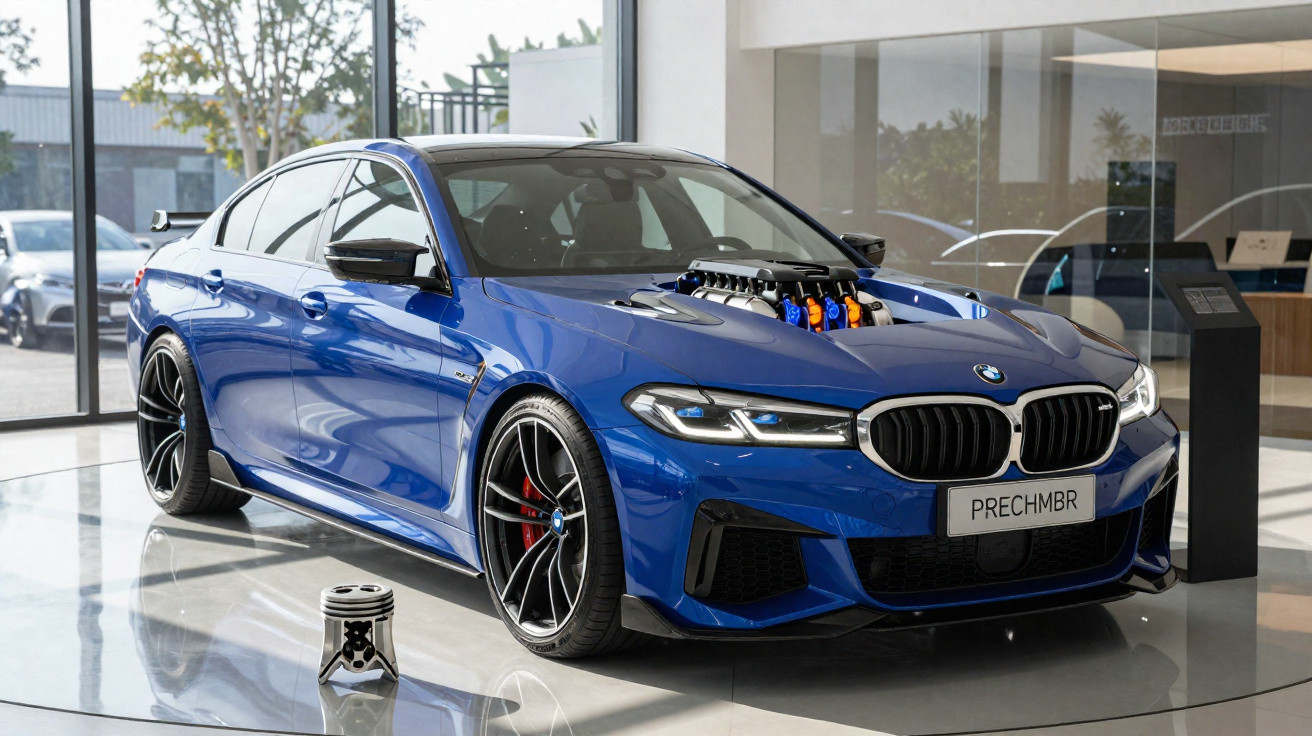
The widely forecast demise of combustion engines appears to have been greatly overstated - there has been no shortage of new developments. Granted, most have been stratospheric: V12s, V16s and a twin-turbo V8 capable of reaching 10,000 rpm… Yet the innovations will not stop there.
We recently introduced a new generation of Toyota four-cylinder engines, with 1.5-litre and 2.0-litre capacities, which will be fitted to numerous models across the group within the next few years.
Today, the focus turns to Bavaria’s engine factory - BMW. It is worth remembering that the manufacturer was among the few not to put a “date” in the diary for ending internal-combustion engines. On the contrary, it committed to continuing investment in their development.
What is BMW developing?
Patent filings, revealed by Auto Motor und Sport, now show what BMW has been working on behind the scenes. While Toyota is developing entirely new engines, BMW’s work is more targeted, focusing on combustion technology.
The key innovation is the addition of a pre-combustion chamber. For anyone familiar with engine technologies, this solution was once very common… in Diesel engines.
Before direct fuel injection was introduced and became widespread in Diesel engines, a pre-combustion chamber - or indirect injection - was the most commonly used technology. Ignition of the air-fuel mixture began in the pre-combustion chamber, mounted in the cylinder head, before passing through small openings linking it to the main combustion chamber inside the cylinder.
This not only delivered more efficient combustion, with improved control over detonation and temperature, but also gave Diesel engines smoother operation while reducing noise. In petrol engines, however, the technology promises a different set of advantages.
How does the BMW pre-combustion chamber work?
As in Diesel engines, the pre-combustion chamber in BMW’s future petrol engines is connected to the main combustion chamber in the cylinder via a series of openings.
Inside this much smaller pre-combustion chamber is a single spark plug with an unusual arrangement: it has only the ignition electrode, while the earth electrode is fixed to the engine. According to the patent, this structural separation enables better heat dissipation and prevents unwanted pre-ignition.
During the compression stroke - this remains a four-stroke engine: intake, compression, combustion and exhaust - the piston compresses the air-fuel mixture, with part of it forced through the openings into the pre-combustion chamber.
The spark plug ignites the air-fuel mixture in the pre-combustion chamber, and the resulting explosion is expelled through the openings as jet-like bursts into the main combustion chamber.
These high-pressure jets allow the air-fuel mixture in the main combustion chamber to burn more quickly, creating multiple ignition points. This is not possible in a conventional petrol engine, which has only one ignition point: the spark plug at the top of the cylinder itself.
Because combustion takes place more rapidly, it is also more efficient. The resulting gains mean lower fuel consumption and emissions without harming performance… quite the reverse. More power with lower fuel consumption is unlikely to meet much opposition.
Another benefit of this technology is that it can be adapted to any petrol engine in BMW’s modular engine family - all of them share a 500 cm³ individual cylinder capacity. That means it could appear in anything from one of the Bavarian manufacturer’s three-cylinder engines to a V8.
Furthermore, since the most significant alteration is limited to the cylinder head, BMW may be able to keep using its existing engine blocks.
Maserati got there first
It is not yet known exactly when pre-combustion chamber technology will reach BMW petrol engines, although all indications suggest it could be around a couple of years away, in 2026, coinciding with the arrival of the new-generation X5.
However, it will not be the first model to benefit from this solution. Maserati has, after all, used this technology since 2020 (!). The 3.0-litre twin-turbo V6 launched in the MC20, known as the Nettuno, was the first to use a pre-combustion chamber. There are some differences compared with BMW’s patent, including the spark plug, for example, but it is the same technology.
When Maserati unveiled the Nettuno, it cited precisely the same benefits of using a pre-combustion chamber in a petrol engine: reduced fuel consumption and emissions alongside greater performance. The MC20’s 630 hp at 7,500 rpm demonstrates this, as does its 11:1 compression ratio - very high for a high-performance turbocharged engine and one of the main indicators of engine efficiency.
What BMW’s petrol-engine development makes clear - and other manufacturers are also investing in this technology - is that combustion engines still have considerable room for advancement. Their development potential has not been exhausted.




Comments
No comments yet. Be the first to comment!
Leave a Comment