
In Europe, hybrids have historically faced an uphill struggle. Their limited presence in the European market is largely down to the strong competition from diesel cars, even though the range of hybrid options has expanded considerably in recent years.
That situation is set to change, however. The rising cost of diesel technology, combined with the need to meet emissions regulations, could make it economically unviable for manufacturers in more affordable segments. Hybrid cars and, especially, mild hybrids are expected to take their place at the beginning of the next decade.
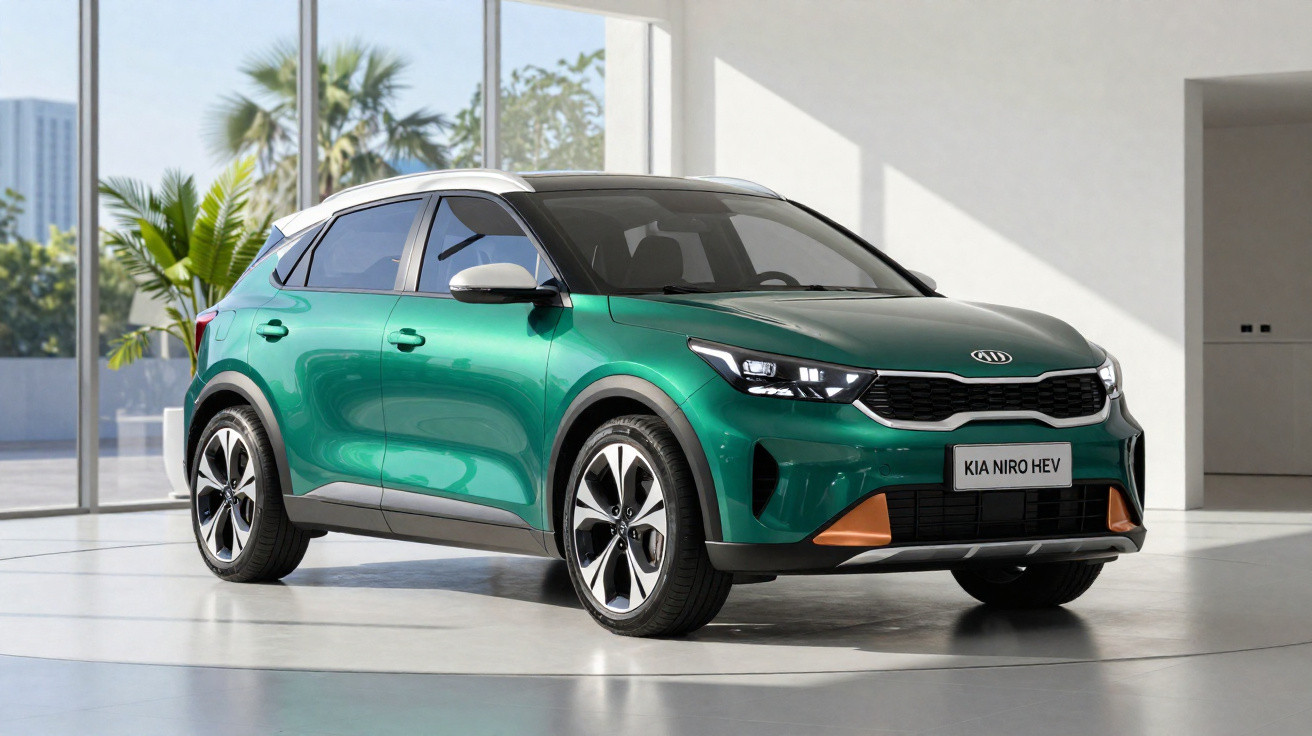
It is against this backdrop that we encounter the Kia Niro 1.6 GDI HEV. This new crossover from the Korean brand sits between the smaller Soul and the larger, highly successful Sportage. It will not be offered with diesel engines: for now, the sole option is a hybrid powertrain, while a plug-in hybrid version will join the line-up at the end of the year. At present, it effectively has only one rival: the feisty Toyota C-HR 1.8 HSD.
It seems the world has been turned upside down when Toyota is the manufacturer with the more striking and original-looking crossover in the C-HR, even if its design will not appeal to everyone. The Kia Niro, meanwhile, is somewhat disappointing in this respect, given what Peter Schreyer, design director for the entire Hyundai group, has accustomed us to. It appears a step below the brand's other crossovers, particularly the “funky” Soul and the stylish Sportage. It should have inherited the latter's proportions and assertiveness. Instead, it is rather conservative and, from certain angles, looks unusual without ever becoming compelling.
What exactly is the Kia Niro?
The Kia Niro shares its underpinnings with the Hyundai Ioniq. The Hyundai introduced an exclusive platform developed specifically for hybrid and electric models. Both cars have the same 2.7 m wheelbase, but the Kia Niro is shorter and narrower, while adopting the vehicle format that seems determined to conquer the world: the crossover.
The Niro also takes its powertrain from the Ioniq. Propulsion comes from two motors. The combustion unit is a 1.6-litre four-cylinder petrol engine, using the more efficient Atkinson cycle and producing 105 horsepower. It is assisted by a permanent-magnet synchronous electric motor, which develops 44 horsepower and delivers 170 Nm of torque from zero revs. This motor is powered by a 1.56 kWh lithium-ion battery pack.
Together, they provide a maximum of 141 hp and 265 Nm, enough to move the Kia Niro's almost 1.5-tonne mass effectively. Drive is sent through a six-speed dual-clutch gearbox. This is the principal difference between the Niro and other hybrids such as the C-HR, which uses a CVT, or continuously variable transmission.
Complex engineering, highly convincing results
The partnership between the combustion engine and electric motor works very smoothly. In general, the handover between the two power sources is virtually imperceptible, making for a refined experience. The Korean model's very effective sound insulation also plays its part.
The instrument cluster and central screen show which motor is driving the wheels, and most of the time it is only by looking at this display that you realise the combustion engine is running. The exception comes when the accelerator is pressed in a “less ecological” manner. When performance is required, the transmission keeps the 1.6-litre engine spinning at high revs.
Officially, the Kia Niro can cover 2-3 km in electric-only mode. During this test, though, it felt capable of much more, as the electric motor remained active for lengthy stretches. This may be a matter of perception, but with the pronounced hills of Lisbon and the surrounding area, the combustion engine is notable mainly for its absence, except on climbs or with a heavy right foot.
To achieve this, the batteries need to retain a healthy level of charge. Whenever possible, energy flow is redirected to replenish them. Braking, downhill sections and even slowing as you approach a junction or traffic lights all send energy back towards the batteries. If the charge level becomes low, the combustion engine takes on the role of generator.
As with other hybrids, the Niro is at its best in urban driving. There are more chances to make use of the electrons, so more traffic means greater economy. The test's final figure of 6.1 l/100 km included motorway driving and more twisting roads driven at a livelier pace. In normal use, amid morning and evening traffic, we recorded consumption between 5.0 and 5.5 l/100 km.
An eco-warrior?
The entire Niro message revolves around efficiency and ecology. It even challenges the driver with small games designed to achieve the best possible consumption and emissions figures. You can progress through levels for eco-driving, with each new level “lighting up” part of a dotted tree, or have your driving style assessed. It is divided into three categories: Economical, Normal and Aggressive. Each category is assigned a percentage, and when Aggressive has the highest figure, it is clear that something is being done wrong.
This emphasis makes the Niro's tyre choice rather peculiar. In Portugal, the Kia Niro comes as standard with 225/45 R18 Michelin Pilot Sport 4 tyres. “Green” tyres? Nah! This is rubber worthy of sports cars. It is worth remembering that this is an urban-focused crossover with 140 hp and a kerb weight approaching 1.5 tonnes. You would normally have to look at coupés, roadsters and hot hatches with 50-70 more horsepower than the Niro to find tyres of this calibre.
Had it been fitted with the standard wheels available in other markets, using more modest 205-section tyres on 16-inch rims, it would save valuable tenths of a litre and its official emissions would fall below 100 grams of CO₂, compared with the official 101 g/km. With the more “modest” wheels, the Kia Niro records 88 g/km.
Not that there is any complaint here. These tyres offer excellent grip and ultimately define the car's behaviour. You would need to drive like a maniac with nothing to lose to reach their limits. The Kia Niro is not that sort of car. Dynamically, it is effective and predictable, resisting understeer well and always maintaining its composure, even when asked to do more.
The chassis has the right ingredients: independent suspension at both ends, gas dampers and a multi-link rear axle. It controls body movement and roll effectively, and it is unquestionably safe. The ride leans slightly towards the firm side, although the 18-inch wheels and 45-profile tyres may bear some responsibility. Even so, it copes very well with poor road surfaces.
Kia Niro space for almost every need
As a family car, it offers very good accommodation and access. Rear-seat space rivals that of the larger Sportage. Despite its good internal width, the boot has a total capacity of only 347 litres, which is a reasonable figure. Visibility is generally good, with the rearward view its only weakness, as is so often the case today. In the Niro, the reversing camera is becoming less of a gadget and more of a necessity.
The interior, like the exterior, follows a conservative approach. Nevertheless, the ergonomics are generally sound, build quality appears excellent and the touchpoints have been carefully considered. The Niro includes a leather steering wheel and armrest, for example. It is easy to find an ideal driving position thanks to the wide range of steering wheel adjustment and the electrically adjusted driver's seat.
This brings us to the excellent standard equipment provision. It is generously equipped, with the only options being metallic paint (€390) and the Safety Pack (€1250), both of which were fitted to our test car. The latter includes autonomous emergency braking, adaptive cruise control, a blind-spot detector and rear cross-traffic alert. As with other Kias, the Niro also comes with a seven-year warranty.
Photography: Diogo Teixeira
Comments
No comments yet. Be the first to comment!
Leave a Comment