
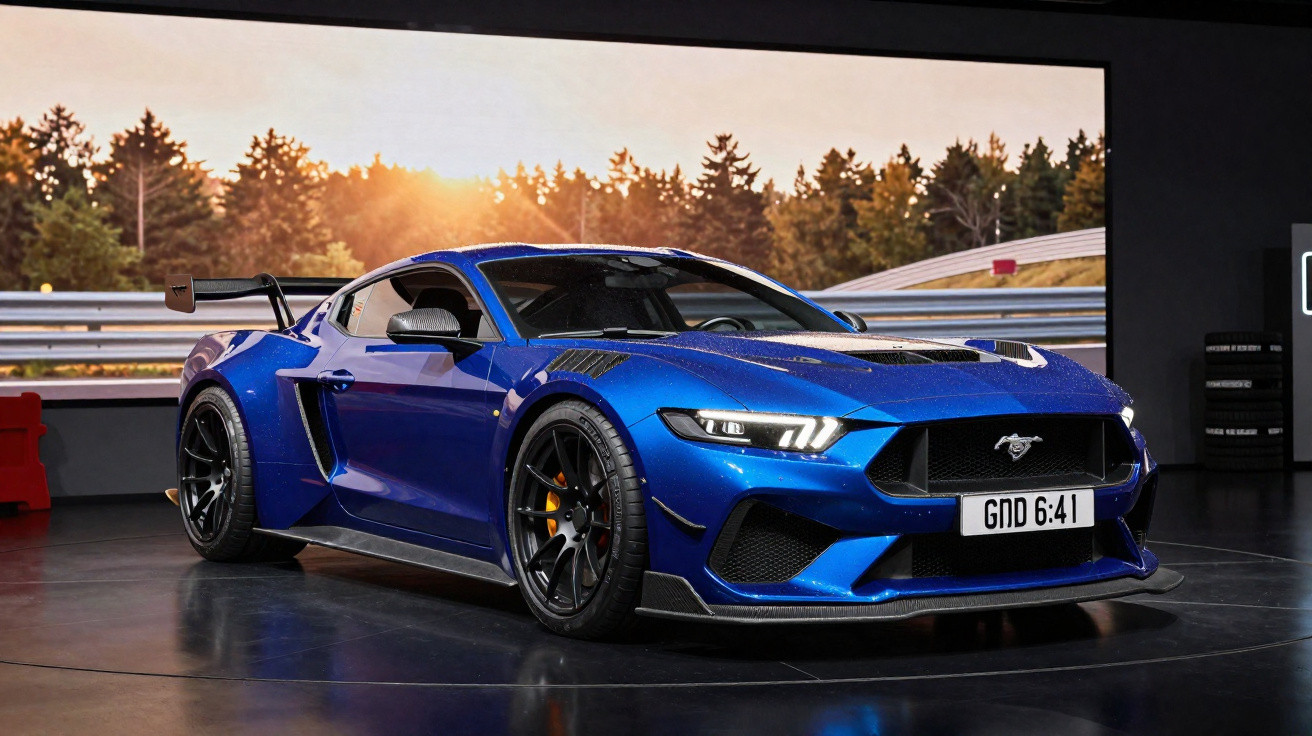
A YouTube video that has, predictably, since been removed appears to show a Ford Mustang GTD in full attack mode on the Nürburgring Nordschleife. A spotter at the trackside times the lap manually, with the result reading 6:41,74 minutes. It is not official, but it is spectacular. And it could reignite the lap-time battle between Ford and Chevrolet.
What lies behind the alleged 6:41 lap
The footage came from the StatesideSupercars channel and was shot from a fixed position on the Nordschleife. In traditional fashion, the person filming starts a stopwatch as the Mustang GTD flashes past, then stops it when the car races through the frame again. The recorded lap is 6:41,74 minutes, although a few tenths of uncertainty are inevitable.
However, the camera captures neither the official start line nor the finish line. The figure relates to just under 20.8 kilometres of the Nordschleife, making it a credible approximation rather than a precisely measured manufacturer-grade result.
Alleged 6:41 minutes: more than ten seconds quicker than the Mustang GTD's previous official factory time.
Ford has already published two official times: initially 6:57,685 minutes, followed by 6:52,072 minutes. The newly reported figure would therefore represent an improvement of more than ten seconds - on a circuit where teams normally fight for tenths.
Ford Mustang GTD: road legality meets hardcore racing engineering
The Mustang GTD is far from an ordinary pony car in any case. Beneath its striking bodywork sits a package developed with an intense circuit focus. It starts with the current Mustang, but Ford and its partner Multimatic have pushed the car towards a GT3-like character.
- Front-mounted V8 producing well over 800 PS in its final specification
- Transaxle layout, with the gearbox at the rear axle for improved balance
- Extreme aerodynamics featuring a large rear wing and diffuser
- Adjustable suspension with a track-oriented set-up
- Price range: more than 300,000 dollars, or roughly from 275,000 euros
Ford recently used the “Liquid Carbon” version at the US Laguna Seca circuit to demonstrate how far the GTD can be taken visually and technically. Exposed carbon surfaces, a high-downforce package and an uncompromising appearance make the intention clear: circuit performance comes first, with visual drama merely a by-product.
The GTD seen in the video is no standard road-going toy
A close look at the footage quickly reveals that this Mustang GTD is not the specification an ordinary customer would select in the configurator. Large aerodynamic fins, known as dive planes, sit at the outer edges of the front bumper. At the rear, the wheels wear aerodynamic disc covers of the kind popular in 1980s motorsport.
Visually, the car recalls the familiar Performance or Carbon production packages, but appears to be even more extreme. More wings, more surfaces and more airflow management all point towards a special package beyond anything officially shown so far.
The GTD shown looks like a factory Nordschleife kit - somewhere between a Clubsport car and a race car.
A lap-time gain of more than ten seconds suggests a tightly integrated combination of aerodynamics, suspension tuning and substantially optimised electronics. Observers suspect a project Ford is developing with Multimatic to extract the final margin from the underlying design.
It sounds like Manthey - just with a Ford badge
The comparison quickly arises in this context: Porsche has been gaining extra seconds on the Nordschleife with Manthey kits for years. These packages officially retain road approval, yet effectively apply racing technology to a production-car base. That is precisely the impression given by the Mustang GTD seen in the video.
If Ford is targeting a record as the “fastest front-engined production car” with a similar package, that package would need to be available for purchase. Only then would enthusiasts accept the run as a genuine production-car record. Many observers therefore expect a “Track Package” to arrive later as a very expensive, limited-sale option.
Ford versus Chevrolet: the quiet war for the Ring crown
A discreet brand war has been playing out on the Nordschleife for years, especially among US manufacturers. The Dodge Viper held the “fastest American” title on the Nordschleife for a long time. The Mustang GTD then entered the picture, only to be surpassed shortly afterwards by the Chevrolet Corvette C8 ZR1 and the even more extreme ZR1X.
| Model | Engine layout | Nordschleife lap time* |
|---|---|---|
| Ford Mustang GTD (official) | Front engine | 6:52,072 min |
| Ford Mustang GTD (video, unofficial) | Front engine | 6:41,74 min |
| Chevrolet Corvette ZR1 | Mid-engine | 6:50,763 min |
| Chevrolet Corvette ZR1X | Mid-engine | 6:49,275 min |
| Mercedes-AMG One | Mid-engine, hybrid | 6:29,090 min |
*Figures are partly factory times and partly publicised best performances.
With a confirmed 6:41 lap, the Mustang GTD would not take the outright top spot, but it would place itself clearly behind the Mercedes-AMG One. Above all, it would become the fastest front-engined car ever driven around the Nordschleife, whether officially or semi-officially.
Significantly, the alleged run has emerged at exactly the time Chevrolet is preparing new versions of the Corvette C8. Put politely, Ford's presence appears anything but accidental. When asked about the Corvette attacks, Ford representatives had already responded tersely with “Game on” - the message is unmistakable.
How much is a manually timed Ring run worth?
For all the excitement, there is a sober question to ask: how reliable is a figure measured with a stopwatch at the trackside? Manual timing naturally introduces measurement errors, including those caused by reaction time. There is also no clear definition of the start and finish points, as the camera does not show the official timing line.
Manufacturer records generally follow a clearly defined protocol using official timekeeping, often with independent observers present. Nothing of that kind is known in this case. Ultimately, the 6:41 looks more like an internal statement of intent: Ford is demonstrating what can be achieved with a development set-up.
Without official confirmation, the figure remains strong evidence rather than a recognised record.
For hardcore fans, that matters only to a limited extent. What they can see is that the Mustang GTD's technical potential apparently extends far below the seven-minute mark. The logical question now is: when will Ford follow up with an official lap, and with which package?
What does this mean for deep-pocketed customers?
Anyone prepared to pay more than 300,000 dollars for a Mustang GTD usually has one aim: a car that delivers without compromise on a race circuit. A possible future extreme kit capable of officially achieving a 6:41 lap would immediately put the GTD in a class of its own.
There would, however, be several considerations for buyers:
- Track focus: Such a package would make the car even more circuit-focused, with comfort and everyday usability suffering noticeably.
- Tyre wear: Tyres offering extreme grip are expensive and wear rapidly on public roads.
- Value development: Limited track packages can significantly increase collector value - provided they are clearly documented and official.
- Homologation: Depending on the market, road approval could become an issue with extreme aero kits.
Many enthusiasts use cars of this type primarily for track days anyway. A package expressly tuned for the Nordschleife and similar circuits offers a tangible advantage there: the car can be driven more quickly while also feeling more stable, because its suspension, tyres and electronics are calibrated to work together.
Nordschleife lap times: fascination, risks and side effects
Nordschleife lap times have become an unofficial measure of performance for sports cars. Manufacturers promote improvements measured in fractions of a second, while fans debate every gain intensely. In the process, several factors can easily be overlooked.
First, such times are always snapshots: weather, track conditions, tyre pressures and the driver's form all play a part. Second, record chases can encourage some customers to drive far beyond their own ability on public country roads, simply because the car is so capable on paper.
Anyone driving a Mustang GTD or a comparable vehicle therefore needs more than money: training, respect for speed and technology, and ideally an experienced instructor. The abilities of such a car can be explored far more safely on closed circuits than on the country road to the ice-cream parlour.
It will be interesting to see how Ford responds. An officially confirmed record lap in a clearly defined configuration would immediately take the discussion around 6:41 to another level. Until then, the mysterious run remains above all one thing: fuel on the fire of a brand war that fans will be happy to see continue for a long time yet.
Comments
No comments yet. Be the first to comment!
Leave a Comment