
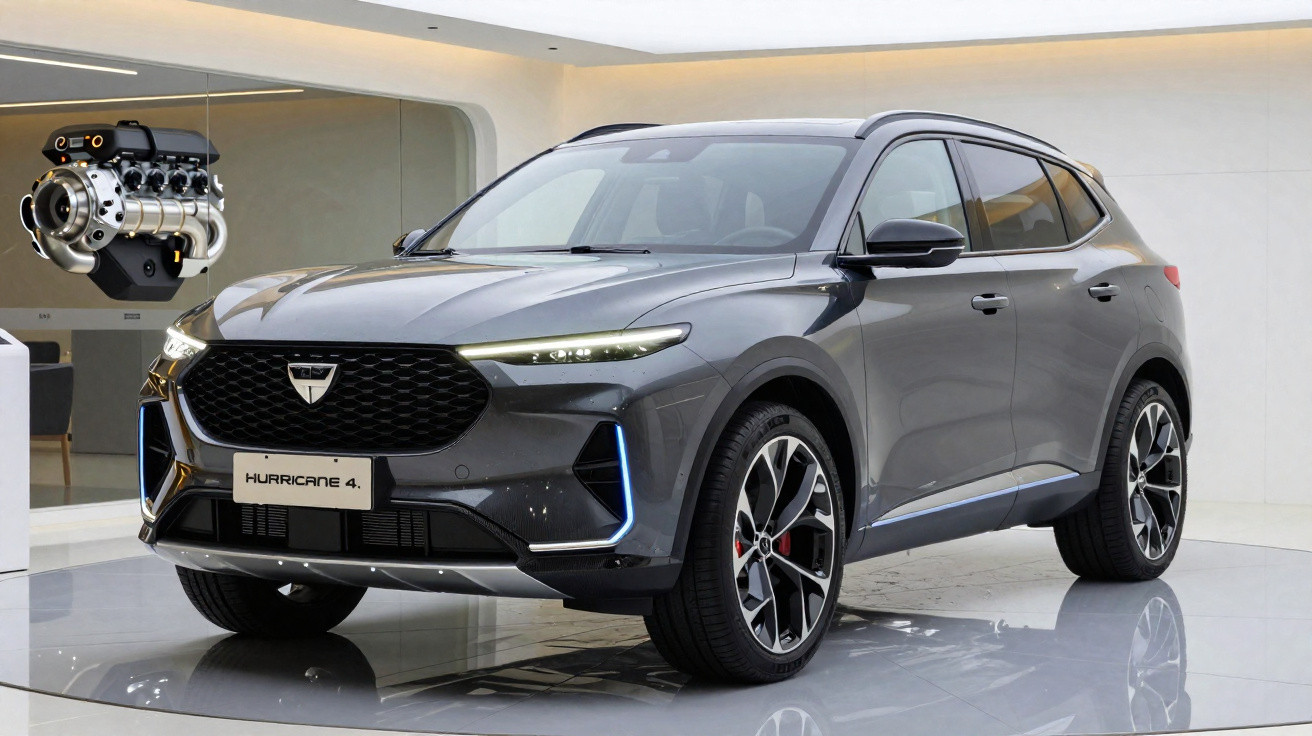
While the automotive world debates range and charging times, Stellantis has chosen to break new ground with a petrol engine. The new Hurricane 4 Turbo is a 2.0-litre, four-cylinder unit producing 330 hp and 450 Nm, yet it is the technology behind it that makes the biggest impression.
It brings to mind Mark Twain’s famous line: “the reports of my death have been greatly exaggerated”. It seems particularly fitting for the internal-combustion engine, and for this example in particular.
Making its debut in the 2026 Jeep Grand Cherokee, it is set to become one of the group’s most significant engines in the years ahead.
A concentration of technology
This engine replaces the GME T4 (Gasoline Medium Engine), found in models such as the Alfa Romeo Giulia and Stelvio. It also receives an appropriately American-style name: Hurricane 4 Turbo, sharing its name with the group’s straight-six engine.
It retains its predecessor’s cylinder count, displacement and turbocharging, but the similarities stop there. It introduces a number of sophisticated solutions that remain unusual in a mass-produced four-cylinder engine.
Perhaps the most important is Turbulent Jet Injection (TJI) technology, which originated in Formula 1. In practical terms, each cylinder has a small pre-combustion chamber with its own spark plug, into which a highly compressed air-fuel mixture is injected.
Igniting this mixture is intended to create a faster, more even combustion event, improving both output and efficiency. This is not the first time the technology has appeared: it is the same system Maserati introduced with the Nettuno, its twin-turbo V6 used in the MCPura, formerly the MC20, and the GranTurismo.
The result is two spark plugs per cylinder, together with dual fuel injection. Fuel can be injected directly, indirectly, or through both systems at the same time. Electronic management determines in real time which approach to use in order to prioritise power or efficiency.
The Hurricane 4 Turbo’s technical credentials extend further. It uses a variable-geometry turbocharger with electrically controlled vanes, enabling up to 2.4 bar of boost pressure (35 psi) while also delivering immediate response at low engine speeds. Stellantis says that 90% of peak torque is available from just 2600 rpm.
Hurricane 4 Turbo engineering built to last
So much technology and such a high specific output of 165 hp/l in a mass-produced engine - especially one launching in a large, heavy SUV such as the Grand Cherokee - naturally raises questions over reliability and longevity. Its figures are comparable with those of the 2.0-litre engine in the much lighter Honda Civic Type R.
Stellantis says it has prepared accordingly. Compared with the previous GME T4, the Hurricane 4 Turbo’s aluminium block has been redesigned with cylinder walls that are 24% thicker and plasma-coated - a finish said to be 10 times more resistant to wear than conventional iron liners - along with larger connecting-rod journals.
Its ancillary systems have also been upgraded, including a variable-displacement oil pump, an electric water pump and a liquid-to-air cooling circuit for the intercooler, all designed to minimise mechanical losses.
The engine runs on the more efficient Miller cycle and has a 12:1 compression ratio. That is a high figure for a turbocharged engine, particularly one with these power and torque outputs - the Maserati V6, for instance, has an 11:1 ratio - and offers another indication of its efficiency.
Ashish Dubey, the project’s chief engineer, told The Drive that the new four-cylinder engine had been “validated over hundreds of thousands of kilometres of testing”, addressing concerns about the durability of an engine with this level of turbocharging.
Lower fuel use, greater flexibility
According to Stellantis, the Hurricane 4 Turbo uses 10% less fuel and delivers 20% more power than the previous 2.0-litre turbo engine, despite producing an additional 50 hp compared with the engine used in Alfa Romeo models. Maserati previously fitted the Ghibli with a 48 V mild-hybrid version of that engine that also produced 330 hp, but the new engine’s technological arsenal is on a different level.
It was also designed from the outset to accommodate hybrid and plug-in hybrid configurations, meaning it is likely to become a key component in Stellantis’s energy transition - paradoxically, through combustion.
The 2026 Jeep Grand Cherokee will be the first model to receive it, although Stellantis intends to install the engine in many more vehicles. North American models will come first, where it is expected to progressively replace the Pentastar V6.
It would also be no surprise if the successors to the Alfa Romeo Giulia and Stelvio - postponed until 2027 to incorporate internal-combustion powertrains - were among the most likely candidates to receive it.
In a world fixated on batteries and zero emissions, a 2.0-litre turbo engine with 330 hp sounds almost heretical, while showing that the internal-combustion engine still has plenty of life left. After all, as Mark Twain might say, reports of the internal-combustion engine’s death continue to be greatly exaggerated.




Comments
No comments yet. Be the first to comment!
Leave a Comment