
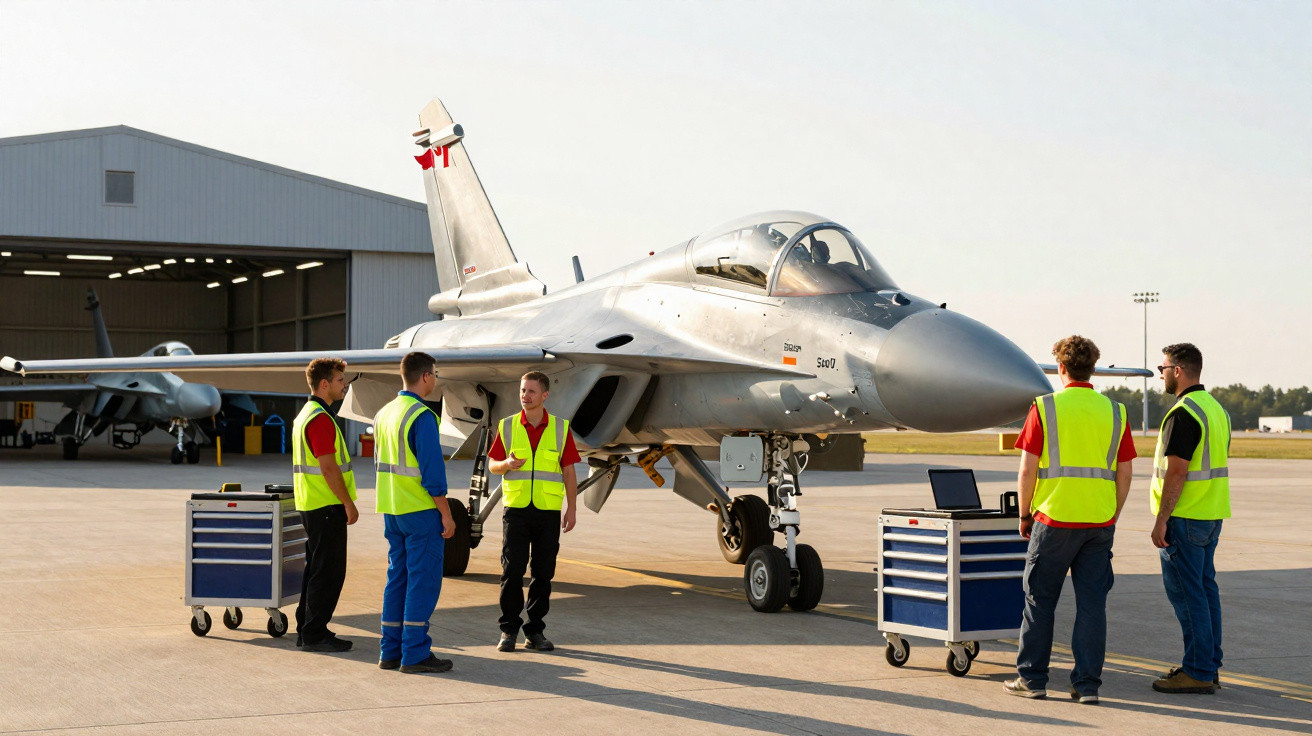
Saab’s Gripen E/F and GlobalEye proposal for Canada
Seeking to secure a role in the Canadian Air Force’s modernisation programme while also delivering on promises to create jobs in Canada, Saab has stepped up its bid to supply the service with up to 72 new Gripen E/F fighter jets and up to 6 GlobalEye airborne early warning aircraft. According to local reports, the Swedish company’s proposals are already being examined by panels comprising both defence and economic specialists, as Ottawa faces a period of strained relations with the United States, which is backing the F-35 bid.
Canadian analysts have indicated that Mark Carney’s government is particularly interested in the prospect of diversifying its arms suppliers while increasing the involvement of domestic industry, in an effort to gain greater independence from its North American neighbour. Saab has also said it would consider Canada as a location for production facilities to build aircraft for Ukraine, which could create up to 10,000 jobs and make the proposal more politically appealing from an economic perspective.
An illustration of this position came in recent remarks by Canada’s Minister of Industry, Mélanie Joly, who stated: “The government is interested in all major projects that can not only protect Canada’s security and sovereignty, but also create jobs across the country. We certainly cannot control President Trump, but we can control our defence investments, to whom we award contracts and how, ultimately, we can create jobs in Canada. Therefore, we are going to focus on that.”
Gripen E/F impact on Canada’s F-35 plans
As noted above, selecting the Gripen fighter bid would clearly affect the number of F-35 aircraft Canada would purchase. The country had already confirmed plans to acquire up to 88 stealth fighters through an investment of around 27 billion dollars. However, that total would be drastically reduced if the purchase of 72 Gripens went ahead, prompting extensive debate about the resulting implications.
Among the issues being considered, Canadian analysts remain uncertain whether the Air Force can integrate two new fighter fleets at the same time under the present circumstances. In addition, the details of Saab’s job-creation proposal have yet to be fully disclosed. From a strategic perspective, there are also serious doubts about whether Washington would be willing to integrate Swedish-built fighters into NORAD, a matter that is fundamental to Canadian defence planning.
Public opinion and the Canadian fighter aircraft decision
The matter has also reached public debate, with opinion divided over the available options. According to polls published on the subject, the largest group of respondents supports introducing a fleet made up entirely of Gripen fighters. This is followed by a proposal for a fleet that also includes the F-35, while the least favoured option is one consisting solely of Lockheed Martin aircraft. Significant differences are also evident depending on each respondent’s political affiliation. This is a relevant consideration, as the Canadian government could ultimately propose an aircraft purchase driven mainly by economic and political reasons in light of current circumstances, rather than giving priority to the platform’s technical capabilities or its effect on defence plans.
Images used for illustrative purposes
You may also be interested in: Construction advances on the first of the Royal Canadian Navy’s new River-class destroyers





Comments
No comments yet. Be the first to comment!
Leave a Comment