
The Paris Agreement set demanding targets for cutting vehicle emissions worldwide. Over the next four decades, CO₂ emissions are expected to fall by roughly 50% globally and by 85% in the most advanced economies.
Let us be realistic. Even if every car were to become electric overnight, other forms of transport - including long-haul lorries, ships and aircraft - would still rely on internal-combustion engines; our article on the subject is well worth reading. Solutions beyond electrification will be needed, as electric power alone will not meet every requirement.
For that reason, it is essential to continue researching and improving the “old” internal-combustion engine. This means investing not only upstream, but also downstream - in other words, in research into the fuels that power it.
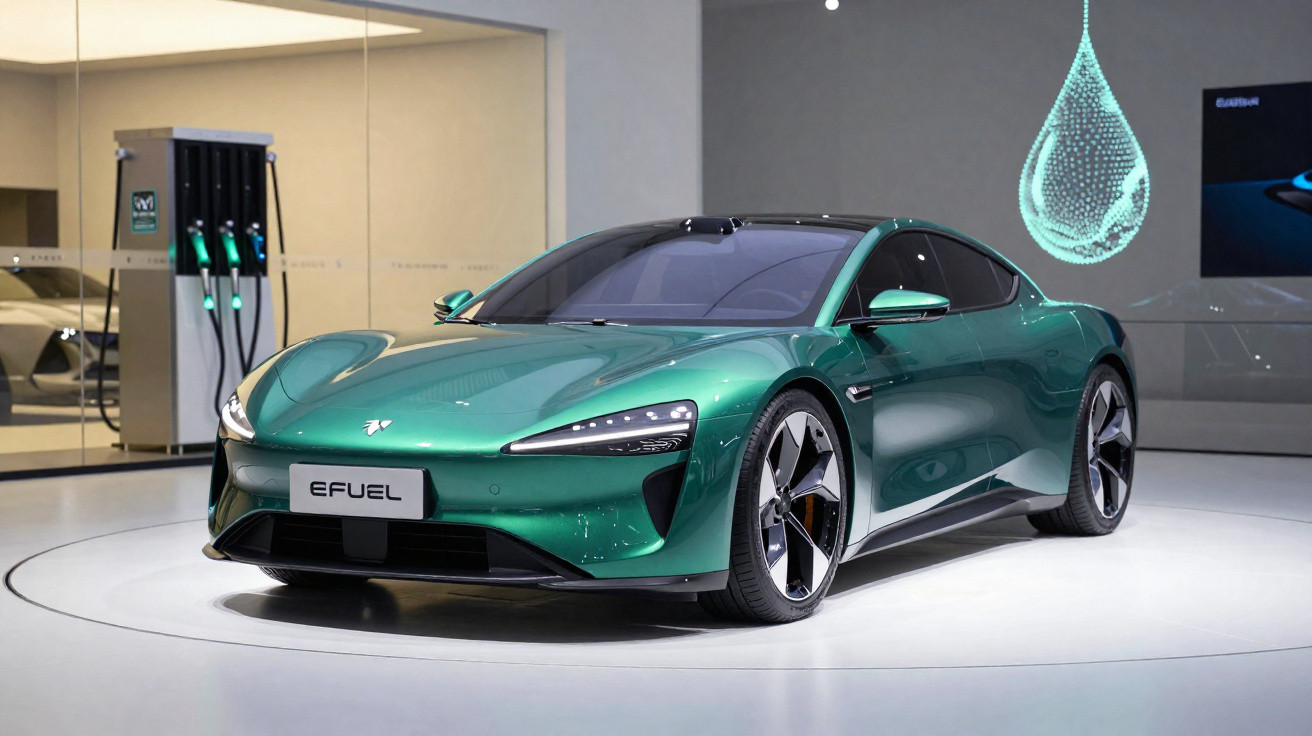
Until recently, the idea that a car with an internal-combustion engine could be CO₂-neutral would have seemed unthinkable. Technological progress now makes that prospect possible. Enter eFuel, a solution presented by Bosch.
eFuel: Bosch’s synthetic fuel solution
The solution: eFuel, the synthetic fuel
Unlike fossil fuels and biofuels, synthetic fuels such as eFuel can achieve carbon neutrality. This is possible because CO₂ - a greenhouse gas - is used as a raw material to produce petrol, diesel and benzine using renewable electricity sources.
Bosch says that widespread use of eFuel-type synthetic fuels could prevent 2.8 gigatonnes of CO₂ from being released into the atmosphere. That would not be their only advantage, however.
Synthetic fuels can be formulated to burn with virtually no soot. This would also reduce the cost of exhaust-gas treatment. There would be no need to build a new refuelling network either, as the existing infrastructure could remain in use.
Can current cars use eFuel?
No modifications of any kind are required for vehicles to use this fuel, whether they are recent models or classics. In chemical structure and fundamental properties, synthetic petrol remains… petrol. Whether it is eFuel or not.
Its introduction and uptake could therefore happen quickly - far more quickly than electrifying the entire current vehicle fleet.
Versatility is another benefit. Synthetic fuel requires H₂ (hydrogen), to which CO₂ is added in order to create a liquid fuel. As H₂ is the first component produced, it could also be used to power fuel cells.
The prospects and production of eFuel
When could eFuel become a reality?
At present, the chief obstacle to the large-scale rollout of synthetic fuels is their associated cost. Bosch states that, although development support already exists for these fuels - including in Germany and Norway, where pilot programmes are under way - processing facilities are expensive and there are not enough test plants.
For costs to come down, synthetic fuel use would need to increase, while the price of electricity generated from renewable sources would have to fall for the proposition to become realistic. According to the latest studies, synthetic fuels such as eFuel could cost between €1.0 and €1.4 per litre before tax in the long term.
In Bosch’s cost modelling, a hybrid vehicle using synthetic fuels would cost less to run than an equivalent electric car up to 160,000 kilometres, depending on the renewable energy source used. These calculations already take account of the downward cost trend for electric cars.
What are synthetic fuels such as eFuel made from?
Synthetic fuels are created by combining CO₂ with H₂ to produce liquid fuel. Hydrogen is made from water (H₂O), while CO₂ can be sourced through industrial recycling processes or captured directly from the air using filters. Combining H₂ and CO₂ can produce several types of synthetic fuel: petrol, diesel, gas or even kerosene.
To be carbon-neutral, they must be produced exclusively using renewable energy.
What is the difference between eFuel and biofuels?
The key distinction lies in how they are made. Biofuels are derived from raw materials such as sugar cane, maize or beetroot. Their production depends on external factors, including the amount of available land and the climate. Synthetic fuels, by contrast, can be produced without limitation when linked to renewable energy sources.
Comments
No comments yet. Be the first to comment!
Leave a Comment