
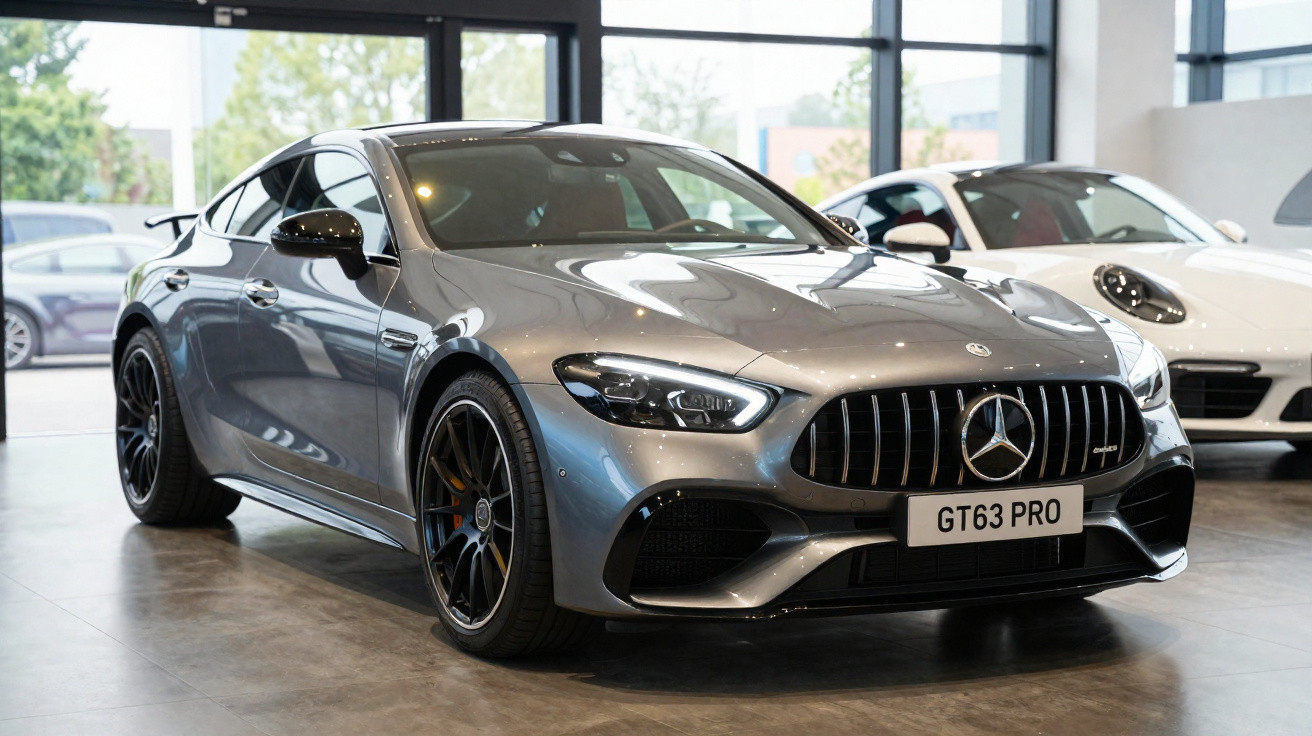
On paper, the two cars appear to be direct competitors: two-door sports cars with rear seats, huge power outputs and German engineering. In practice, AMG says their customers think very differently. Anyone considering the GT 63 Pro is usually already part of the AMG world and rarely looks towards what is available in Zuffenhausen.
A sports car not intended to take on the 911
Objectively, the Mercedes-AMG GT 63 Pro occupies the same territory as a Porsche 911: a traditional coupé, a 2+2 seating arrangement and exceptionally powerful engines. They inevitably sit alongside one another in price lists and comparison tests. Yet AMG is keen to reject that comparison in its communications.
The message from Affalterbach is that the typical buyer does not cross-shop the two models. AMG drivers remain loyal to AMG. This pattern is particularly clear in markets such as Australia, where the GT 63 Pro has only just gone on sale.
According to AMG, most buyers do not come from the Porsche camp, but directly from other AMG models - and want to take the next, even more radical step.
That changes the perspective: for many people, the GT 63 Pro is not an alternative to the 911, but a reward for long-standing AMG enthusiasts moving from a fast SUV or powerful saloon into a genuine sports car.
Front engine rather than rear: a different architecture and character
Technically, these two sports cars are worlds apart. For decades, the 911 has used a rear-mounted engine, giving it its distinctive and unconventional driving character. The Mercedes-AMG GT 63 Pro instead follows the traditional grand-tourer formula, with the engine at the front, a long bonnet and a broad, imposing rear end.
That layout affects everything, from weight distribution and turn-in response to stability at the limit. Mercedes' approach feels more familiar to drivers stepping out of large AMG saloons or SUVs. As a result, moving from a G 63 or E 63 to the GT feels less like a complete culture shock.
Where the philosophies diverge
- Porsche 911: a compact, rear-biased sports car with its engine behind the rear axle, intensely focused on driving dynamics and heritage.
- Mercedes-AMG GT 63 Pro: a long, front-engined grand tourer offering strong everyday usability, a powerful GT character and brutal straight-line performance.
- Target audience: 911 owners often regard themselves as “Porsche people”. GT 63 buyers are more likely to see themselves as “AMG people” and remain loyal to that camp.
Similar performance figures therefore do not mean that the cars appeal to the same emotions. AMG deliberately offers a different driving style and a different sense of lifestyle.
610 PS V8: at the heart of the AMG experience
At the centre of the GT 63 Pro is AMG's familiar 4.0-litre twin-turbocharged V8. In this specification, AMG has raised the stakes again, with 610 PS and a substantial 850 Nm of torque listed on the specification sheet. Compared with the “standard” GT 63, that represents an increase of 26 PS and 50 Nm.
A nine-speed automatic transmission sends that power to all four wheels, assisted by 4Matic+ performance all-wheel-drive technology. This enables the GT 63 Pro to deploy its output extremely effectively. Traction is hardly the issue; the real question is how much confidence the driver has.
3.1 seconds from 0 to 100 km/h and a top speed of 317 km/h - the GT 63 Pro is clearly brushing against supercar territory.
This places the AMG almost precisely between two versions of the current 911:
- Porsche 911 GTS T-Hybrid: 535 PS, 609 Nm
- Porsche 911 Turbo S: 711 PS, 800 Nm
In terms of output, the GT 63 Pro sits between them - a kind of German middle ground in an already extreme segment. Those figures also make one thing clear: anyone interested in this car has no reason to browse the compact-car aisle.
Who actually buys the GT 63 Pro?
The answer from Affalterbach is strikingly clear: people who already own an AMG. Many are trading in a V8-thundering G 63 or an E 63 saloon. Others simply add the GT 63 Pro as an extra fun car to an already well-stocked garage.
For this clientele, three factors are central:
- Brand loyalty: drivers who identify with AMG want that badge on their sports car too.
- Progression rather than a switch: the internal logic is not “away from AMG”, but “even more AMG”.
- A distinctive presence: the GT looks more muscular and more luxurious than many 911 variants. That suits drivers who enjoy standing out.
Within that mindset, the 911 barely enters the equation. It exists and is regarded as a reference point, but more as a benchmark in the background. The actual buying decision has already been made in customers' minds: AMG or not AMG.
Sound and presence: two characters, two camps
Emotionally, two automotive cultures collide here. The high-revving boxer engine in the 911 has a mythology of its own. Anyone who has heard a 911 in Sport mode inside a tunnel is unlikely to forget it quickly.
The GT 63 Pro responds with the entirely different force of an AMG V8. It is deeper, darker and more aggressive on acceleration. At higher revs in particular, its soundtrack feels almost threatening: far less refined and more like a statement on four wheels.
The unmistakable AMG sound appeals precisely to buyers who enjoy waking the neighbourhood on a cold start - and are not remotely ashamed of it.
The AMG's design follows the same approach: a long bonnet, an enormous grille, wide haunches and considerable visual presence. Beside it, the 911 appears almost elegantly restrained. They represent two completely different versions of sportiness.
Why the comparison is still worthwhile
Even though AMG officially stresses that its customers seldom look at Porsche, the comparison remains interesting for prospective buyers. Anyone taking an open-minded approach will quickly discover that each concept has clear strengths depending on how the car will be used.
| Feature | Mercedes-AMG GT 63 Pro | Porsche 911 (GTS / Turbo S) |
|---|---|---|
| Engine position | Front, longitudinally mounted | Rear |
| Power | 610 PS | 535–711 PS |
| Drivetrain | All-wheel drive (4Matic+) | Rear-wheel or all-wheel drive (depending on version) |
| Character | Grand tourer, suited to long distances, highly assured | Classic sports car, very direct, engaging to drive |
| Typical driver | Existing AMG customer | Committed Porsche enthusiast |
Anyone coming from a G 63 or E 63 will feel immediately at home in the GT 63 Pro: its controls, brand feel and soundscape are all familiar. Moving to a 911, by contrast, would require more adaptation, especially in terms of space and driving behaviour.
How this trend affects the sports-car market
This clear separation illustrates how powerful brand identity is in the high-performance sector. Technical specifications and lap times matter, but an emotional connection with a marque often carries more weight. That is exactly what AMG relies on with the GT 63 Pro.
For the market, it means that these supposed rivals take fewer customers from each other than many people expect. Those who move in Porsche circles tend to stay there. Those who love the muscular, loud AMG approach are more likely to move further up within the brand.
It will be interesting to see how this strategy holds up amid tighter emissions rules and increasing electrification. A 4.0-litre V8 with 610 PS is no longer an automatic choice for the future. Manufacturers must show performance enthusiasts how they will move towards electrification without diluting their brand DNA.
That leaves buyers with a strategic question: should they choose the traditional V8 now, while it is still available? Or should they wait for an electrified AMG variant that may be faster, but also quieter and more rational? The GT 63 Pro sends a clear message here: AMG still believes in the V8 as an anchor of its identity - and that is exactly what its established customers want to hear.
Comments
No comments yet. Be the first to comment!
Leave a Comment