
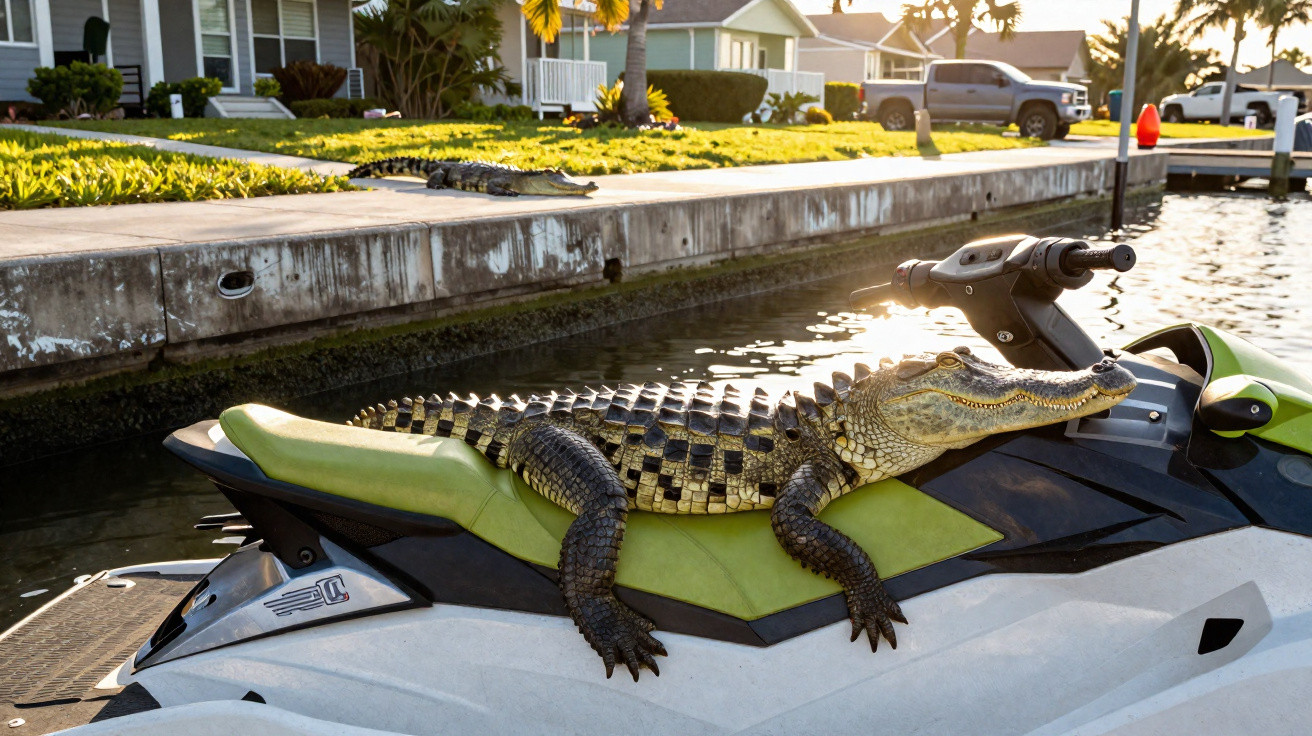
What may look, at first glance, like an amusing photo opportunity is actually a quiet distress signal from the animal world. In South Florida, American crocodiles are increasingly using boats, paddleboards and jetties as sun loungers because their natural basking spots have all but disappeared.
When concrete shorelines become a trap for crocodiles
American crocodiles once rested on shallow sandy shores and natural banks in South Florida’s bays and mangroves. They could spend hours basking there, undisturbed by people or motorboats. In many places, these areas have vanished, replaced by:
- concrete walls and reinforced shorelines
- narrow residential canals with private docks
- marinas, slipways and harbour facilities
While these structures are convenient for people, they create stress for crocodiles. The animals need shallow, dry and preferably quiet places where they can warm themselves. Without such basking sites, their bodily functions are disrupted.
“Without regular basking, crocodiles can neither digest properly nor defend themselves effectively against disease – in the long term, it costs them their lives.”
Biologists in Florida now regularly report animals climbing on to unattended jet skis, kayaks, paddleboards or low floating jetties. Although such scenes quickly become viral jokes on social media, specialists regard them as a clear sign that the animals are being forced to adapt to an environment that is becoming increasingly hostile to them.
The return of American crocodiles – and new conflicts
Ironically, the population trend of American crocodiles in Florida is considered a conservation success story. In the late 1980s, researchers counted only around 200 adult animals. Today, the responsible research institute estimates the population at approximately 2,000 individuals.
Yet this success comes at a cost: crocodiles are moving ever further into populated areas. Many of these residential districts lack natural basking places altogether. Where there might once have been a sandbank, there is now concrete. Instead of mangroves, lawns extend right to the canal edge.
For crocodiles, this leaves only what people leave behind: an unused jet ski, a kayak chained to the dock after a party, or a low dock where nobody is sitting at midday.
Why basking is vital for crocodiles
Their bodies depend on warmth to function properly
Crocodiles are ectothermic animals. They generate very little body heat themselves and adjust their metabolism according to the surrounding temperature. Sunlight acts as their biological heating system.
Without sufficient warmth, key processes can function only to a limited extent:
- Digestion: At temperatures that are too low, food remains in the stomach for a long time, allowing putrefactive bacteria to thrive.
- Immune system: Many pathogens do well at moderate temperatures, whereas heat harms them.
- Reproduction: Mating, egg production and embryo development are all strongly dependent on temperature.
When basking sites disappear, every one of these systems is weakened. An animal that cannot warm up properly grows more slowly, is more susceptible to infections and produces fewer healthy offspring.
Heat as a defence against parasites
A similar pattern can also be seen in other reptiles: infected lizards spend noticeably more time in the sun. Researchers call this “behavioural fever” – the animal deliberately raises its body temperature to kill parasites and bacteria.
Heat has several effects:
- Many microorganisms tolerate high temperatures poorly.
- UV radiation directly damages parasites, including mites and certain fungi.
- External parasites become more active, making them easier to spot and remove during subsequent grooming.
For crocodiles in densely developed areas, this means that if they cannot find a suitable place in the sun, small health disadvantages can accumulate over the years and ultimately become life-threatening.
From lemurs to vultures: basking as an ongoing survival strategy
The phenomenon is not limited to reptiles. Numerous birds also use sunbathing very deliberately. Specialist wildlife behaviour resources list around 50 species that stand in the sun in conspicuous poses. Vultures, for example, often spread their wings wide in the morning. They appear to do so to kill germs picked up while feeding on carrion.
The ring-tailed lemurs of Madagascar are even more striking. After cool nights, they sit in a characteristic posture: backs rounded, arms slightly spread and their pale bellies fully exposed to the sun. Researchers believe this routine has several effects:
- warming up after a cold night in order to become active quickly
- producing vitamin D in the skin
- increasing serotonin, which affects mood, sleep and stress responses
Whether crocodile, lemur or vulture, a sunny spot is not a wellness feature but a component of physical stability.
What the Florida scenes really reveal
An image of a two-metre-long crocodile lying motionless on a jet ski in a residential canal can easily be dismissed as a curious snapshot. To specialists, it tells a different story: where people radically reshape landscapes, animals must adjust their strategies or die.
“The sunbath remains, only the surface changes: from sandbank to sports equipment.”
Crocodiles do not simply abandon their biological needs because a villa with a swimming pool now stands where their habitat once was. They seek alternatives, even when those lie in the middle of civilisation and create fresh conflicts.
Possible solutions: basking islands for reptiles
Researchers and authorities in Florida are already developing approaches to reduce pressure on the animals without entirely dismantling coastlines. Proposals under discussion include:
- Floating platforms in canals and harbour basins, designed specifically as basking areas for reptiles.
- Structured shoreline zones instead of smooth concrete walls, using shallow steps or natural stones.
- Targeted protected areas in residential districts where boats do not moor and people do not swim.
Artificial structures have already been created around the Turkey Point power plant facilities to provide crocodiles with safe resting places. Projects like these show that modern infrastructure and reptile conservation do not necessarily have to be incompatible when planned together.
What this means for people in crocodile areas
Anyone living near a canal in Florida or visiting on holiday should not rely solely on warning signs. A few simple rules can significantly reduce the risk of uncomfortable encounters:
- Remove sporting equipment from the water whenever possible after use.
- Do not leave boats and kayaks permanently beside shallow shoreline areas.
- Do not allow pets to drink or swim at the canal edge.
- Never feed wild animals, not even “out of pity”.
This reduces the likelihood of a crocodile discovering a jet ski as a sun lounger – and makes people less likely to approach the animal for a selfie.
A wider trend: wildlife in the shadow of urbanisation
The story of jet-ski crocodiles forms part of a broader pattern. Around the world, animals are increasingly using human-made structures: foxes sleep beneath garden sheds, birds nest in ventilation shafts and fish breed in harbour basins. In many cases, these behaviours are responses to lost habitats.
For urban and regional planning, this means it is worth considering, with every new canal, shoreline reinforcement project and marina, how at least some functions of the original natural environment can be recreated – whether through small basking islands for reptiles, planted banks or quiet zones without boat traffic.
Anyone who looks more closely will see not a “cheeky nuisance” in the crocodile on the jet ski, but an animal trying to survive with minimal means in a radically altered environment. This is precisely where modern conservation begins: not far from civilisation, but right among docks, gardens and concrete walls.





Comments
No comments yet. Be the first to comment!
Leave a Comment