
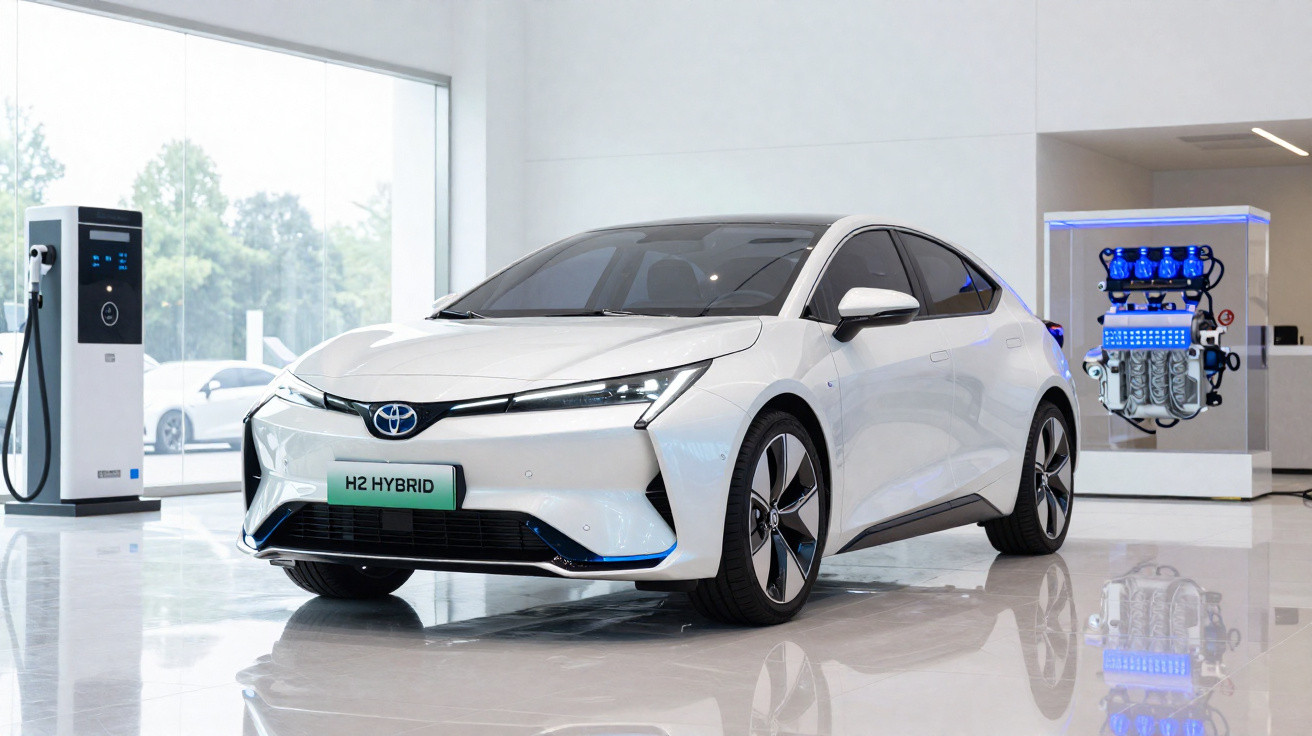
Toyota has already confirmed investment of more than €13 billion in the digitalisation and electrification of its range. Yet combustion engines equipped with hybrid technology will retain a central role in both the Japanese manufacturer’s line-up and, above all, its finances. The company recently reported record profits and sales for the 2023 financial year; Japan’s financial year ends in March.
Speaking to Automotive News, Hiroki Nakajima, Chief Technology Officer at Toyota Motor Corporation, again underlined that importance while sharing further information about the brand’s next-generation engines.
The claims are ambitious. Nakajima says the entirely new technology “could change the rules of the game”. It is a ‘super engine’ not because of its power output, but because of its efficiency.
Hydrogen gives Toyota new ideas
In his comments to Automotive News, Hiroki Nakajima disclosed several details about the engines, including their capacities for the first time: 1.5 and 2.0 litres.
Although these are two very conventional engine sizes, he says they will feature “potentially revolutionary solutions” that are “completely different from current combustion engines”.
So where does this revolution come from? From lessons learned with the Toyota Mirai. By studying hydrogen’s thermal behaviour in the fuel cell, Toyota engineers were able to apply certain findings to the ‘old’ internal-combustion engine.
What will change in Toyota’s new engines?
Toyota’s current hybrid engines are said to achieve energy efficiency of around 40%. Therefore, when the manufacturer refers to “changing the rules of the game”, it may be signalling another advance in efficiency through more effective combustion processes.
Few technical details have been released, but the direction is becoming clearer. Nakajima said the new engines will use a considerably shorter piston stroke. This will support increased power at higher revs, although it will reduce torque delivery at low engine speeds. To offset this loss of pulling power at lower revs, Nakajima stresses the importance of pairing them with hybrid systems.
Toyota’s major progress is therefore expected to lie principally in two areas: management of the engine’s ignition timing and integration of the combustion unit with the electric motor. Nakajima says this new engine family will offer “a lot of freedom to play”, indicating that the company still has many engineering solutions to reveal.
As for timing, Toyota’s new combustion engines are still some way off. The Japanese executive identifies 2027 as the earliest possible launch date for this new generation of engines in the brand’s models.
Source: Automotive News


Comments
No comments yet. Be the first to comment!
Leave a Comment