
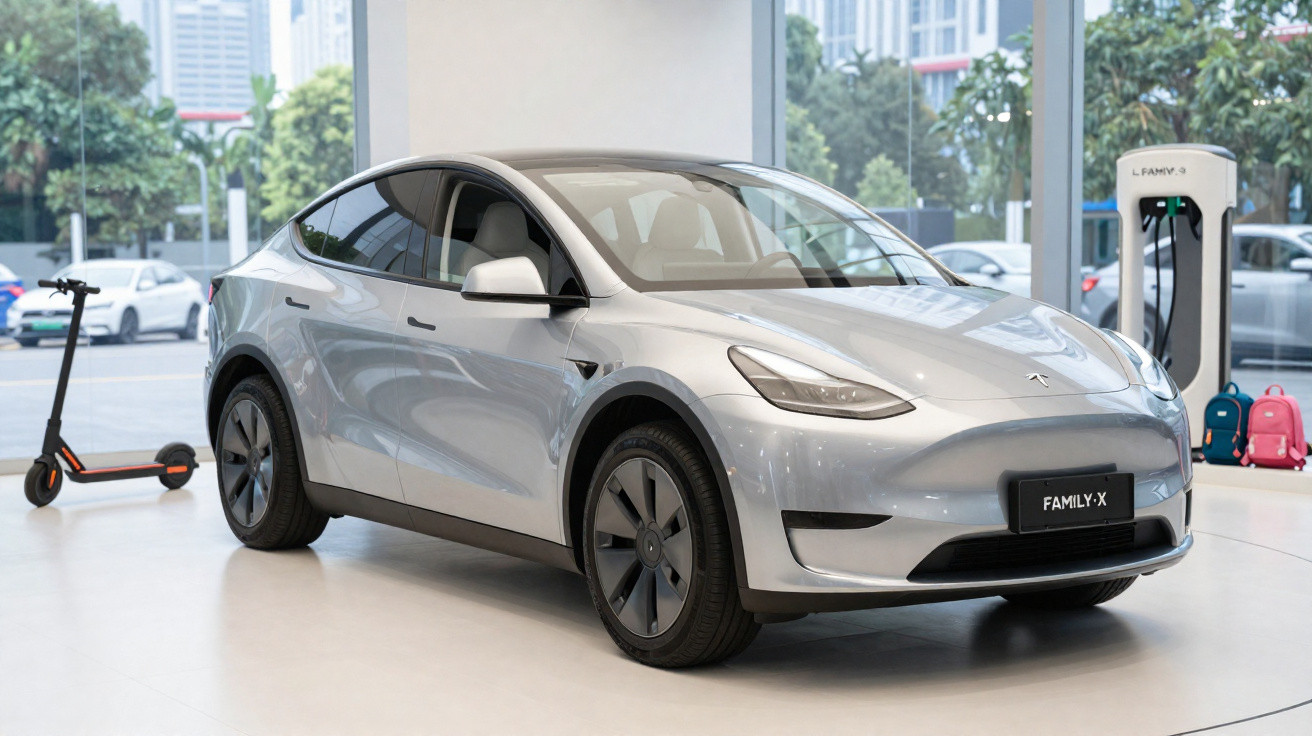
Elon Musk is fuelling speculation: Tesla is said to be developing a new family car – larger than anything before it, angular, futuristic and explicitly not a conventional MPV.
Tesla appears to be approaching a changing of the guard. As the Model S and Model X gradually head towards retirement, Elon Musk is reportedly working on a new family SUV designed for XXL requirements. In a brief but closely watched post on X, Tesla’s chief executive suggested that a far more spectacular vehicle is in development – a clear message to everyone who has spent years hoping for a more conventional family MPV.
Elon Musk makes it clear: no dull family MPV
The discussion began on X, where a user directly urged Musk to finally build a proper family vehicle in the style of a minivan. Demand for practical seven-seat electric cars is considerable, especially among families that currently often turn to hybrid MPVs or large petrol and diesel SUVs.
Elon Musk’s answer was characteristically short and confident. He made clear that Tesla would not simply launch a typical family MPV, but rather a vehicle with considerably more visual impact and emotional appeal.
A standard family car is not enough for Musk – Tesla is planning a large SUV that deliberately distinguishes itself from traditional MPVs.
Tesla is therefore deliberately setting itself apart from manufacturers whose electric strategy centres on practical but visually discreet family vehicles. Musk instead favours a car that combines usefulness, visual drama and a stronger brand image.
The departure of the Model S and Model X makes room for something new
The Model S and Model X are expected to be phased out of the range by summer 2026. With its Falcon Wing doors and optional third row of seats, the Model X was an early demonstration of what a fully electric SUV could look like. Compared with newer rivals, however, the concept no longer feels entirely fresh.
Many buyers have criticised the cramped third row and the somewhat compromised use of cabin space. Other manufacturers now favour more square-cut bodies, greater rear headroom and third-row seats that are easier to access. This is precisely where Tesla now intends to make its move, clearing the stage for a new flagship.
More room, sharper edges and greater usability
The plans point towards a vehicle that will be substantially larger than the Model Y and whose styling will be closer to that of the Cybertruck. It is not expected to be a straightforward copy of the angular pick-up, but rather a related model with a similarly tough foundation.
Current suggestions include:
- body dimensions comparable with the largest SUVs available in the US market
- up to seven genuinely usable seats with increased legroom
- a robust structure capable of handling demanding use and towing duties
- Cybertruck-inspired styling, made more civilised for everyday driving
Tesla would thereby fill a gap of its own making: between the relatively compact Model Y and the unconventional Cybertruck, it currently lacks a truly large, conventional family SUV.
Cybertruck as the foundation: an XXL steel family car
The technical basis could come from the very pick-up that has divided opinion more than almost any other vehicle since its unveiling: the Cybertruck. Its steel construction and modular layout give Tesla a resilient platform capable of supporting various body styles – including a three-row SUV.
The Cybertruck structure can carry enormous loads, provides plenty of space and is built for demanding work – ideal ingredients for an XXL family SUV.
This approach would offer Tesla several advantages. Development costs would fall because much of the underlying technology – the battery, drivetrain and core structure – already exists. At the same time, the platform could enable an interior that ideally offers more room than conventional combustion-engine SUVs, as there is no engine block at the front.
Focus on the US market: a rival to Rivian and Cadillac
Tesla is clearly targeting the especially profitable market for XL SUVs in North America. Vehicles such as the Rivian R1S and Cadillac Escalade IQ are considered benchmarks among large electric SUVs there. They combine lifestyle appeal with off-road looks, luxury with vast interior space.
A new Tesla SUV based on the Cybertruck could enter exactly this segment:
- positioned at the upper end of the market, while remaining below established luxury brands
- a dedicated electric platform rather than a converted combustion-engine architecture
- software features such as “over-the-air” updates and Autopilot
- driving ranges that make long family journeys realistically achievable
Design chief Franz von Holzhausen had already suggested that customers should “wait” to see what Tesla has planned. Behind the scenes, the project therefore appears to be further advanced than the limited public comments indicate.
Why the long-wheelbase Model Y plays only a minor role
The obvious question is this: why does Tesla not simply put the longer version of the Model Y on roads worldwide in substantial numbers? A Model Y with a longer wheelbase and an optional third row is already available in some markets, including Australia and Thailand.
Nevertheless, Musk explicitly does not describe this variant as a priority for the US, and perhaps not for Europe either. The reasoning is strategic: Tesla is not seeking merely “a little more space”, but an entirely different format.
Rather than a slightly stretched best-seller, Tesla seemingly intends to build a genuine giant – clearly positioned above the rest of the range.
An XXL SUV would not only offer higher margins. It would also sharpen the brand’s premium positioning once again and separate the vehicle clearly from the Model Y, which is increasingly established in the mainstream market.
What this could mean for Europe and Germany
It remains unclear whether such a large SUV would reach Europe in this form at all. Multi-storey car parks are tighter, environmental regulations are stricter, and public debate around enormous SUVs in city centres is far more charged than in many parts of the US.
Even so, Tesla could eventually introduce a slightly toned-down version suitable for Europe. One possibility would be a large three-row SUV with a marginally shorter body and an optimised turning circle. In Germany especially, many families are looking for an electric car offering seven proper seats without looking like a van.
Everyday questions for families: range, charging and daily use
For families, practical considerations are often more important than visual drama:
- Range: Holiday journeys with a roof box, pushchair and luggage consume energy. A large battery would be essential.
- Charging speed: Anyone standing at a charging point with three children in the car does not want to wait indefinitely.
- Interior concept: Isofix points, flexible seating, and room for pushchairs and sports equipment determine everyday suitability.
- Towing capacity: Many buyers want to tow caravans, horseboxes or boat trailers electrically.
Tesla could excel in these areas if the new SUV inherits the Cybertruck’s toughness while also delivering the comfort expected from a typical family car.
How the electric family car segment could change
The shift away from the traditional MPV and towards large electric SUVs has already been emerging for several years. Customers value the raised driving position, sense of security and ability to travel beyond surfaced roads when necessary. By comparison, dedicated MPVs can quickly appear to be delivery vehicles, even when they are exceptionally practical.
A new Tesla SUV with seven proper seats could increase pressure on manufacturers that still primarily offer plug-in hybrid MPVs and traditional diesel seven-seaters. If Tesla delivers a vehicle combining range, charging infrastructure and space, many established brands would need to reassess their position.
At the same time, there is a risk: very large electric SUVs are increasingly criticised for their heavy use of materials, energy and road space. Tesla will therefore have to strike a careful balance over how such a giant fits into the rest of its portfolio – between the more mass-market Model Y and the highly polarising Cybertruck.
For interested observers, it is worth keeping terms such as “platform” and “structure” in mind: a shared basis for several models reduces costs and can accelerate innovation. If Tesla uses the Cybertruck architecture intelligently, the angular pick-up and a family SUV could become part of a modular system from which customers benefit directly, through lower prices, more variants and faster model updates.
Comments
No comments yet. Be the first to comment!
Leave a Comment