
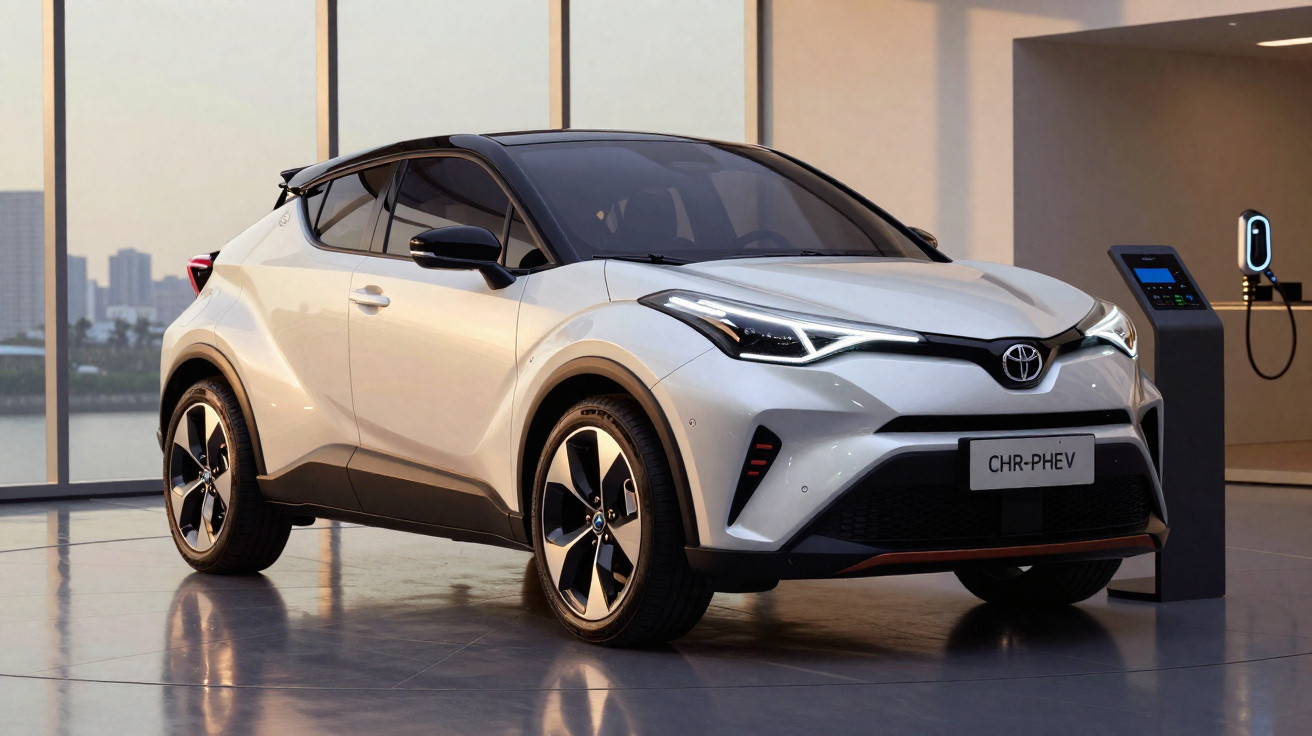
Low consumption and high efficiency, yet the price could “push” the new Toyota C-HR PHEV towards company buyers and put off private motorists. Or could it?
Following the full-hybrid version, which arrived in Portugal in November 2023, Toyota is now introducing the plug-in hybrid, or PHEV, version of the C-HR.
Using the same plug-in hybrid system found in the new Toyota Prius, the C-HR PHEV delivers genuine all-electric range, as well as greater output and stronger performance.
But is that enough to warrant the price gap between the new C-HR PHEV and the familiar 140 hp hybrid C-HR? We drove it in Marseille, in southern France, to find out.
Externally, were it not for the “PHEV” badge on the tailgate and the additional charging flap, it would be virtually impossible to tell this plug-in model apart from the conventional hybrid C-HR.
That is certainly no criticism, though. The exterior styling remains one of the strongest selling points of the new-generation C-HR, currently one of Toyota’s most important models in the European market.
Toyota C-HR PHEV boot capacity has been reduced
While the outside is unchanged from the hybrid C-HR already known, the same is true inside. Apart from several extra physical controls on the centre console and certain dedicated menus in the instrument display, the cabin is unchanged.
That is good news. When I first drove the new-generation C-HR, I said and wrote that it had, in my view, Toyota’s best current interior. Several months on, I can only reaffirm that judgement.
There are soft-touch materials across the top of the dashboard, robust trim and precise assembly, all qualities to which the Japanese manufacturer has accustomed us.
The C-HR also features details normally associated with cars with premium aspirations, starting with its huge panoramic roof with thermal treatment.
What about passenger room?
Despite having a larger battery than the hybrid version, rear-seat space has not been compromised, and passengers up to 1.85 m tall can be accommodated comfortably.
Even so, the rear seats remain somewhat tight, although they are adequate for everyday needs.
As for the boot, capacity suffers in this plug-in hybrid variant. This is not because of the battery, which is “stored” beneath the cabin floor, but because of the placement of the onboard chargers, one of which sits below the boot floor.
As a result, load capacity in the PHEV is limited to 311 litres, compared with 388 litres in the 140 hp hybrid.
This detail creates an even wider divide between the C-HR and the Corolla Cross. While the former is increasingly aimed at buyers looking for a more sophisticated and enjoyable-to-drive offering, the latter is becoming the quintessential family car: roomy and versatile.
The most powerful model in the range
As mentioned at the outset, the C-HR PHEV’s plug-in hybrid system is shared with the new Toyota Prius. It combines a naturally aspirated 2.0-litre four-cylinder petrol engine with an electric motor mounted at the front.
The petrol engine produces 152 hp and 190 Nm of peak torque. The electric motor, meanwhile, develops 120 kW (163 hp) and 208 Nm. Together, they provide a maximum combined output of 223 hp and 208 Nm of maximum torque, sent exclusively to the front wheels.
These figures make this the most powerful and quickest C-HR in the line-up, capable of reaching 100 km/h from rest in 7.4 seconds and a limited top speed of 180 km/h.
The difference is apparent on the road, as it takes only a few kilometres to realise that it offers considerably stronger response than the 140 hp hybrid version we drove a few months ago in Ibiza.
Nevertheless, the overall feel is similar, because everything unfolds progressively and smoothly, with the transitions between the electric motor and petrol engine very well calibrated.
On the subject of calibration, the work carried out by Toyota’s engineers on the brake-pedal set-up and the gearbox’s B mode deserves praise, as both are consistently pleasant to use.
Up to 66 km of electric range
The efficiency of the complete system is equally impressive, beginning with electricity consumption: throughout this first drive, it remained at around 10 kWh/100 km.
At that rate, it would even be possible to exceed Toyota’s claimed 66 km electric range by a considerable margin, given the battery’s 13.8 kWh capacity.
Naturally, this also has a very positive effect on petrol consumption, which stood at around 2.3 l/100 km during this initial drive, covering roughly 150 km.
For me, this is the C-HR’s most compelling argument: it is a genuine consumption champion. Not only can it cover several dozen kilometres in electric mode, but it also returns very low fuel consumption once the battery charge has been depleted.
Firmer suspension
Another aspect that becomes immediately apparent behind the wheel of the C-HR PHEV is that its suspension has a firmer set-up than the 140 hp hybrid. In truth, this is hardly surprising, as there is a 215 kg difference between the two versions.
Even so, the suspension does a good job of filtering out road imperfections, while also making a significant contribution to the C-HR’s highly capable dynamic behaviour.
A version aimed at business customers
Business is the entry-level trim, although the C-HR PHEV can also be ordered in Square Collection, Lounge and GR Sport Premiere Edition specifications.
Designed for the business market, while also available to private buyers, the Business version comes as standard with 18-inch alloy wheels, a 12.3-inch digital instrument display, an 8-inch multimedia screen, heated front seats and steering wheel, dual-zone automatic climate control, a rear-view camera, parking sensors and intelligent adaptive cruise control.
At the top of the Toyota C-HR PHEV range is the GR Sport Premiere Edition, which includes leather and Alcantara sports seats, 20-inch alloy wheels, a head-up display, a nine-speaker JBL sound system and the Night Sky Plus roof.
And the prices?
The new C-HR PHEV is available from €46,020 including VAT for the Business version. However, Toyota expects the Square Collection variant, with a base price of €47,890, to account for the highest number of sales.
For entry-level versions, the price difference compared with the 140 hp C-HR HEV is around €9,000. For private buyers, the latter may still be the more suitable choice, particularly as its fuel consumption is also very appealing.
For those who make short urban journeys and can charge every day at home or at work, the plug-in hybrid could genuinely be the more attractive option, despite the additional outlay.
For companies, however, there is little doubt. The C-HR PHEV is the more valuable proposition, especially when the tax advantages to which these models are still entitled are taken into account.
Comments
No comments yet. Be the first to comment!
Leave a Comment