
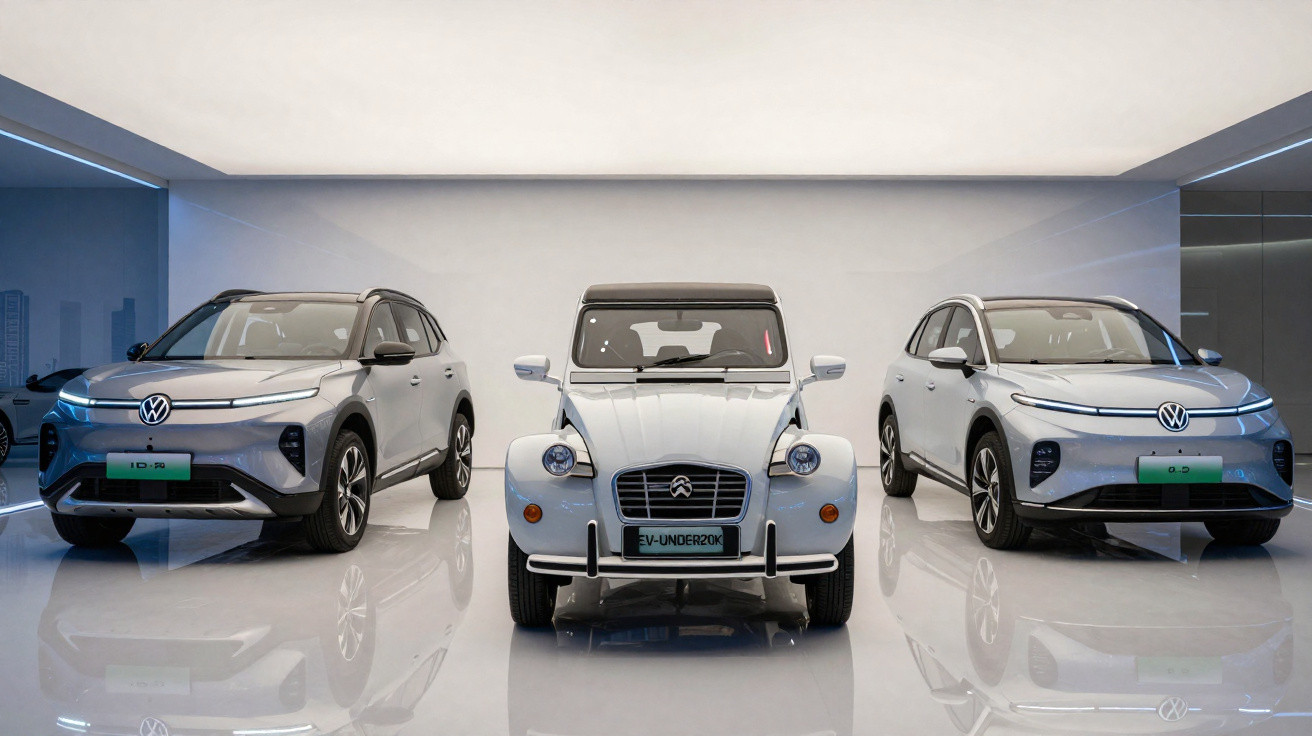
Electric cars are gradually making their way into the lower-priced segments, at figures within reach of more buyers. There are admittedly still few models below the €20,000 threshold, but they now exist - unlike the period before the Dacia Spring arrived in 2021.
This trend is set to gather pace over the coming years, as an increasing number of manufacturers seek a place in a segment led by the Renault Twingo, Citroën ë-C3, Leapmotor T03 and the aforementioned Dacia Spring.
Among all the low-cost electric cars due to arrive over the next two years, however, three stand out immediately and, as the title suggests, have every chance of generating plenty of discussion.
Citroën 2CV
No other model could possibly open this list. Citroën is indeed bringing back the 2CV, launching it as an affordable electric car priced at around €15,000.
Due to arrive in 2028, the new 2CV was previewed in a recently revealed teaser at Stellantis Investor Day. It will make its debut as a prototype at the Paris Motor Show in October.
Very little is known about this model so far, but it has been confirmed that it will share its technical platform with the forthcoming electric FIAT Panda and will be built in Italy.
If its anticipated price point of roughly €15,000 is confirmed, the new Citroën 2CV will take a title long held by Dacia as soon as it reaches the market: “the cheapest electric car on the market”.
Dacia Evader
Talking of Dacia, which has held the “price champion” title among affordable electric cars with the Spring since 2021, another accessible small electric model is on its way. Although it has yet to be unveiled, we already know almost everything about it.
That is because the Dacia Evader - it may be called this - will share its entire technical basis with the Renault Twingo. The latter is offered solely with a 60 kW (82 hp) electric motor producing 175 Nm of peak torque, paired with a 27.5 kWh LFP battery that delivers a claimed range of up to 263 km.
This close relationship also means it will necessarily be larger than the current Spring. The Twingo measures 3.8 m long and 1.7 m wide, whereas the Spring is no more than 3.7 m long and 1.58 m wide, respectively.
However, while the Twingo adopts a more playful and friendly design, the Evader is expected to follow the more adventurous identity Dacia has given its latest models, taking on a tougher appearance.
Its pricing has not yet been announced, but its market positioning means it will need to cost less than the Renault Twingo, which is available from €19,490.
Volkswagen ID.1
Volkswagen will also enter the fray with an electric car priced below €20,000. It will not arrive until 2027, but it will be built in Portugal at the Volkswagen Autoeuropa factory.
Naturally, this is the Volkswagen ID.1, the smaller “sibling” of the ID. Polo, which we recently highlighted as the car of ECAR Show 2026.
Previewed by the ID.Every 1 prototype, the ID.1 is expected to offer around 95 hp and a combined WLTP range of approximately 250 kilometres.
Its final styling is not yet known, though it will be revealed before the end of this year.
Comments
No comments yet. Be the first to comment!
Leave a Comment