
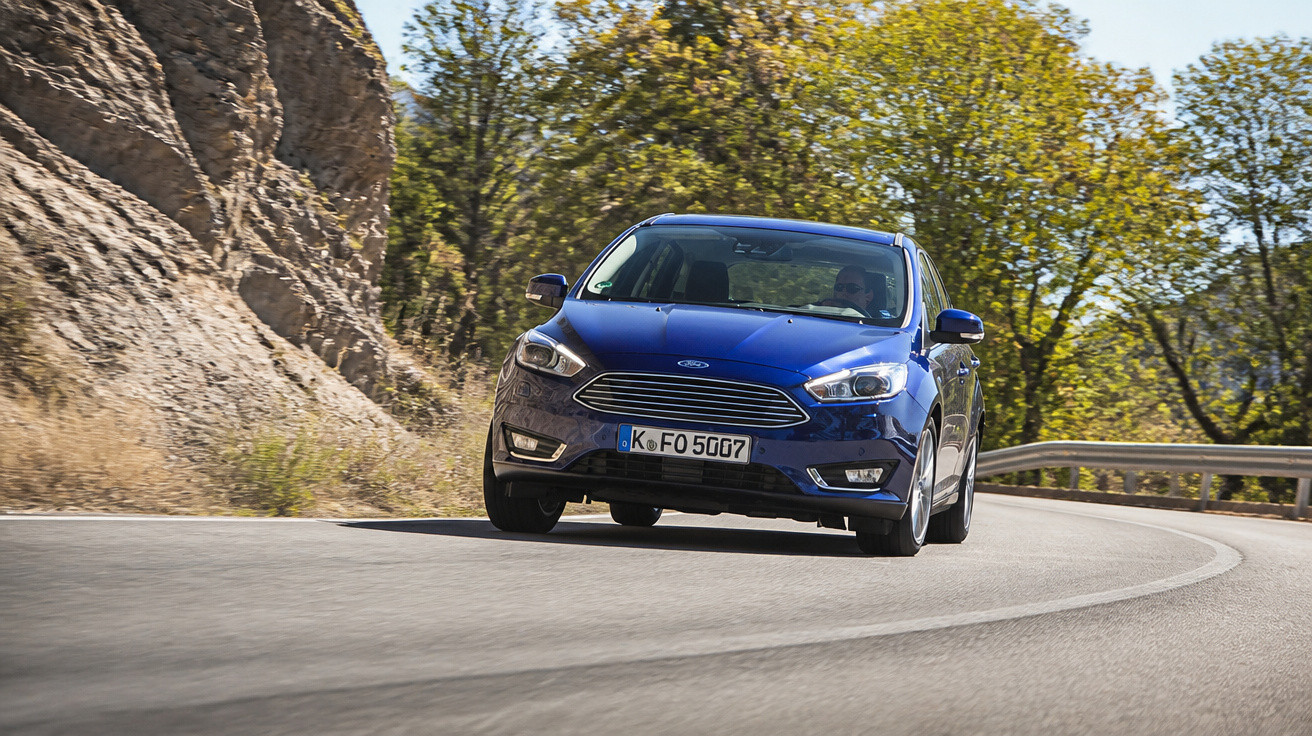
A new Ford Focus? It appears much like the previous model.
That is certainly true at first glance. The third-generation Focus has received a facelift, bringing tidier headlamps and Ford’s latest grille design, rather than a dramatic transformation. There is a sound reason for that restraint: it has been the world’s best-selling car for the past two years and was set to claim the crown once more in 2014.
If it isn’t broken, there is little need to repair it.
Even so, Ford has made a wide selection of carefully judged updates. These include fresh engines, with the expected emphasis on improved fuel economy and lower CO2 emissions, minor chassis revisions and a reworked cabin.
Ford Focus driving dynamics
Does it remain enjoyable to drive?
When the Focus succeeded the ageing Escort 16 years ago, its sharp handling was genuinely revelatory. Over time, the Focus has become heavier and its rivals have narrowed the gap, but this mid-cycle revision of the third-generation Focus restores much of its former edge.
The alterations are modest, chiefly involving recalibrated electric power steering to make it easier to use, alongside more compliant dampers. The outcome is greater agility, with sharper reactions from steering that feels more natural and rewarding. For an EPAS set-up, it is particularly impressive.
Most notably, the Focus feels as though its front and rear ends operate as one. A demanding run of bends will not unsettle it: the capable suspension absorbs changes in the road surface, while the rear axle will help tighten the car’s line through a corner when prompted. Grip levels are reassuringly high when you simply need to make progress, yet there is ample driver involvement when you want to enjoy the journey. It remains composed throughout.
New Ford Focus engines
What are the new engines like?
A new 1.5-litre diesel producing under 99g/km is expected to account for almost half of all Focus sales, although 118bhp is the highest output offered. We headed directly for the new petrol unit: a 1.5-litre, four-cylinder Ecoboost turbo engine available with 148bhp or 180bhp. Both versions claim 127g/km CO2 emissions and 51.4mpg. We drove the more powerful model, which is largely very impressive. Its strong band of torque arrives with a linear character similar to that of a naturally aspirated engine, something enthusiastic drivers will appreciate.
However, it only becomes properly lively beyond 2500rpm. The shortage of low-rev urgency is especially apparent in town-centre traffic and when selecting a lower gear than usual to maintain momentum on steeper climbs. At least it provides a worthwhile reason to use the excellent six-speed manual gearbox.
Cabin layout and technology
And the redesigned interior?
This is an aspect of the Focus, and Ford models more broadly, that has long needed attention. Previously, the dashboard was something of an ergonomic conundrum, with small climate-control and entertainment buttons scattered indiscriminately over the centre console. That has changed. A new touchscreen system immediately cuts the number of buttons, and its display layout has plainly drawn inspiration from more intuitive rival systems, including Audi’s MMI. It functions well and gives the cabin a considerably improved appearance and atmosphere. The plastics, however, still do not match Volkswagen’s standards.
What about the technology?
There is plenty of it. When it arrived in 2011, the third-generation Focus was something of a market leader, offering large-car features including self-parking and lane-departure warning. Those systems have now been improved and expanded: the parking assistance can guide the car back out of the tight space it so eerily manoeuvred into, while the forward crash-avoidance radars are more vigilant.
It all sounds promising. What is the drawback?
It comes at the dealership. To have the 180bhp engine, you must go directly to Titanium X trim. That brings plenty of equipment, but it also sets the starting price at £23,520. This is roughly £1500 more than the current Focus ST, which is admittedly less luxurious but has 247bhp and a wild character.
The 148bhp 1.5 Ecoboost produces the same 177lb ft torque figure as the 180bhp model, however, and prices begin at £20,545 for the Zetec S. For buyers who simply want a Focus with no extras, an old-fashioned 84bhp 1.6 petrol model costs £13,995.
Comments
No comments yet. Be the first to comment!
Leave a Comment