
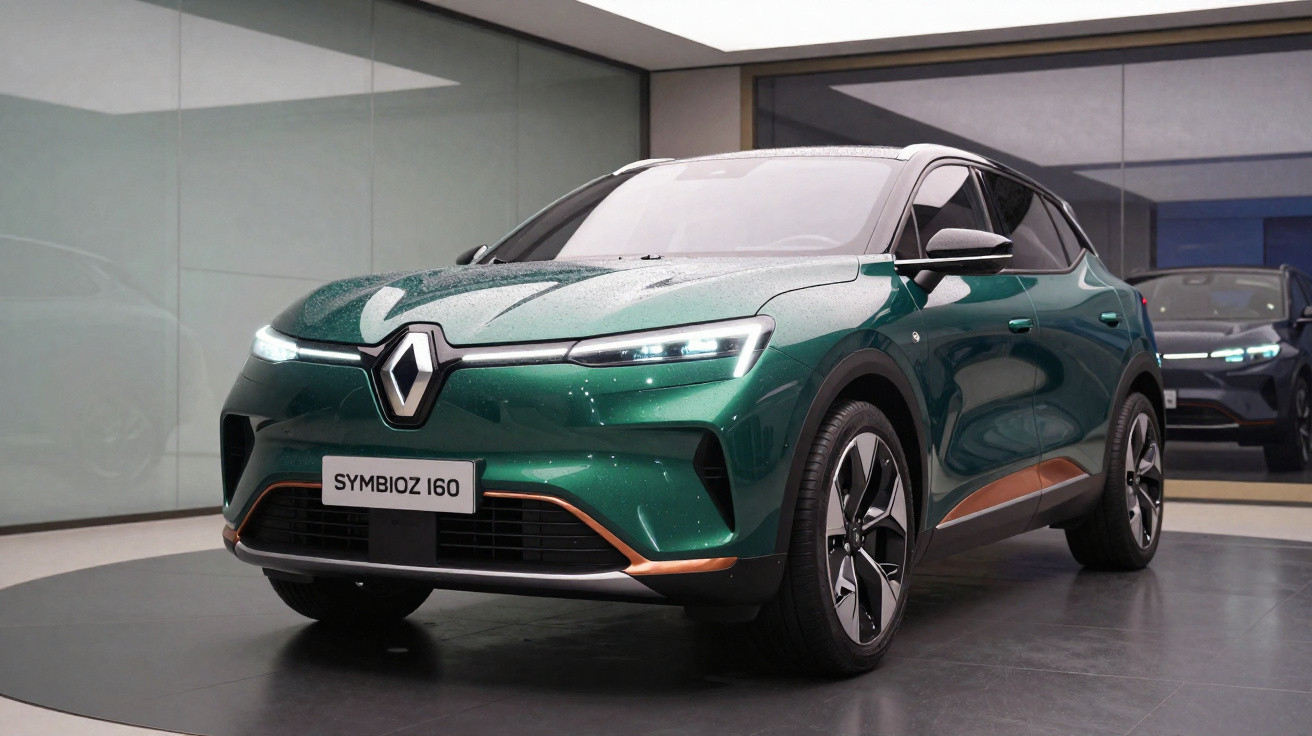
Until now, the Renault Symbioz could only justify its price difference over the Captur with greater versatility on board. It has now gained another important advantage.
At first glance, the Renault Symbioz appears to occupy something of a no-man’s-land: it is expensive for what could be seen as simply an alternative to the Captur, yet it does not have enough to “stand up to” its larger sibling, the Austral, while the Arkana also sits between the two.
With that in mind, it is easy to argue that there are too many models aimed at similar customers. However, the Symbioz has one strong card in its favour: space. Its larger boot and roomier, sliding rear seats distinguish it from the Captur, making it a far more capable choice for families.
There is now another reason to choose the Symbioz, too: Renault has just fitted it with the hybrid system introduced in the Dacia Bigster, featuring a 1.8-litre engine, which we recently tested on video.
For that reason, I will not dwell on this SUV’s dimensions or passenger-space figures, as Miguel Dias already covered them when he spent a few days “alone” with the Symbioz. I invite you to read - or revisit - his review.
During this first drive around Mortefontaine in France, my focus was chiefly on the new full-hybrid powertrain beneath the bonnet, not least because this is the first Renault model to use it.
What has changed in the Renault Symbioz E-Tech 160?
There is nothing on the outside to reveal that this Symbioz uses a new powertrain. As mentioned, the key changes are not visible… unless you lift the bonnet. Let us look at the figures.
Compared with the previous hybrid powertrain, which used a 1.6-litre engine, the Symbioz now receives the new 1.8-litre unit that Renault Group recently debuted in the Dacia Bigster.
As well as its increased capacity, the naturally aspirated combustion engine gains 15 hp, taking its output to 109 hp, and 22 Nm of torque, for a total of 172 Nm. Combined system output rises from 145 hp to 160 hp - 5 hp more than in the Romanian SUV.
The two electric motors within the system remain unchanged, with both fitted at the front. One provides propulsion and produces 36 kW (49 hp); the other acts as a motor-generator and develops 15 kW (20 hp).
The battery is also new. Its capacity has increased to 1.4 kWh, up from 1.2 kWh, allowing the Symbioz to run in 100% electric mode for much of the time in urban environments. Naturally, fuel consumption benefits: Renault claims 4.4 l/100 km (WLTP) and 99 g/km of CO₂ - 0.2 l/100 km less and 7 g/km of CO₂ lower than the former 1.6-litre version.
Technical-specification changes aside, the first thing apparent from behind the Symbioz’s wheel is that this system feels more responsive and more eager.
What is it like to drive?
On the road, and although the drive was brief, just a few kilometres at the wheel of the Renault Symbioz E-Tech 160 were enough to leave me very impressed by the evolution of the full-hybrid system. It proved consistently smooth and offered considerable responsiveness from low revs.
The Multimode gearbox is another area that has improved. With the earlier version of the hybrid system, it could occasionally feel hesitant and lacking in refinement.
Renault listened to “our” criticism and addressed it. Thankfully, it has moved in the right direction. Gear changes are smoother and quicker, making the driving experience substantially more comfortable.
Under harder acceleration, the petrol engine is still audible, as expected, but the way the gearbox lowers engine revs and the speed of its response deserve recognition, especially compared with the previous set-up. Even on the motorway, noise levels never become intrusive.
As for the driving experience itself, there is little to criticise. Thanks to effective hybrid-system management - everything is automatic, so there is nothing for the driver to do - you find yourself driving in 100% electric mode more often than expected.
Even the brake-pedal feel, which can sometimes be difficult to “read” in hybrid models, deserves no criticism: it was consistently progressive and intuitive.
When the pace increases, it soon becomes clear that dynamic sharpness has been sacrificed in favour of comfort, even in this Esprit Alpine version - the only one available in Portugal - which has 19-inch alloy wheels.
The Symbioz never becomes uncomfortable, even over poorer road surfaces. Although plastics are the dominant material in the cabin, the quality of assembly was good, reflected in the absence of unwanted rattles.
Diesel-like fuel economy
Fuel consumption was another surprise, coming in comfortably below the manufacturer’s official figure. Over my route, which covered several different driving conditions, I recorded an average of 4.2 l/100 km.
The good news extends beyond consumption. With a 48-litre fuel tank, range beyond 1,100 kilometres should be possible, a figure that no 100% electric model can (yet) guarantee.
Of course, we will only be able to assess this system’s efficiency more accurately once we carry out a longer test on Portuguese roads.
However, considering the figures we recently achieved in the Bigster, which is larger and heavier than the Symbioz, we can only assume that the consumption recorded during this first drive will be easy to repeat.
What about prices?
The new Renault Symbioz E-Tech 160 is priced from €37,800 and, unlike the 145 hp version, is available solely in Esprit Alpine specification, the best-equipped trim.
Although it includes a long and more appealing standard-equipment list, choosing options such as the panoramic roof or the additional driver-assistance package can easily push the price of this French SUV beyond €40,000.
When all is considered, and largely because of Portuguese taxation, it is difficult to justify the additional cost over an equivalent Captur, which will shortly receive this new powertrain as well.
The extra outlay is only justified for buyers who genuinely need more luggage space. Even then, the Renault Austral with the E-Tech 200 hybrid powertrain is available for only around €2,000 more. It is worth considering the step up. After all, it is a superior model in virtually every respect.
If choosing a full-hybrid powertrain is not essential, there is good news. The Renault Symbioz is now also available with a mild-hybrid engine, offering considerably more attractive prices - starting from €29,300. Discover the full range in this article:
Comments
No comments yet. Be the first to comment!
Leave a Comment