
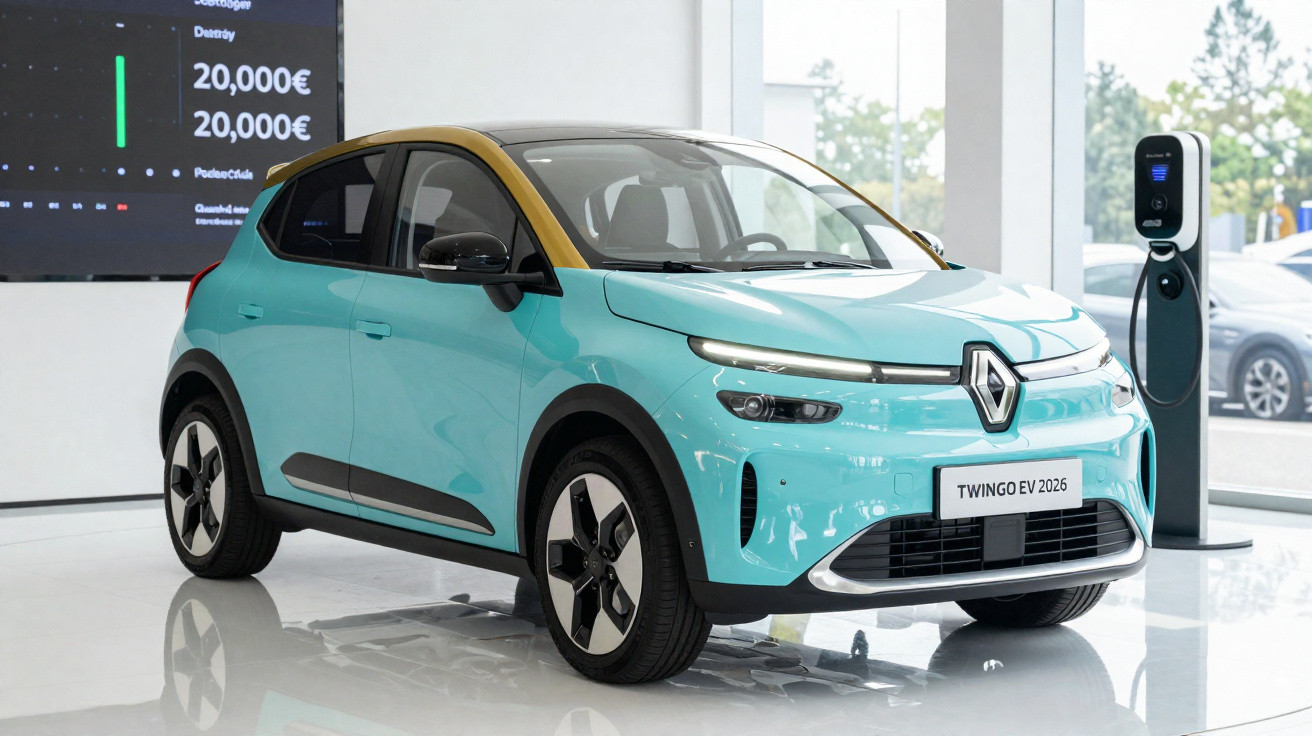
Developed for the first time largely outside France, in China, Renault has unveiled an electric Twingo that draws on the styling of the original generation. It uses the platform shared with the French brand’s other electric models, while introducing technical distinctions of its own. This guide to the 2026 Renault Twingo electric covers everything there is to know about the new city car.
Renault presented 6 November 2025 as the arrival of a “game changer”: the fourth-generation Twingo, and the first sold exclusively with electric power. Beyond its powertrain, this city car stands apart because its development was mainly managed from China, alongside a co-development partner called Launch Design; 40% of the value of its components also comes from China. Although its looks take inspiration from the first-generation Twingo of 1993, this is an entirely new car, using new parts and design teams that were partly external.
According to Renault, these changes were needed to keep pace with Chinese manufacturers, which have cut vehicle development times to just two years rather than four. The approach is intended to keep Renault competitive and reduce costs, with the final cost of the 2026 Renault Twingo electric reportedly falling by 29%. It was also necessary because former Renault boss Luca de Meo wanted this new electric Twingo to become the first zero-emission model in the range priced below €20,000; the R5, meanwhile, was targeting €25,000. Savings therefore come from the development timeline, component pricing and, above all, the battery.
Every dimension of the 2026 Renault Twingo
- Length: 3,789 mm
- Width: 1,720 mm
- Height: 1,491 mm
- Wheelbase: 2,493 mm
- Ground clearance: 143 mm (unladen)
- Weight: from 1,200 kg
- Boot: 305 dm³ (360 litres)
- Boot with seats folded: more than 1,000 litres
- Rear knee room: 160 mm
- Turning circle: 9.87 m
- Loading height: 745 mm
The 2026 electric Twingo is a city car measuring 3.79 m long, 1.49 m high and 1.72 m wide. It has a 2.49 m wheelbase, 143 mm of ground clearance and a starting weight of 1,200 kg. Interior room is primarily allocated to front occupants, although rear passengers have not been overlooked. Its notably rounded shape gives it a larger boot than the R5, at 360 litres rather than 326 litres. With the rear seats folded, capacity can exceed 1,000 litres, enough to carry items measuring 2 m. Renault quotes a loading height of 745 mm.
Interior storage adds a further 19 litres of capacity, according to Renault’s initial information. There is also a 50-litre compartment beneath the boot floor for charging cables. The rear seats can slide by 17 centimetres and operate independently. The new 2026 Twingo is offered exclusively as a five-door, with four proper adult seats. On the road, the dimensions of the 2026 Renault Twingo result in a 9.87 m turning circle: not as tight as a Fiat 500, Grande Panda or Smart Fortwo, but better than the 11-metre average for cars.
2026 Renault Twingo design and equipment
The 2026 Renault Twingo resembles the original chiefly through its so-called “one-box” styling, which makes the whole vehicle rounder and more cheerful. In its press release, Renault refers to “playful and expressive” rounded forms, also reflected in the front lights, which create a happy “face” and “a clever look”. The major difference from the first-generation Twingo lies in its proportions, as everything appears larger on this new 2026 electric Twingo. The round front lamps are not solid units, and neither are those at the rear.
| Evolution | Techno | |
|---|---|---|
| Equipment | - 7-inch driver display + 10-inch central display - Cruise control - Lane-keeping assist - Automatic emergency braking - Sliding rear seats, adjustable driver’s seat - Manual air conditioning - Rear parking assist - Mode 3 charging cable - 16-inch wheel trims |
- OpenR Link with Google built in - Reno avatar (voice co-driver with built-in ChatGPT-4o mini AI) - Stop & Go adaptive cruise control - “One Pedal” driving - Automatic climate control - Tinted rear windows - Folding front passenger seat - Hands-free key card - Digital reversing camera - Electrically folding door mirrors - Arkamys 6-speaker audio system - 18-inch alloy wheels |
Two versions of the 2026 electric Twingo will be available to order: Evolution and Techno. As its name suggests, the Techno version includes more functions and equipment, including One Pedal mode, which provides genuine regenerative braking when the driver lifts off the accelerator; Stop&Go adaptive cruise control; automatic climate control; a hands-free access card; a reversing camera; an Arkamys six-speaker sound system; OpenR Link with Google built in; and a voice assistant using integrated ChatGPT-4o AI. Renault requires buyers to choose this trim if they want a folding front seat for carrying larger items.
The entry-level Renault Twingo Evolution, the version costing less than €20,000 excluding taxes, does not include electric door mirrors, built-in Google services, a reversing camera or tinted rear windows. It does, however, receive a 10-inch central display, in addition to the 7-inch screen behind the steering wheel with wireless Android Auto and Apple CarPlay compatibility, cruise control, lane-keeping assist, which does not change on the Techno version, traffic-sign recognition, automatic emergency braking, manual air conditioning, sliding rear seats, an adjustable driver’s seat and rear parking sensors.
As a reminder, Renault partnered with Google so the American giant could supply all its services, its app store and a reliable, responsive operating system. The Techno version of the electric Twingo will benefit from this arrangement, with Renault stating that customers will receive 2 GB of internet data per month for downloading apps and using built-in services without their phone, for 3 years.
The two trims will also differ in their wheels. The Techno version, shown in Renault’s images on Thursday 6 November, features 18-inch alloy wheels, which appear especially large on such a compact model. The sub-€20,000 Evolution makes do with 16-inch wheel trims. Four colours will be available: Absolute Red, Absolute Green, Mango Yellow and Starry Black. Both versions of this new 2026 Renault Twingo electric have full LED lighting at the front and rear.
2026 Renault Twingo battery and range
- Battery type: Lithium iron phosphate (LFP), with no cobalt or nickel
- Usable capacity: 27.5 kWh
- Architecture: “cell-to-pack” (more cells, -20% on battery price)
- Range: up to 263 km WLTP
- Standard charging: 6.6 kW AC as standard, 10 to 100% in 4h15
- “Advanced Charge” fast-charging option: 11 kW bidirectional AC + 50 kW DC; AC: 10 to 100% in 2h35; DC: 10 to 80% in 30 min
- Bidirectional charging: V2L: powers 220V devices up to 3,700 W; V2G: returns energy to the grid via the Mobilize PowerBox Verso charging point (22 kW AC)
- Management through the My Renault app (scheduling, pre-conditioning, charge planning)
With the Twingo, Renault is demonstrating that an electric car can be designed without ending up €10,000 more expensive than an equivalent petrol model, even if Chinese manufacturers proved this much earlier. Can the manufacturer change direction and also show that an electric city car can be sufficiently versatile? The key detail concerning the new 2026 Renault Twingo is clearly its battery. And, unexpectedly, it is small, very small. It cannot be called Renault’s smallest battery, because the Twizy exists, but even a Zoe offered a larger unit - almost twice as large.
The 2026 Renault Twingo therefore uses a 27.5 kWh battery in usable capacity, supplied by CATL. It uses LFP rather than NMC chemistry to cut its price and avoid nickel and cobalt. Under the car’s WLTP measurement, the range of the 2026 Renault Twingo is 263 km. Expect a real-world range of 200 km at best, unless use is solely in urban areas. On A-roads and motorways, reaching 200 km will be difficult. Fast charging with DC power requires an extra-cost pack called “Advanced Charge”; otherwise, charging is limited to AC.
In detail, the Renault Twingo charges at 6.6 kW AC, taking 4h15 to go from 10 to 100%. Choosing “Advanced Charge” increases AC power to 11 kW, reducing a 10-to-100% charge to 2h35, while enabling 50 kW DC charging for a 10-to-80% charge in 30 minutes. Fast charging is therefore far from genuinely fast - the Renault 5 offers 100 kW rapid charging, which was already somewhat limited - but the especially small battery keeps charging times typical for this type of car.
The electric Twingo is nevertheless fitted with V2L and V2G charging systems supplied by EVTech, a Chinese company, allowing it to power electrical devices from the car at 220 V and up to 3,700 W, as well as return energy to the grid. Through the My Renault app, the electric Renault Twingo can also be pre-conditioned remotely. The app provides several scheduling functions too, notably for charging and for taking advantage of new off-peak periods on the French grid.
2026 Renault Twingo motor and driving
- Electric motor: 60 kW (82 hp)
- Torque: 175 Nm
- Architecture: rear-wheel drive via the AmpR Small platform (the same base as the Renault 5 and 4 E-Tech)
- Weight: from 1,200 kg (Evolution version)
- Performance: 0–50 km/h: 3.85 s; 0–100 km/h: 12.1 s; top speed: 130 km/h
- “One Pedal” mode (on Techno trim): enables braking by lifting off the accelerator, with four intensity levels controlled using the steering-wheel paddles
How will the small battery in the electric Renault Twingo be put to use? To turn electrical energy into motive power, an 82 hp motor will sit beneath the front bonnet. Renault offers no alternative electric motor: whichever electric Twingo version is selected, buyers get this 82 hp, 60 kW unit producing 175 Nm of torque. Renault quotes 0–50 km/h in 3.85 seconds and 0–100 km/h in 12.1 seconds, making it more capable than a combustion-engined version but gentler than other electric city cars on the market. Top speed is 130 km/h.
Despite being electric, the car weighs only 1,200 kg. A small battery, a compact motor and extensive use of plastic parts have helped achieve a sufficiently low mass to keep the car responsive, regardless of trim, although the Techno will be slightly heavier because of its additional equipment and 18-inch wheels. In driving terms, the Techno version differs through its One Pedal mode and the four regenerative-braking levels selectable with paddles behind the steering wheel.
2026 Renault Twingo price and launch
Renault has kept one important detail confidential for the new 2026 electric Twingo: its price. It is still described as “below €20,000”, with no further precision. It is now known, however, that it will be available under the €20,000 mark when taxes are excluded. In other words, Renault should position the Evolution version just under €20,000. The Techno version is expected to cost €2,000 more. Buyers will also need to add the option for 50 kW DC fast charging, available for both trims but not fitted as standard; its price is not yet known.
The car will be built in Novo Mesto, Slovenia, where Renault will send all the components used to make it. As part of its promotional messaging, Renault says most customers will be within 1,000 km of the car’s assembly plant. It should nevertheless be remembered that at least 40% of the vehicle’s value, including the battery, will be imported from China by sea, a journey lasting one month, and then by rail once the parts have been unloaded at ports in France or Portugal. Production is due to begin in the coming weeks, with deliveries scheduled for early 2026. Renault will initially fulfil orders for customers who paid €100 for an “R Pass”, a type of queue-jump that gives their order priority.
Comments
No comments yet. Be the first to comment!
Leave a Comment