
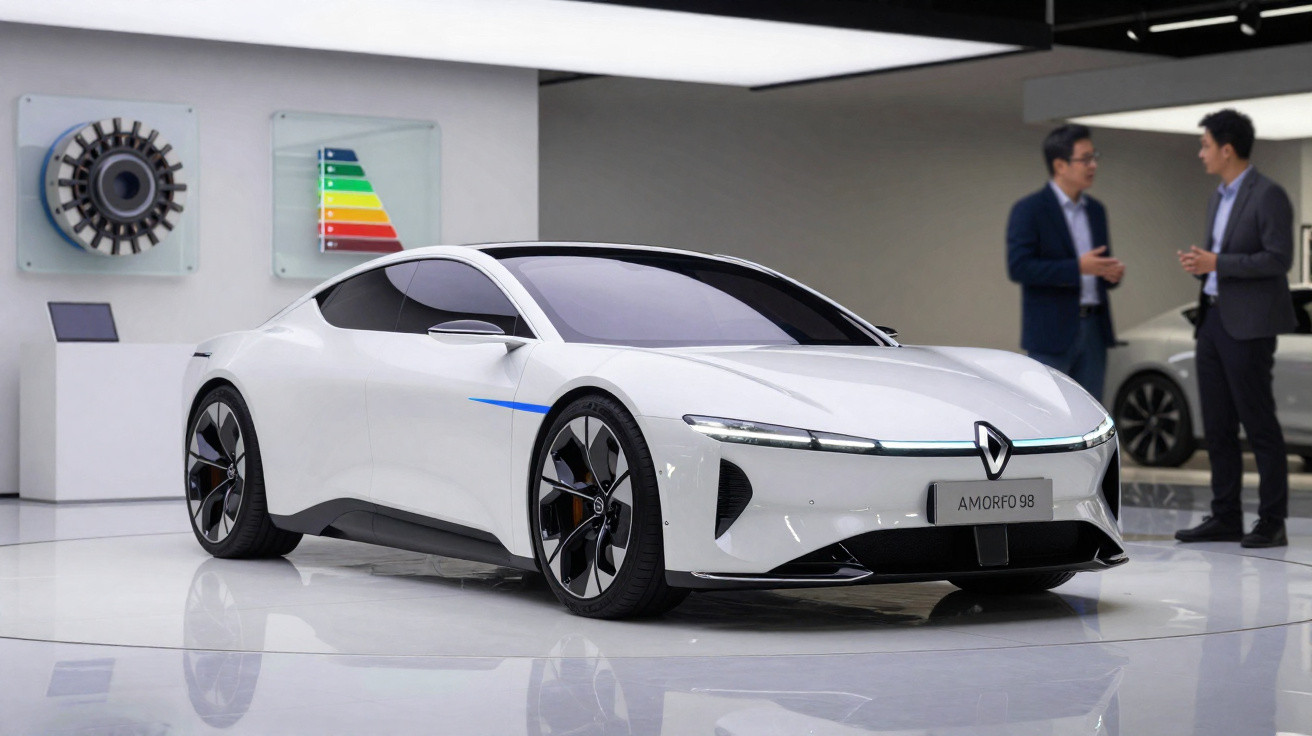
A new drive unit with 98.2 per cent efficiency is creating a stir in the automotive industry. The technology comes from Horse, the joint powertrain venture owned by Renault and Geely. Called “Amorfo”, the motor is intended chiefly to make hybrid vehicles more economical: according to the manufacturer, it can reduce day-to-day energy consumption by around one per cent.
Why this motor matters so much to the automotive industry
For years, manufacturers have competed to develop more efficient powertrains. Japanese and European brands were long considered the benchmark, but Chinese groups are now pushing ahead with intensive research. Dongfeng and Changan are reporting record figures for combustion engines, while BYD is doing so for electric drives. Against this backdrop, Renault and its partner Geely have introduced an electric motor that claims a new best result.
The Amorfo motor is explicitly aimed not at pure electric cars carrying huge batteries, but primarily at hybrids and range-extender vehicles. Every percentage point of efficiency carries extra weight in these vehicles, where the combustion engine, electric motor and battery must operate together.
“At 98.2 per cent efficiency, the new Renault-Geely motor is approaching the physical limit of what currently appears realistic for mass production.”
The key lies in the stator material
The name “Amorfo” derives from the concept’s central element: amorphous steel used in the stator. Motors would normally use crystalline electrical steel. Its atoms are arranged in a regular pattern, making it well understood in conventional machines, although certain losses cannot be avoided.
Amorphous steel, by contrast, has a disordered atomic structure, almost like glass. This disorder is far more than a marketing point: it delivers physical benefits. Its magnetic properties differ, allowing Horse to reduce losses within the motor’s magnetic field.
Thinner than a human hair
The thickness of the steel laminations making up the stator is particularly striking. They measure just 0.025 mm. By comparison, the sheets used in many common electric motors are ten times thicker.
- Stator lamination thickness: 0.025 mm
- Difference compared with typical motors: around 10 times thinner
- Reduction in motor losses, according to the manufacturer: about 50 %
- Maximum efficiency: 98.2 %
These ultra-thin laminations reduce what are known as eddy currents. They arise within the metal as the motor’s magnetic field continually changes. The currents heat the steel and consume energy; thinner sheets leave less room for them, so less energy is lost as heat.
What 98.2 % efficiency means in practice
For electric motors, manufacturers typically quote efficiency figures of between 93 and 97 per cent, depending on load point and rotational speed. At first glance, 98.2 may appear to be only a modest improvement. Yet in a field already operating close to physical limits, achieving it is technically demanding.
Horse pairs this high efficiency with respectable output figures: 190 PS and 360 Newton metres of torque. That is sufficient for mid-sized SUVs, saloons and vans, and it suits modern plug-in hybrids in which the electric motor covers a substantial share of driving.
“One per cent more efficiency across millions of vehicles adds up to enormous energy and CO₂ savings over the years.”
One per cent lower consumption may sound small, but it is noticeable
Across a complete hybrid system, Horse expects real energy use to fall by roughly one per cent. The reason is that the electric motor represents only one part of the overall system: the battery, power electronics, transmission and combustion engine each introduce their own losses.
A brief calculation illustrates this:
- A modern mid-sized hybrid uses around 15 kWh of electricity per 100 km as a plug-in hybrid, or equivalent energy in combustion mode.
- One per cent of that equals 0.15 kWh per 100 km, or a tiny quantity of fuel.
- Over 200,000 km, however, this amounts to 300 kWh; when multiplied across hundreds of thousands or millions of vehicles, the effect becomes significant.
Seen in this context, the apparently minor gain becomes much more relevant. Manufacturers seek tenths of a percentage point in every component. Securing one per cent at a stroke in a key part of the powertrain creates a genuine advantage in fleet consumption.
Laboratory figure or real-world gain? Where caution is justified
The 98.2 per cent figure comes from laboratory testing. Temperatures, speeds and load points can all be optimised to achieve an ideal test-bench result. On the road, however, a motor continually faces changing conditions: cold starts, stop-start traffic, high summer temperatures, and ageing insulation and bearings.
Anyone comparing test-bench data with later real-world measurements will recognise this issue. Official figures and actual consumption often differ. The gap is generally smaller for electric motors than for combustion engines, but it does not disappear entirely.
Horse has also not yet disclosed which production vehicle will be the first to receive the Amorfo motor. No timetable has been published either. For now, the motor appears in the joint venture’s catalogue, meaning it is in principle available to Renault brands and other Geely subsidiaries such as Volvo, Lynk & Co and Zeekr.
Technical challenges of amorphous steel
Amorphous steel does not offer advantages alone. Its manufacture is complex because the steel must cool extremely rapidly to retain its disordered structure. This limits available formats and production methods, while increasing costs.
| Aspect | Conventional electrical steel | Amorphous steel in the Amorfo motor |
|---|---|---|
| Structure | Crystalline, ordered | Amorphous, disordered |
| Lamination thickness | typically 0.2–0.3 mm | 0.025 mm |
| Magnetic losses | higher | significantly reduced |
| Manufacturing effort | Established, less expensive | complex, more expensive |
For series production, efficiency is not the only consideration; manufacturability matters too. Carmakers must establish how the exceptionally thin sheets can be stamped, layered and insulated accurately in high volumes without scrap levels and costs soaring.
Why hybrids benefit especially from this motor
In everyday use, hybrids frequently operate under partial load: pulling away repeatedly, recuperating energy, making short electric journeys, then returning to combustion-engine operation. The electric motor therefore rarely runs precisely at the point where it achieves its theoretical peak efficiency.
When a motor can reach 98.2 per cent at its optimum point, its wider operating range generally benefits too. Average losses are lower. This is particularly important for plug-in hybrids, whose electric motor can account for 50 to 80 per cent of the daily distance depending on the driving profile.
Renault and Geely are expanding their hybrid strategy while many manufacturers are simultaneously promoting fully electric models. Efficient hybrid systems help them meet fleet limits and serve transitional markets where pure electric cars are not yet widely accepted or affordable.
What this development could mean for future electric cars
Although the Amorfo motor is designed mainly for hybrids, elements of the technology can be transferred to pure battery-electric cars. Every additional kilometre of range achieved without fitting a larger battery saves weight, cost and resources.
For example, if an electric car uses two to three per cent less energy per kilometre because of a more efficient motor, the manufacturer can reduce battery size slightly while retaining the same range. That not only cuts material use, but also makes rapid charging easier and reduces buyers’ costs.
What consumers should take from this development
For motorists in Germany, Austria and Switzerland, the new motor is initially a technical signal: the race for efficiency is far from over. While much discussion centres on range and battery chemistry, major advances are also taking place behind the scenes in powertrain components.
Anyone buying a new Renault, Volvo or another hybrid from the Geely group in a few years could already benefit indirectly from this development, without seeing it explicitly mentioned in the brochure. Manufacturers often introduce technologies like these quietly during a model-year update.
Terms such as efficiency, internal losses and amorphous steel may sound unwieldy, but they help determine whether a car suddenly consumes considerably more in winter or whether consumption remains stable even after many years. The more efficient the underlying motor, the easier it is to limit all of these effects.
Those examining the specification sheets of new models should therefore look beyond headline system output alone. Details on efficiency, motor technology and hybrid architecture indicate how economically a vehicle will operate in real life, regardless of how optimistic its official consumption figure may sound.
Comments
No comments yet. Be the first to comment!
Leave a Comment